
Disclosure: As an Amazon Associate, I earn from qualifying purchases at no extra cost to you.
If you’re a new parent, you’ve probably heard about tummy time during one of your baby’s early checkups. The American Academy of Pediatrics recommends tummy time while babies are awake and supervised because it gives them opportunities to practice using and strengthening the muscles they need for early movement.
But knowing tummy time is important doesn’t always make it easy. Some babies fuss, cry, or simply don’t seem to enjoy being placed on their stomachs at first. That’s where a comfortable, safe play surface and a little parent interaction can make tummy time easier to introduce.
In this guide, we’ll look at what to consider when choosing a tummy time play mat, which features may be useful, and a few simple ways to make tummy time more comfortable for your baby.
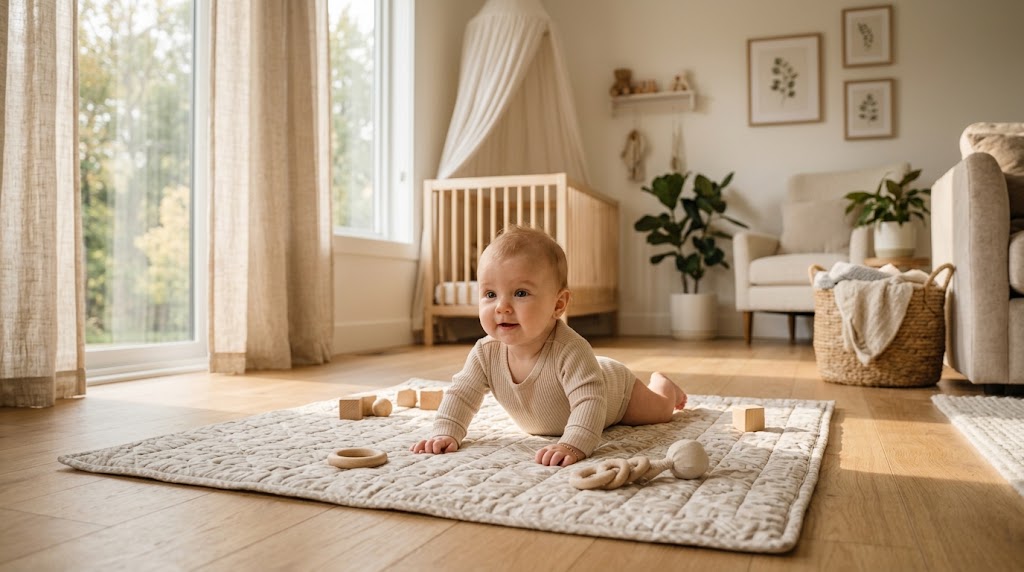
Table of Contents
- Why Tummy Time Matters for Early Movement
- Key Features to Look for in a Tummy Time Play Mat
- Types of Play Mats for Tummy Time
- Simple Ways to Make Tummy Time Easier
- Safety Tips for Tummy Time
- Final Thoughts
- Frequently Asked Questions
Why Tummy Time Matters for Early Movement
Tummy time gives babies an opportunity to practice lifting and turning their heads and using their neck, shoulders, arms, back, and other muscles while they are awake.

The American Academy of Pediatrics notes that tummy time helps babies develop strong muscles and prepares them for movements such as pushing up, rolling, and eventually crawling.
It can also help reduce the amount of time a baby spends resting on the back of the head while awake. The AAP notes that supervised tummy time can help minimize the development of positional plagiocephaly, commonly known as a flat spot on the head.
What does tummy time work?
During tummy time, your baby may practice:
- Head and neck control — lifting and turning the head.
- Upper-body movement — pushing against the floor with the arms.
- Back and shoulder strength — working against gravity while lifting the upper body.
- Movement and coordination — gradually learning how to shift and move the body.
Remember that tummy time is playtime, not sleep time. Your baby should be awake and closely supervised throughout the activity.
Key Features to Look for in a Tummy Time Play Mat
You don’t need an elaborate play mat to begin tummy time. A safe, firm, comfortable floor surface can provide a suitable place for supervised play.
If you’re shopping for a dedicated tummy time play mat, however, a few features are worth considering.
1. A Firm, Stable Surface
A play mat should provide a stable surface where your baby can move their arms and legs without the material bunching up underneath them.
Avoid using very soft or loose materials as a substitute for a safe play surface. Most importantly, remember that a play mat is for awake, supervised play—not sleep. Babies should sleep on a firm, flat sleep surface designed for safe sleep.
2. Easy-to-Clean Materials
Babies spend a lot of time exploring with their hands and mouths, so easy cleaning is a practical feature.
Look for a mat that can be wiped clean or washed according to the manufacturer’s instructions. Also check the manufacturer’s information about materials and age recommendations before buying.
3. Simple Visual Features
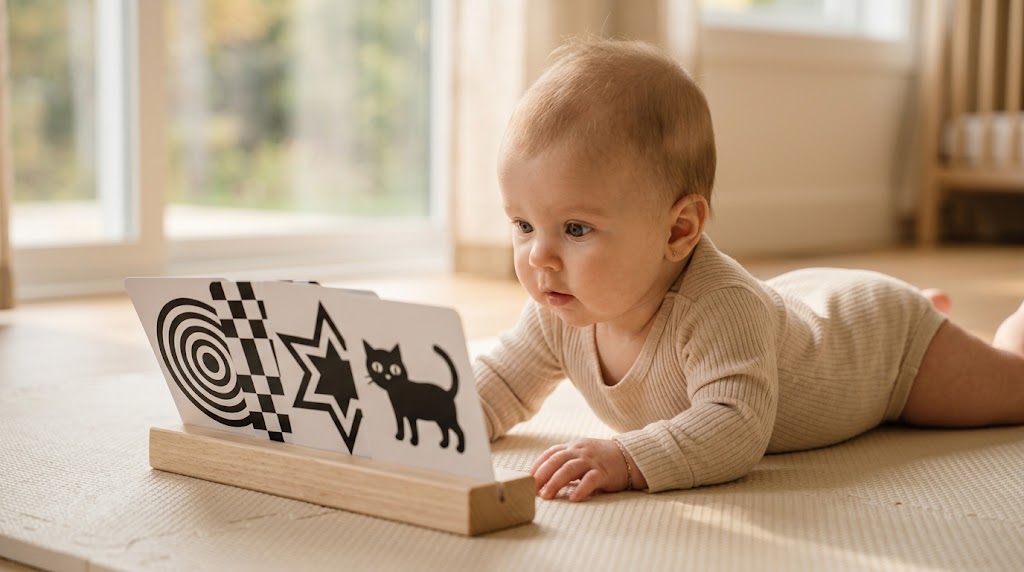
Some play mats include black-and-white patterns, mirrors, toys, or other visual features.
These aren’t essential for tummy time, but they can give your baby something to look at while they practice lifting and turning their head.
If your baby enjoys looking at high-contrast patterns, you can also place an appropriate high-contrast card nearby during supervised play.
4. Enough Space for Movement
A small mat may work for a young newborn, but babies quickly become more mobile.
If you want a mat that can continue to be useful as your baby begins rolling and reaching, consider choosing a larger surface with enough room for movement.
Types of Play Mats for Tummy Time
Different families may prefer different types of play mats. Instead of looking for one universally “best” mat, consider which design fits your baby’s age, your available space, and how you plan to use it.
Category A: High-Contrast Activity Mats
These mats often combine a padded play surface with high-contrast patterns, mirrors, or removable toys.
They can give younger babies something interesting to look at while they practice lifting and turning their heads.
Category B: Large Foam Play Mats
A larger foam mat can provide a dedicated floor area for tummy time, rolling, sitting, and other forms of supervised play as your baby becomes more mobile.
When considering one, check the manufacturer’s recommended age range, dimensions, materials, cleaning instructions, and safety information.
Category C: Water-Filled Sensory Mats
Water-filled tummy time mats contain floating shapes or images that move when the baby presses against the surface.
Some babies may find the movement interesting, but these mats aren’t essential for tummy time. If you use one, follow the manufacturer’s instructions carefully and supervise your baby closely.
Because water-filled products can leak or become damaged, inspect the mat regularly and stop using it if you notice any damage.

Simple Ways to Make Tummy Time Easier
A new play mat won’t necessarily solve tummy-time frustration by itself. Your interaction can be just as important.
Get Down on Your Baby’s Level
Instead of placing your baby on the mat and walking away, lie down nearby and make eye contact.
Talk, smile, sing, or gently encourage your baby to look toward you.
Start With Short Sessions
AAP guidance recommends beginning with short periods of tummy time and gradually increasing the total amount as your baby becomes stronger. One AAP resource suggests starting with 3–5 minutes two or three times a day and gradually increasing tummy time; another notes that babies can work toward a total of 15–30 minutes a day by about 7 weeks.
You don’t have to make every session long. Several short sessions throughout the day can be easier for both baby and parent.
Try Tummy Time After a Diaper Change
A diaper change can be a convenient reminder to include a short period of supervised tummy time during the day.
Choose a time when your baby is awake and comfortable rather than immediately after a large feed.

Use Your Face as the “Toy”
You don’t always need flashing lights or lots of toys.
Your face, voice, and interaction can give your baby a simple reason to look up and turn their head.
Safety Tips for Tummy Time
Tummy time should always be treated as awake, supervised play.
Keep these points in mind:
- Always stay with your baby during tummy time.
- Make sure your baby is awake.
- Use a safe, stable play surface.
- Keep small objects and loose items away from your baby.
- Never use a tummy time session as a substitute for safe sleep.
- If your baby falls asleep during tummy time, move them to a safe sleep surface and place them on their back.
A play mat, pillow, or sensory product should never be used as a sleep surface.
If your baby consistently struggles with head control, seems unusually uncomfortable during tummy time, or you have concerns about their development, talk with your pediatrician.
Final Thoughts
Tummy time doesn’t have to be complicated.
A safe play surface, a few minutes of supervised practice, and your attention can give your baby opportunities to work on early movement skills. You don’t need the most expensive mat or one packed with toys.
When choosing a tummy time play mat, focus on practical features such as a stable surface, easy cleaning, appropriate materials, enough space, and the manufacturer’s age and safety information.
Most importantly, remember that the mat is simply a tool. Your interaction and your baby’s opportunity to move freely during supervised play are what make tummy time meaningful.
Does your baby enjoy tummy time, or are they still getting used to it? Share your experience in the comments below.
For more ideas about play and development, read our guide to Best Educational Toys for 1-Year-Olds That Teach, Not Distract.
If you’re comparing toy materials, you can also read Wooden Toys vs. Plastic Toys: Why Parents Choose Eco-Friendly Play.
📚 Sources & References
1. American Academy of Pediatrics — Back to Sleep, Tummy to Play
American Academy of Pediatrics — Back to Sleep, Tummy to Play
2. American Academy of Pediatrics — How to Keep Your Sleeping Baby Safe
American Academy of Pediatrics — How to Keep Your Sleeping Baby Safe
3. American Academy of Pediatrics — Positional Skull Deformities
American Academy of Pediatrics — Positional Skull Deformities and Torticollis
❓ Frequently Asked Questions
Is tummy time necessary for newborns?
Tummy time is recommended while babies are awake and supervised. It gives babies opportunities to practice using the muscles involved in early movement.
How long should tummy time last?
You can begin with short sessions and gradually increase the amount as your baby becomes stronger. The AAP suggests starting with short periods several times a day and gradually increasing tummy time.
Do I need a special tummy time mat?
No. A dedicated mat isn’t essential. A safe, stable floor surface can work for supervised tummy time. A play mat can simply make the area more comfortable and convenient for everyday play.
Can my baby sleep on a tummy time mat?
No. Tummy time should only happen while your baby is awake and supervised. For sleep, babies should be placed on their backs on a firm, flat sleep surface.
What if my baby hates tummy time?
Some babies need time to get used to it. Try shorter sessions, get down at your baby’s level, talk or sing to them, and gradually build up the amount of tummy time. If you have concerns about your baby’s ability to tolerate tummy time or their development, discuss them with your pediatrician.