
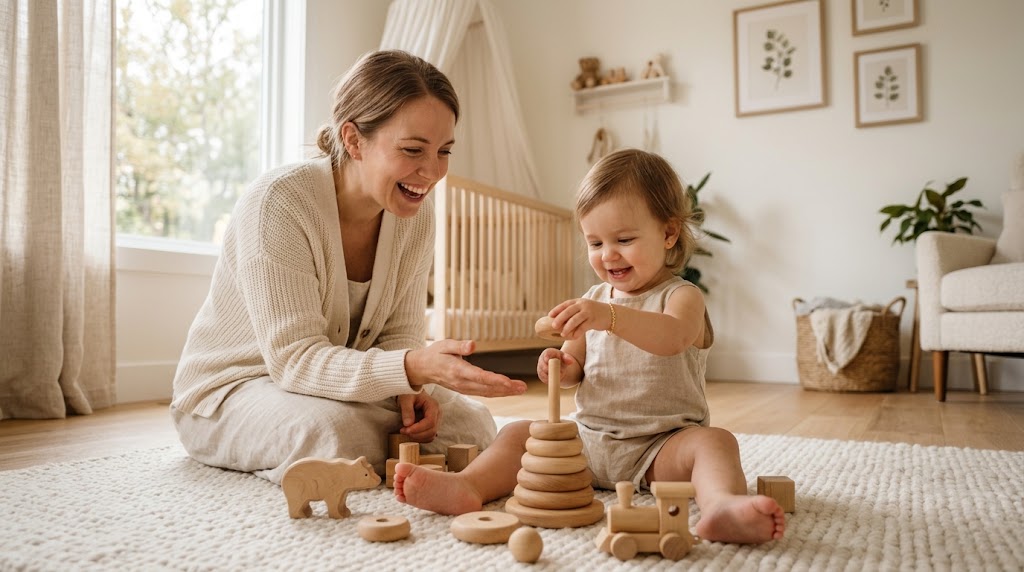
Turning one is an exciting stage. Your baby is becoming more mobile, more curious, and increasingly interested in figuring out how things work.
You may notice your 1-year-old picking things up, putting objects into containers, trying to fit pieces together, turning pages, or repeating the same little action over and over again. These everyday activities give children plenty of opportunities to practice using their hands and fingers. In fact, putting objects into containers and picking up small items with the thumb and index finger are among the developmental milestones listed by the CDC for 1-year-olds.
This is where Montessori-inspired toys for 1-year-olds can be useful. Instead of relying on flashing lights or lots of buttons, many simple Montessori-style materials give toddlers one clear activity to explore at a time.
The goal isn’t to make a 1-year-old “learn faster.” It’s simply to give them safe, age-appropriate opportunities to practice movement, coordination, concentration, and independent play.
So, which toys are worth considering?
Here are seven simple options that can fit naturally into a toddler’s play environment.
Disclosure: As an Amazon Associate, I earn from qualifying purchases at no extra cost to you.
In This Article
- 1. Object Permanence Box
- 2. Single-Shape Wooden Puzzles
- 3. Wooden Stacking Rings
- 4. Coin Drop Box
- 5. Simple Shape Sorters
- 6. Large-Hole Threading Toys
- 7. Montessori-Inspired Busy Boards
- What to Look for When Buying Montessori Toys
- Final Thoughts
1. Object Permanence Box
An object permanence box is a simple wooden activity in which a child places a ball or other large object into an opening and then watches it appear again through another part of the box.
For a young toddler, the activity can be surprisingly engaging because it combines a simple hand movement with an interesting result.
What it encourages:
- Reaching and grasping
- Hand-eye coordination
- Placing objects into an opening
- Repeating an action and observing what happens
The CDC lists putting an object into a container as a cognitive milestone around age one, so activities built around dropping and retrieving objects can fit naturally into this stage of development.
Choose a version with pieces that are large enough for the recommended age, and always follow the manufacturer’s safety instructions.
2. Single-Shape Wooden Puzzles
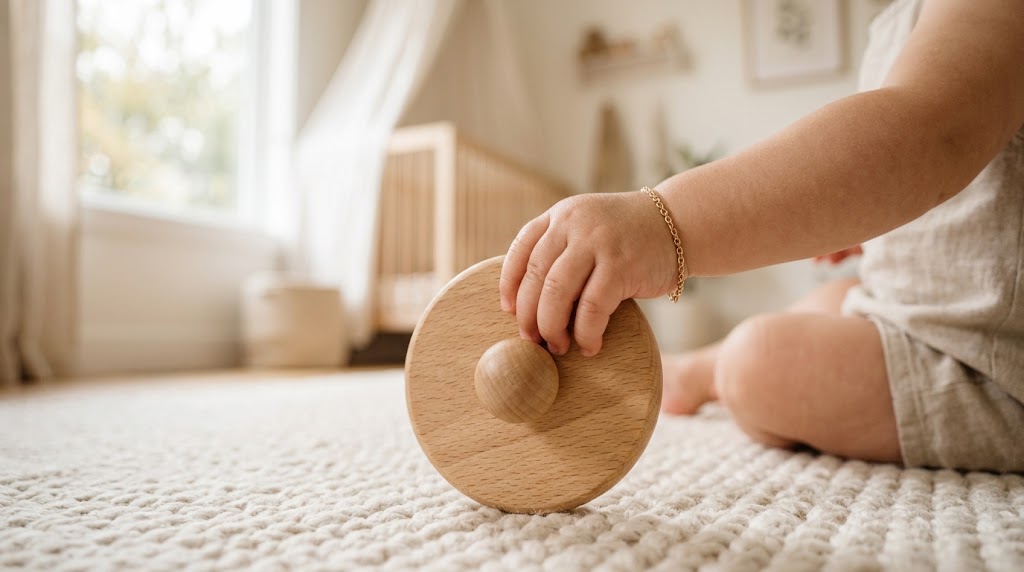
For a young toddler, a simple wooden puzzle with one large piece can be easier to explore than a puzzle containing many small pieces.
A common example is a large wooden circle with a knob that the child can grasp and place back into its matching space.
What it encourages:
- Grasping and releasing
- Hand-eye coordination
- Matching
- Early problem-solving
- Concentration
A simple puzzle also gives toddlers the opportunity to try something, notice whether it fits, and try again without needing to complete a complicated set of instructions.
You don’t need to start with several shapes at once. One large, easy-to-handle piece can be enough for a child who is just beginning to explore this type of activity.
3. Wooden Stacking Rings
Stacking rings are another simple activity that can keep a toddler busy without needing batteries, sounds, or screens.
The basic idea is easy: the child picks up a ring and tries to place it over a wooden post.
At first, your toddler may simply explore the rings rather than stack them in the “correct” order. That’s perfectly fine. Picking up the pieces, turning them around, and experimenting with the post are all part of the activity.
What it encourages:
- Hand-eye coordination
- Grasping and releasing
- Visual attention
- Repeated practice
You can start with just a few large rings and allow your child to explore at their own pace.

4. Coin Drop Box
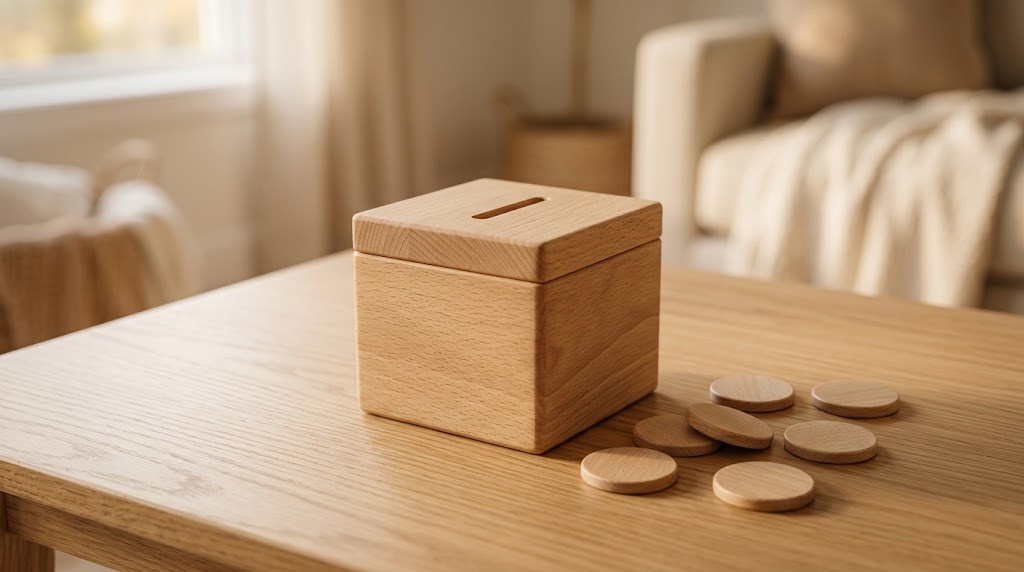
A coin-drop box gives toddlers a slightly different challenge. Instead of dropping a ball into a large opening, the child places a flat, oversized piece through a slot.
This type of activity can encourage more controlled hand movements as the child learns how to position the piece before putting it through the opening.
What it encourages:
- Thumb-and-finger coordination
- Hand-eye coordination
- Placing and releasing objects
- Repeated problem-solving practice
For a 1-year-old, however, size matters. Don’t use actual coins or small pieces. Choose a toy specifically designed for the child’s age with pieces that cannot easily become a choking hazard. The AAP recommends following toy age recommendations and avoiding toys with small or detachable parts for young children.
5. Simple Shape Sorters
Shape sorters give toddlers an opportunity to experiment with matching objects to openings.
A simple design with only a few large shapes can be easier for a young child to explore than a toy with many different pieces and complicated features.
Your toddler may not understand the matching concept immediately. They may turn the pieces over, bang them together, or try several openings before finding the right one.
That’s part of the fun.
What it encourages:
- Matching and sorting
- Hand-eye coordination
- Problem-solving
- Grasping and turning objects
The important thing is to choose a design that is appropriate for your child’s developmental stage rather than focusing on how many shapes the toy contains.
6. Large-Hole Threading Toys
Threading activities can become more challenging as children get older, but there are toddler-friendly versions with large pieces and wide openings.
For a 1-year-old, the activity should be very simple. The child might place a large wooden piece onto a sturdy post or work with another age-appropriate threading material.
What it can encourage:
- Using both hands together
- Hand-eye coordination
- Grasping and releasing
- Patience and repeated practice
This is one activity where safety deserves extra attention. Avoid small beads, thin strings, or pieces that could fit into a child’s mouth. Always follow the toy’s age recommendation and supervise your child during play. The AAP specifically recommends avoiding toys with small parts and choosing toys that are appropriate for the child’s age and developmental stage.
7. Montessori-Inspired Busy Boards
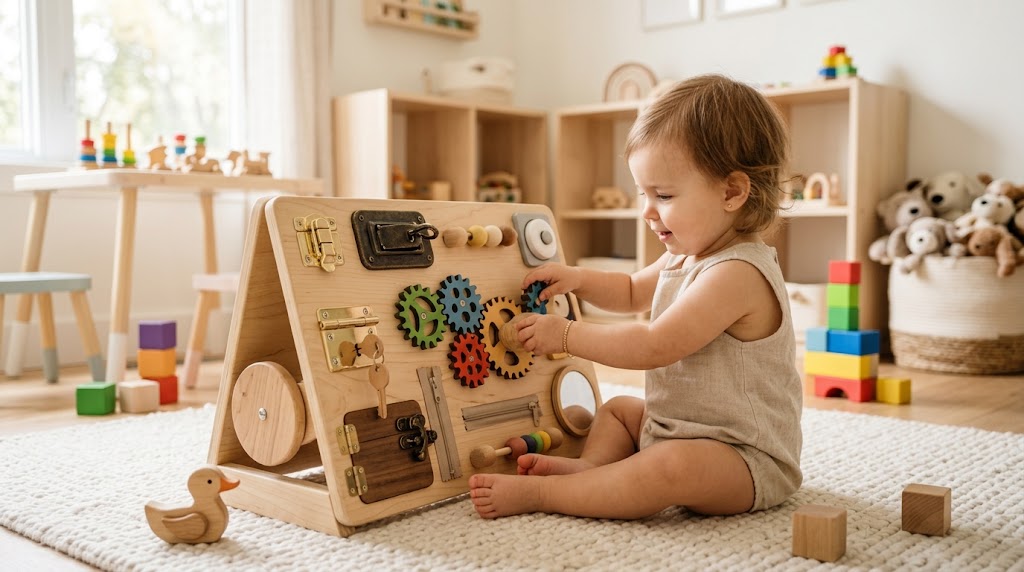
Busy boards can include everyday-style activities such as large latches, switches, wheels, zippers, or other simple mechanisms.
Toddlers are often interested in copying what adults do, so opening, closing, turning, and moving these features can be an enjoyable way to explore cause and effect.
What it can encourage:
- Finger movements
- Grasping and turning
- Hand-eye coordination
- Exploring how things work
However, not every busy board is suitable for a 1-year-old. Look carefully at the manufacturer’s recommended age and inspect the board for loose parts, sharp edges, pinch points, or small components.
For young toddlers, simple is usually better.
What to Look for When Buying Montessori Toys
You don’t need to buy an entire shelf of Montessori materials. A few well-chosen, age-appropriate toys can provide plenty of opportunities for exploration.
Here are some things to consider before buying.
1. Choose the right size
Look for toys and pieces that are appropriate for your child’s age. Young children naturally explore objects with their mouths, so small pieces can present a choking risk.
2. Keep the activity simple
A toy doesn’t need dozens of buttons, sounds, and features to keep a toddler interested. Simple activities can give children the opportunity to repeat an action and discover how it works.
3. Check the recommended age
Age recommendations are more than just marketing information. They help parents determine whether a toy is suitable for a child’s abilities and whether it presents potential safety concerns.
4. Look for sturdy construction
Check that knobs, handles, hinges, strings, and other parts are securely attached. Avoid toys that have loose pieces, sharp edges, or damaged components.
5. Remember that the toy isn’t the whole experience
You don’t need to leave your child alone with a toy and expect the toy to do the teaching. Simple interaction with a parent or caregiver can make play more meaningful. Harvard’s Center on the Developing Child notes that playful interactions with adults can support young children’s developing attention, working memory, and self-control.
Final Thoughts
The best Montessori-inspired toy for a 1-year-old doesn’t have to be complicated or expensive.
A simple puzzle, stacking toy, object box, or shape sorter can give your toddler a chance to pick things up, move them around, try again, and discover what happens.
At this age, the process matters more than getting the “right” answer.
Give your child time to explore, choose toys that match their current abilities, and don’t worry if they use a toy differently from the way it was designed. Their curiosity is part of the learning process.
Most importantly, choose toys with safety in mind and stay nearby during play, particularly when a toy contains movable or detachable pieces.
Have you tried any of these Montessori-inspired activities with your toddler? Which one seems to keep them interested the longest? Share your experience in the comments.
If you’re also comparing toy materials, you may want to read our guide on Wooden Toys vs. Plastic Toys: Why Parents Choose Eco-Friendly Play.
Sources & References
1. CDC — Milestones by 1 Year
CDC — Milestones by 1 Year
2. American Academy of Pediatrics — How to Buy Safe Toys
American Academy of Pediatrics — How to Buy Safe Toys
3. American Academy of Pediatrics — Prevention of Choking Among Children
American Academy of Pediatrics — Prevention of Choking Among Children
4. Harvard Center on the Developing Child — Brain-Building Through Play
Harvard Center on the Developing Child — Brain-Building Through Play
Frequently Asked Questions
1. What are the best Montessori-inspired toys for a 1-year-old?
Simple toys that allow a child to grasp, place, stack, match, sort, or manipulate objects can be useful choices. Examples include stacking rings, simple wooden puzzles, shape sorters, object permanence boxes, and toddler-friendly activity boards. The best choice depends on the child’s current abilities and interests.
2. Are Montessori toys good for fine motor skills?
They can provide opportunities to practice movements such as grasping, releasing, placing, turning, and fitting objects together. However, a toy itself does not guarantee a particular developmental outcome. Everyday activities and play with caregivers also give toddlers valuable opportunities to practice these skills.
3. What should I look for when buying toys for a 1-year-old?
Check the manufacturer’s recommended age range and make sure the toy is sturdy and appropriate for your child’s developmental stage. Avoid toys with small parts that could become choking hazards. The American Academy of Pediatrics also recommends paying attention to warning labels and making sure toy parts are larger than a child’s mouth.
4. Does a 1-year-old need expensive Montessori toys?
No. You don’t need expensive toys to give a toddler useful opportunities for play. Simple activities such as putting safe objects into containers, taking them out, stacking, sorting, and playing with a caregiver can provide meaningful practice. CDC and Harvard resources both highlight simple play and interaction as part of learning and development.
5. Are wooden toys better than plastic toys?
Not necessarily. The material alone does not determine whether a toy is better for a child. More important factors include safety, durability, age suitability, and whether the toy provides an appropriate opportunity for play. If you’re comparing the two materials, you can also read our guide on [Wooden Toys vs. Plastic Toys].
6. Can a 1-year-old play with a busy board?
A toddler-friendly busy board can provide opportunities to practice turning, pulling, opening, and other hand movements. However, parents should check carefully for loose pieces, small components, sharp edges, magnets, or other hazards before allowing a young child to use one.
7. Should I let my 1-year-old play independently?
Short periods of independent exploration can be appropriate when the environment and toy are safe, but caregiver interaction remains important. Harvard’s play resources emphasize playful interactions between adults and young children, while also describing how children gradually become more independent in play.