
During the toddler years, a child’s brain forms neural connections at an astonishing speed. Every touch, drop, stack, and pour is a mini-experiment. Long before children enter a formal classroom, they are natural scientists, engineers, and mathematicians exploring the mechanics of the world around them.
Introducing early STEM toys for toddlers is one of the most effective ways to channel this innate curiosity into foundational cognitive skills. STEM—which stands for Science, Technology, Engineering, and Mathematics—might sound complex for a two- or three-year-old. However, at the toddler stage, STEM learning is simply structured play that encourages problem-solving, trial and error, spatial reasoning, and logical thinking.
In this guide, we will explore why early STEM exposure matters, how toddlers interact with science and math concepts, and the top STEM tools that turn playtime into an exciting learning adventure.
In This Article
What Does STEM Look Like with Early STEM Toys for Toddlers?
When adults think of STEM, they often imagine computers, coding, or complex algebra. For a toddler, STEM looks entirely different. It is tactile, visual, and grounded in active exploration.
- Science for Toddlers: Exploring cause and effect (e.g., What happens when I drop this ball into water?), discovering textures, observing nature, and understanding gravity.
- Technology for Toddlers: Understanding how simple mechanics work—gears turning, levers pressing, or push-and-pull mechanisms.
- Engineering for Toddlers: Building towers with wooden blocks, experimenting with balance, and figuring out how structures collapse and rebuild.
- Mathematics for Toddlers: Sorting shapes by color or size, counting objects, recognizing patterns, and understanding spatial relationships (inside, outside, big, small).
According to research shared by the National Association for the Education of Young Children (NAEYC), early STEM experiences foster critical thinking, language development, and executive functioning skills that form the bedrock for lifelong academic success.

Key Benefits of Early STEM Toys for Child Development
Investing in open-ended, age-appropriate STEM tools offers far more than just entertainment. Here are the primary developmental advantages:
1. Enhances Problem-Solving and Resilience
When a block tower falls over, a toddler learns patience and trial-and-error. They evaluate why it collapsed—perhaps the base was too narrow—and adjust their approach. This process builds emotional resilience and spatial awareness.
2. Strengthens Fine and Gross Motor Skills
Manipulating small gears, fitting wooden shapes into matching slots, and connecting magnetic tiles refine fine motor control and hand-eye coordination.
3. Fosters Early Math Literacy
Long before children write numbers, they need an intuitive understanding of quantity, sorting, and measurement. Toys that involve counting beads or sorting shapes build this numerical intuition naturally.
4. Sparks Curiosity and Independent Play
Unlike electronic toys with flashing lights and automated sounds that encourage passive consumption, open-ended STEM toys invite children to take the lead. They decide what to create, how to build, and when to start over.

Top Early STEM Toys for Toddlers Introducing Science & Math Tools
To help you choose the best learning tools for your child, we have grouped top-rated STEM toys by their core focus area.
1. Shape Sorters and Counting Abacuses (Early Math Skills)
Classic wooden shape sorters and bead abacuses are powerhouses for early mathematical thinking.
- What They Teach: Color recognition, shape categorization, fine motor precision, and 1-to-1 counting correspondence.
- Why Toddlers Love Them: The instant satisfaction of dropping a shape into its correct slot builds confidence and encourages repetition.
2. Magnetic Tiles and Building Blocks (Engineering & Spatial Awareness)
Translucent magnetic tiles and simple wooden blocks introduce toddlers to 3D geometry and structural engineering.
- What They Teach: Symmetry, balance, spatial awareness, and basic physics principles like magnetism and gravity.
- Why Toddlers Love Them: Magnetic tiles snap together effortlessly, allowing little hands to build tall towers, houses, and tunnels without frustration.
3. Gear Sets and Activity Cubes (Technology & Simple Machines)
Interlocking gear toys allow toddlers to see cause and effect in real-time. Turning one central handle spins an entire network of colorful wheels.
- What They Teach: Mechanical cause-and-effect, force transmission, and rotational movement.
- Why Toddlers Love Them: The visual feedback of moving gears captivates their attention and encourages hands-on experimentation.
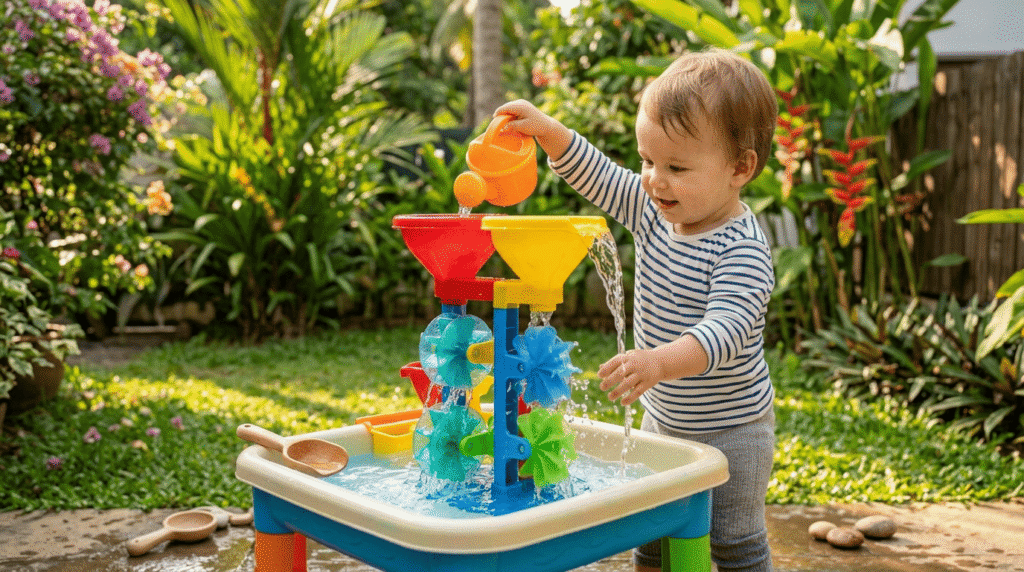
4. Water and Sand Activity Tables (Sensory Science)
Water tables, measuring cups, and funnel systems turn outdoor play into a physics lab.
- What They Teach: Buoyancy (sink vs. float), volume comparison, flow rate, and sensory observation.
- Why Toddlers Love Them: Toddlers have a natural affinity for water play, making sensory tables a soothing yet deeply educational activity.

How to Choose Safe Early STEM Toys for Toddlers
Not every educational toy on the market is suitable for toddlers. When shopping for 2- and 3-year-olds, keep these essential safety and usability guidelines in mind:
- Avoid Small Parts (Choking Hazards): Ensure all components are larger than your child’s fist, especially with magnetic sets or sorting beads.
- Prioritize Durable, Non-Toxic Materials: Look for solid wood coated with water-based non-toxic paints, or BPA-free, food-grade plastics.
- Keep It Simple: Avoid overly complex sets with strict instructions. Toddler STEM toys should allow for free-form exploration without a rigid “right or wrong” outcome.
For further insights on selecting developmental play materials, check out the resources provided by ZERO TO THREE, a leading organization dedicated to early childhood development.
Tips for Parents: Guiding STEM Play Without Taking Over
The goal of STEM play is not to teach complex facts, but to guide your toddler’s natural inquiry. Here is how you can support their learning without stepping in too much:
- Ask Open-Ended Questions: Instead of saying, “Put the red block here,” ask, “What do you think will happen if we put this big block on top?”
- Describe What You See: Use rich descriptive vocabulary. Say words like “heavy,” “balanced,” “floating,” “curved,” and “pattern.”
- Embrace the Mess: Science exploration can get messy! Water spills and block collapses are part of the learning process.
- Celebrate the Process, Not Just the Result: Praise your child’s effort and curiosity rather than focusing solely on a completed tower or solved puzzle.

Final Thoughts: Nurturing Tomorrow’s Thinkers Today
Integrating early STEM toys for toddlers into daily play is a joyful, rewarding investment in your child’s cognitive development. By providing tools that encourage building, sorting, testing, and exploring, you equip your toddler with the critical thinking skills needed to navigate an increasingly complex world.
Explore our top recommendations, set up a supportive play space, and watch your little scientist discover the wonders of math and science firsthand!
“To help your toddler develop early logic and problem-solving skills, explore the [Top Shape Sorters and Stacking Toys for Toddler Development].”
“If you are deciding between different toy materials, read our breakdown on [Wooden Toys vs. Plastic Toys: Why Parents Choice Eco-Friendly Play].”