
Shape sorters and stacking toys give toddlers simple ways to explore how objects fit, balance and move. A child may turn a block several times before finding the matching opening, or rebuild a tower after it falls. These small experiments are part of everyday learning.
This guide compares common sorter and stacking-toy designs, explains what children can practise with them, and offers practical points to consider when choosing age-appropriate toys.
Disclosure: This post contains Amazon affiliate links. As an Amazon Associate I earn from qualifying purchases at no extra cost to you.
In This Article

Why Early Problem-Solving Skills Matter for Toddlers (And How Shape Sorters & Stacking Toys Help)
For a toddler, problem-solving can be as simple as turning a shape, trying another opening or finding a way to balance a ring. These small challenges give children chances to experiment and notice what happens.
Play gives toddlers opportunities to practise trying an idea, noticing the result and adjusting what they do next. Supportive interaction with an adult can make these moments more engaging, but a shape sorter does not by itself determine later attention, memory or school performance.
When toddlers engage with hands-on, manipulative toys, they practice several core cognitive steps:
- Trial and Error: Experimenting with different orientations until a piece fits.
- Hypothesis Testing: Predicting that a large ring won’t fit on top of a small ring.
- Spatial Processing: Mentally rotating shapes to understand angles and geometry.
- Emotional Regulation: Learning to manage small frustrations when a tower topples.
What Children Practise During Sorting and Stacking
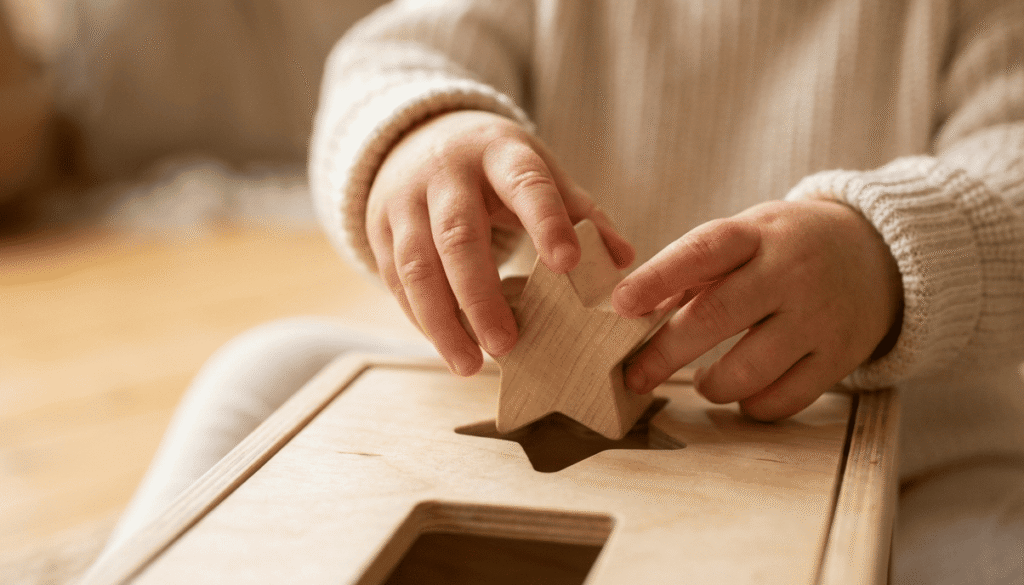
Shape sorters let toddlers explore matching, grouping and the way shapes fit into spaces. The task is simple, but it gives a child a chance to look closely, turn a piece and try different orientations.
1. Spatial Awareness and Geometry Foundations
As children handle the pieces, parents can name simple features such as round, straight, corner, big and small. These words describe what the child is exploring; they should not be presented as proof that a toy teaches later reading or mathematics.
2. Fine Motor Precision and Wrist Rotation
Turning and repositioning a shape gives a toddler practice coordinating what they see with how they move their hands. It is one of many ordinary play experiences involving grasping and releasing; it does not guarantee stronger pencil skills or a particular writing grip.
3. Cause-and-Effect Understanding
The immediate feedback of a shape sorter is deeply satisfying. When the correct shape is inserted, it drops inside with a rhythmic “clack.” This clear feedback teaches toddlers that their intentional actions produce predictable results.
How Stacking Introduces Balance and Sequencing
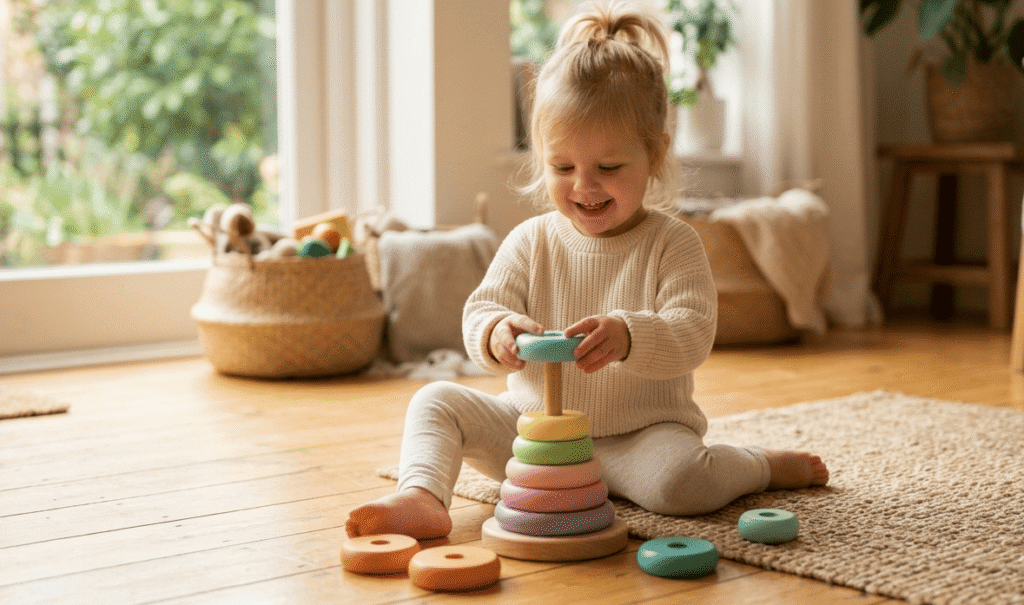
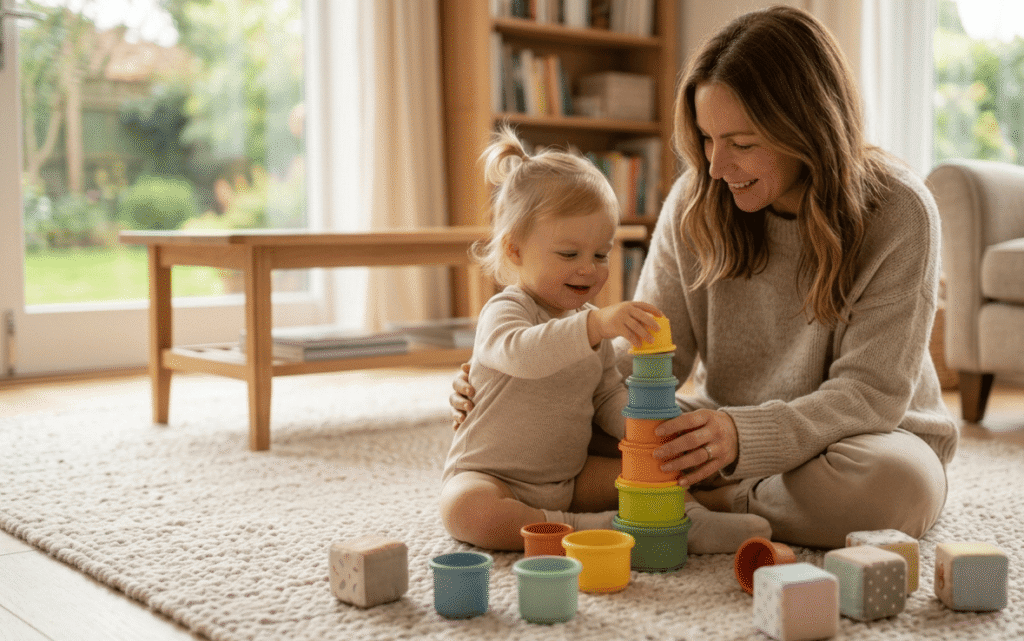
While shape sorters focus on spatial matching, stacking toys challenge a child’s understanding of balance, gravity, scale, and sequencing. Whether using classic stacking rings, nesting cups, or wooden blocks, toddlers must organize objects relative to one another.
Skills Children Can Practise Through Stacking
- Size Grading: Identifying concepts like bigger, smaller, top, and bottom.
- Sequencing and Logic: Understanding that a foundation must be wide to support a narrow peak.
- Hand-Eye Coordination: Aligning a center hole with a vertical peg while keeping hand movements steady.
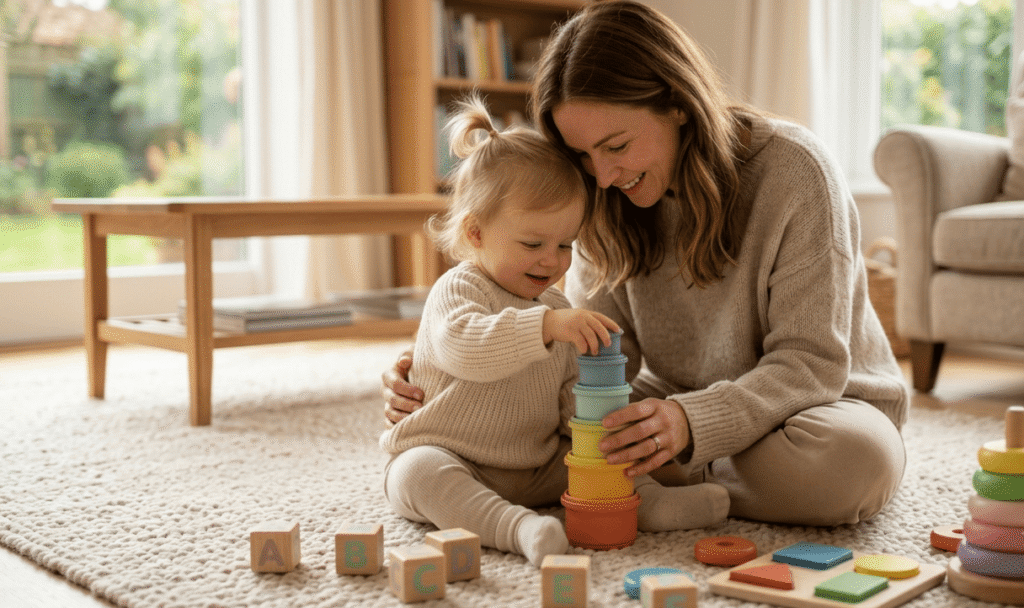
Simple hands-on toys can make it easy for an adult and child to talk, take turns and explore together. Their value comes from how the child uses the toy and the interaction around it, rather than a blanket claim that every non-electronic toy is better than every digital activity.
Common Shape Sorters and Stacking Toys to Consider
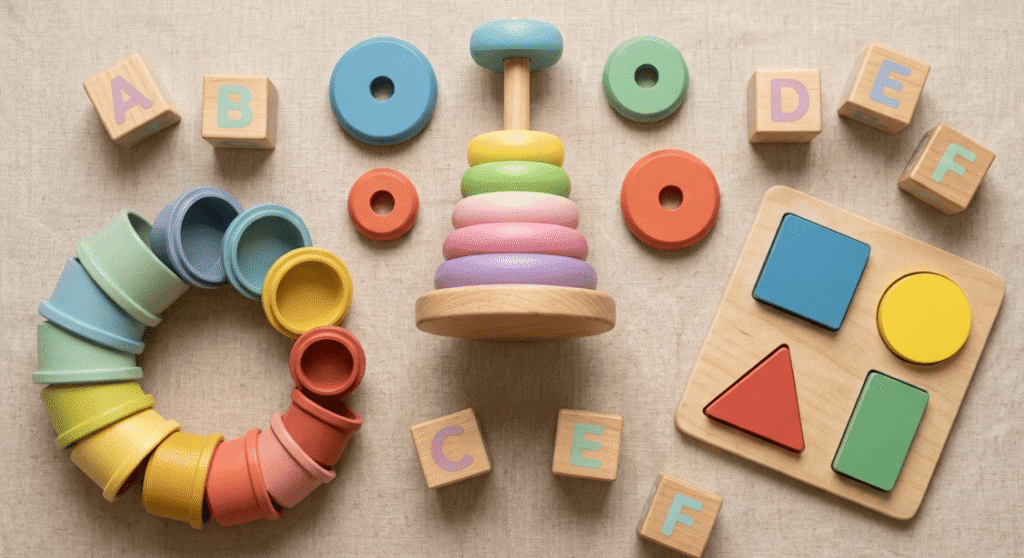
Here are five common play materials to consider, along with the kinds of play they can invite at different stages:
| Toy type | Play focus | What parents should check |
|---|---|---|
| Wooden shape sorter | Matching shapes and exploring how pieces fit | Large, securely finished pieces and age guidance |
| Wooden stacking rings | Ordering by size, grasping and placing | Stable base, smooth finish and secure central post |
| Nesting and stacking cups | Stacking, nesting and simple size comparisons | Durable, easy-to-clean cups without sharp edges |
| Peg or board sorter | Placing shapes over pegs and coordinating hand movements | Peg and piece size appropriate to the child |
| Soft stacking blocks | Handling different textures and building simple towers | Material information, seams and manufacturer guidance on mouthing |
1. Classic Wooden Shape Sorting Cube
Explore wooden shape sorter cubes on Amazon (affiliate link).
The ultimate timeless classic. Featuring solid wooden construction with primary shapes (circle, square, triangle, star), this toy introduces basic categorization without overwhelming visual distractions.
2. Rainbow Wooden Stacking Rings
See wooden stacking ring toys on Amazon (affiliate link).
A vertical peg holding smooth, graduated wooden rings. Toddlers learn to sort by size, building patience as they try to fit the largest ring at the base and the smallest on top.
3. Nesting and Stacking Cups
Browse nesting and stacking cups on Amazon (affiliate link).
Extremely versatile and budget-friendly. These lightweight cups can be stacked upward into a tall tower or nested inward for compact storage, teaching children inverse spatial relationships.
4. Geometric 3D Board Sorter
Unlike enclosed cubes, flat geometric boards feature multiple pegs where children must align shapes with single, double, or triple holes. This introduces counting alongside shape sorting.
5. Soft Silicone Stacking Blocks
Soft stacking blocks may offer a different texture and be easier to handle than rigid pieces. Do not assume that a silicone block is a teether: allow chewing only if the manufacturer specifically identifies it as an age-appropriate teething product, and inspect it for damage.
How Parents Can Encourage Play Without Taking Over
It is natural for parents to want to step in and fix a toy when they see their toddler struggling. However, intervening too quickly can rob children of the valuable “lightbulb moment” when they solve a problem on their own.
Here is how you can support your child’s problem-solving skills using scaffolding techniques:
- Observe Before Acting: Pause for 10-15 seconds when your toddler gets stuck. Watch their thought process before offering help.
- Use Descriptive Language: Instead of saying “Put the blue one there,” try saying “Look, this block has three sharp corners. Where do you see three corners on the box”
- Praise Effort, Not Outcome: Celebrate persistence! Say “You kept trying different sides until it went in!” rather than just “Good job.”
- Model Mistakes: Intentionally try putting a square block into a round hole and say “Hmm, that didn’t fit. Let me try another hole.” This normalizes trial-and-error.
Choosing the Right Toy: Safety, Material, and Age Appropriateness
When shopping for these play materials for your toddler, keep these essential safety and quality guidelines in mind:
- Material Safety: Prioritize sustainably sourced hardwoods with non-toxic, water-based stains, or child-safe, age-labelled BPA-free silicone.
- Choking Hazard Prevention: Do not rely on a guessed diameter or a parent’s visual estimate to judge choking risk. Follow the toy’s age label and applicable safety information; keep small parts and small balls away from children under three, and stop using any piece that cracks or breaks.
- Weight and Edges: Choose pieces with smooth, rounded corners that won’t bruise delicate toes if a stacked tower falls over.
Final Thoughts: Learning Through Sorting and Stacking Play
Shape sorters and stacking toys are simple ways to explore matching, balance and trial and error. Let your toddler try at their own pace, offer help when needed and remember that everyday play—not a particular product—is what gives children repeated chances to explore.
Regular opportunities to sort, stack and experiment give toddlers repeated chances to practise matching, coordination, balance and trial and error.
“While considering the material of your child’s toys, it’s also important to focus on their developmental stage. For insight into age-appropriate learning tools, read our guide on the [Best Educational Toys for 1-Year-Olds].”
“When selecting tools that teach, many parents prefer sustainable materials. Before you buy, read our in-depth comparison of [Wooden Toys vs. Plastic Toys] to make an informed choice for your little one.”
Sources
For general guidance on play materials and age suitability, see the NAEYC guide to toys for young children. The CDC toddler guidance also suggests simple matching games, including shape sorting, for children in this age range. Development varies from child to child, so use these examples as general guidance rather than a deadline for every toddler.
Frequently Asked Questions
Are shape sorters suitable for every toddler?
Not every child is ready for the same pieces at the same time. Start with large, simple shapes and follow the age guidance on the toy.
Are stacking cups different from stacking rings?
Yes. Cups can be nested, stacked and used for supervised water or sand play, while rings usually fit over a central peg.
How can I help if my child gets frustrated?
Show one example, name the shape or size, then give your child time to try. It is fine to pause and return later.