
STEM play for toddlers is less about formal lessons and more about exploring everyday questions: Which object floats? What makes a tower wobble? How many cups fit inside one another? These activities introduce early ideas from science, technology, engineering and mathematics through hands-on discovery.
This guide suggests simple play materials and adult-led activities, with an emphasis on curiosity, safe exploration and the process of trying things out.
Disclosure: This post contains Amazon affiliate links. As an Amazon Associate I earn from qualifying purchases at no extra cost to you.
In This Article
What STEM Looks Like in Toddler Play
When adults think of STEM, they often imagine computers, coding, or complex algebra. For a toddler, STEM looks entirely different. It is tactile, visual, and grounded in active exploration.
- Science for Toddlers: Exploring cause and effect (e.g., What happens when I drop this ball into water?), discovering textures, observing nature, and understanding gravity.
- Technology for Toddlers: Understanding how simple mechanics work—gears turning, levers pressing, or push-and-pull mechanisms.
- Engineering for Toddlers: Building towers with wooden blocks, experimenting with balance, and figuring out how structures collapse and rebuild.
- Mathematics for Toddlers: Sorting shapes by color or size, counting objects, recognizing patterns, and understanding spatial relationships (inside, outside, big, small).
Early STEM play can give toddlers opportunities to notice patterns, compare objects, ask simple questions and see what happens when they try something. These experiences are valuable as play, but they do not guarantee later academic success.

Key Benefits of Early STEM Toys for Child Development
Investing in open-ended, age-appropriate STEM tools offers far more than just entertainment. Here are the primary developmental advantages:
1. Trying an Idea, Observing and Adjusting
When a block tower falls over, a toddler learns patience and trial-and-error. They evaluate why it collapsed—perhaps the base was too narrow—and adjust their approach. This process builds emotional resilience and spatial awareness.
2. Movement and Hand Use During Play
With an age-appropriate activity cube that has large, enclosed gears, a child can turn one part and watch another move. Choose a design with no accessible small parts, and supervise closely; avoid loose gears or small magnetic components.
3. Exploring Early Math Ideas
Long before children write numbers, they need an intuitive understanding of quantity, sorting, and measurement. Toys that involve counting beads or sorting shapes build this numerical intuition naturally.
4. Encouraging Curiosity With Adult Support
Unlike electronic toys with flashing lights and automated sounds that encourage passive consumption, open-ended STEM toys invite children to take the lead. They decide what to create, how to build, and when to start over.

Hands-On Toys and Activities for Early STEM Exploration
To help you choose the best learning tools for your child, we have grouped top-rated STEM toys by their core focus area.
1. Shape Sorters and Counting Abacuses (Early Math Skills)
Explore early-math toys for toddlers on Amazon (affiliate link).
Simple sorting and counting materials can help parents talk about ideas such as same, different, more, fewer and one more. Use large pieces designed for the child’s age; this article focuses on early math exploration rather than a detailed guide to shape-sorter products.
- What They Teach: Color recognition, shape categorization, fine motor precision, and 1-to-1 counting correspondence.
- Why Toddlers Love Them: The instant satisfaction of dropping a shape into its correct slot builds confidence and encourages repetition.
2. Magnetic Tiles and Building Blocks (Engineering & Spatial Awareness)
Browse magnetic building tiles on Amazon (affiliate link).
When a child builds with large, age-appropriate pieces, an adult can ask simple questions such as “Which base feels steadier?” or “What happens if we add one more?” Magnetic construction sets require extra care: use only products labelled for the child’s age, check for cracked tiles and exposed magnets, and keep high-powered magnet sets away from young children.
- What They Teach: Symmetry, balance, spatial awareness, and basic physics principles like magnetism and gravity.
- Why Toddlers Love Them: Magnetic tiles snap together effortlessly, allowing little hands to build tall towers, houses, and tunnels without frustration.
3. Gear Sets and Activity Cubes (Technology & Simple Machines)
See toddler gear and activity cubes on Amazon (affiliate link).
Interlocking gear toys allow toddlers to see cause and effect in real-time. Turning one central handle spins an entire network of colorful wheels.
- What They Teach: Mechanical cause-and-effect, force transmission, and rotational movement.
- Why Toddlers Love Them: The visual feedback of moving gears captivates their attention and encourages hands-on experimentation.
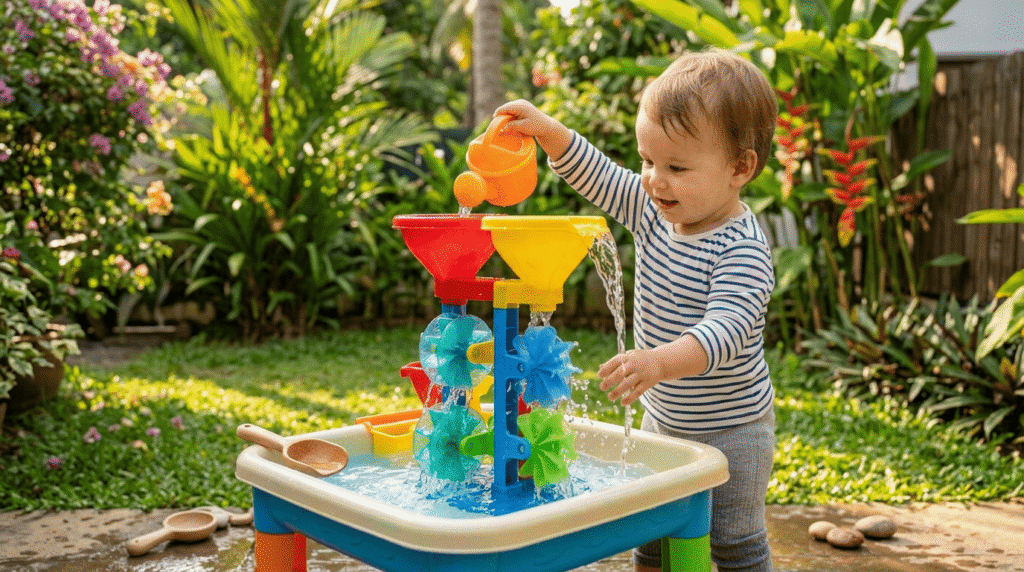
4. Water and Sand Activity Tables (Sensory Science)
Water tables, measuring cups, and funnel systems turn outdoor play into a physics lab.
- What They Teach: Buoyancy (sink vs. float), volume comparison, flow rate, and sensory observation.
- Why Toddlers Love Them: Toddlers have a natural affinity for water play, making sensory tables a soothing yet deeply educational activity.

Choosing Safe Materials for STEM Play
Not every educational toy on the market is suitable for toddlers. When shopping for 2- and 3-year-olds, keep these essential safety and usability guidelines in mind:
- Avoid Small Parts (Choking Hazards): Ensure all components are larger than your child’s fist, especially with magnetic sets or sorting beads.
- Prioritize Durable, Non-Toxic Materials: Look for solid wood coated with water-based non-toxic paints, or BPA-free, child-safe, age-labelled plastics.
- Keep It Simple: Avoid overly complex sets with strict instructions. Toddler STEM toys should allow for free-form exploration without a rigid “right or wrong” outcome.
For further insights on selecting developmental play materials, check out the resources provided by ZERO TO THREE, a leading organization dedicated to early childhood development.
Tips for Parents: Guiding STEM Play Without Taking Over
The goal of STEM play is not to teach complex facts, but to guide your toddler’s natural inquiry. Here is how you can support their learning without stepping in too much:
- Ask Open-Ended Questions: Instead of saying, “Put the red block here,” ask, “What do you think will happen if we put this big block on top”
- Describe What You See: Use rich descriptive vocabulary. Say words like “heavy,” “balanced,” “floating,” “curved,” and “pattern.”
- Embrace the Mess: Science exploration can get messy! Water spills and block collapses are part of the learning process.
- Celebrate the Process, Not Just the Result: Praise your child’s effort and curiosity rather than focusing solely on a completed tower or solved puzzle.

Final Thoughts: Nurturing Tomorrow’s Thinkers Today
Integrating hands-on STEM play into daily play is a joyful, rewarding investment in your child’s cognitive development. By providing tools that encourage building, sorting, testing, and exploring, you equip your toddler with the critical thinking skills needed to navigate an increasingly complex world.
Explore our top recommendations, set up a supportive play space, and watch your little scientist discover the wonders of math and science firsthand!
“To help your toddler develop early logic and problem-solving skills, explore the [Top Shape Sorters and Stacking Toys for Toddler Development].”
“If you are deciding between different toy materials, read our breakdown on [Wooden Toys vs. Plastic Toys: Why Parents Choice Eco-Friendly Play].”
Frequently Asked Questions
What does STEM mean for a toddler?
It means exploring simple ideas through play—for example, testing which objects float, sorting by size or building a stable tower.
Do toddlers need electronic STEM toys?
No. Everyday objects and simple hands-on materials can provide useful opportunities to explore, compare and solve problems.
How can I keep STEM play safe?
Stay within arm’s reach during water and sand play, empty water containers immediately afterwards, and keep small parts, loose magnets and damaged components away from young children. Choose products with clear age guidance and inspect them before use.