
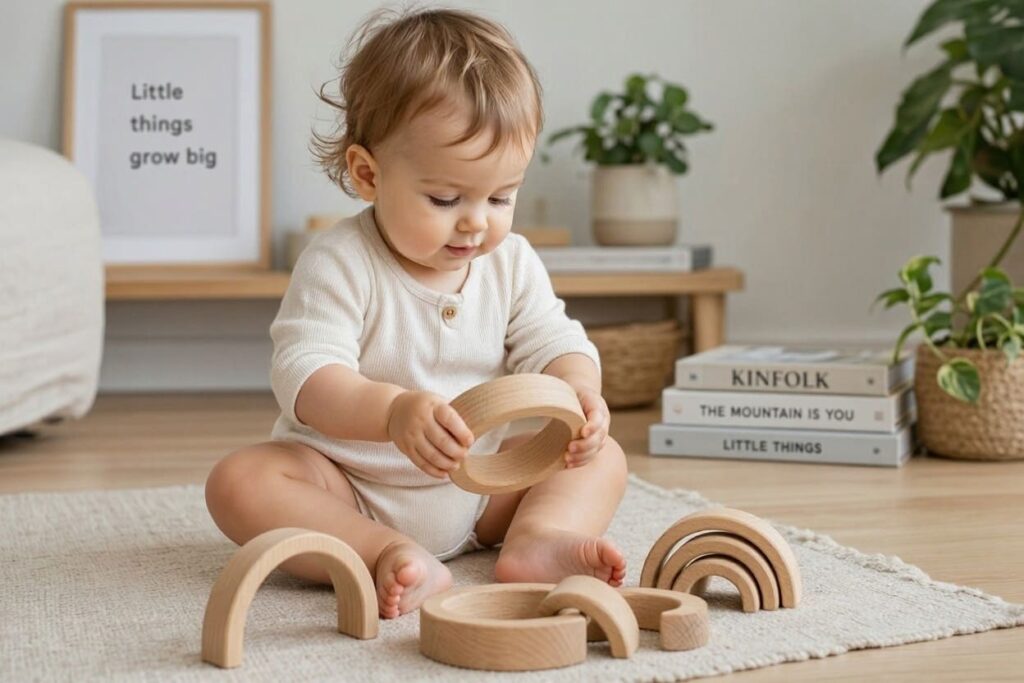
Choosing a toy for a 1-year-old can be surprisingly difficult. Store shelves are full of products described as educational, developmental, sensory, or interactive. But a toy does not need flashing lights or dozens of buttons to give a child something valuable to do.
At this age, simple play can involve picking objects up, putting them into containers, taking them out again, stacking, turning pages, copying adults, and exploring what happens when an object is moved or dropped. These ordinary actions give parents useful clues when choosing toys.
The goal is not to find a toy that “teaches everything.” This broader guide looks at different kinds of everyday play—movement, pretend play, books, simple cause-and-effect and interaction with caregivers. For a focused list of Montessori-style puzzles, posting toys and stacking materials, see our Montessori toys for 1-year-olds guide.
This post contains Amazon affiliate links. As an Amazon Associate, I earn from qualifying purchases at no extra cost to you.
Table of Contents
What Should an Educational Toy Do for a 1-Year-Old?
A good toy for this age usually gives a child something to do, rather than simply something to watch.
For example, a child might:
- Put large objects into a container
- Take objects back out
- Stack or nest pieces
- Turn pages in a sturdy board book
- Fit a large piece into a simple puzzle
- Carry an object from one place to another
- Pretend to feed a doll or stuffed animal
- Push a suitable toy while moving around
- Repeat a simple action to see what happens
These activities don’t have to look like a lesson. In fact, play at this age is often most useful when the child is allowed to explore while an adult talks, responds, and joins in.
The American Academy of Pediatrics emphasizes that play with young children is especially valuable because it supports interaction between children and caregivers. It also recommends choosing toys that encourage imagination and interaction rather than relying on overstimulating features.
Choose Toys Based on What Your Child Can Do Now
Not every 1-year-old is at exactly the same stage. Some are already walking independently, while others are still crawling or cruising around furniture.
The CDC’s 1-year milestone guidance includes skills such as walking while holding onto furniture, picking up small pieces of food using the thumb and pointer finger, and putting objects into containers.
That makes it more useful to look at the action a toy encourages rather than buying something simply because the packaging says “12 months+.”
For example:
- If your child enjoys putting things inside containers, look for toys that involve filling and emptying.
- If your child likes carrying objects, choose lightweight items that are easy to hold.
- If your child is beginning to experiment with stacking, try large nesting cups or appropriately sized blocks.
- If your child enjoys copying you, simple pretend-play objects may be more interesting than another electronic toy.
- If your child enjoys looking at books, sturdy board books can become part of everyday play.
This approach also helps prevent buying toys that are technically age-appropriate but don’t match your child’s current interests.
1. Fill-and-Empty Toys
A simple fill-and-empty activity can use a wide, stable container and a few large objects specifically suitable for the child’s age. Offer one item at a time, stay close, and let the child decide whether to put it in, take it out or carry it elsewhere. Avoid small household items, lids that can trap fingers, and anything that could break.
You don’t necessarily need a complicated toy for this.
A large container with several appropriately sized objects can provide plenty of opportunities for supervised exploration. Purpose-built posting toys and simple activity boxes can also give children a clear place to put objects.
This type of play can encourage children to practice:
- Picking up objects
- Releasing objects
- Looking for where an object went
- Repeating an action
- Using both hands together
The CDC specifically lists putting something into a container as a milestone around 1 year.
The important point is to choose pieces that are large enough and designed for the child’s age. Small loose pieces should not be used simply because they seem interesting.
Parent tip: You can make this activity very simple. Hand your child one large, safe object at a time and let them experiment with putting it into a container and removing it.
Object Permanence Box Montessori Guide
2. Nesting Cups and Large Stacking Toys
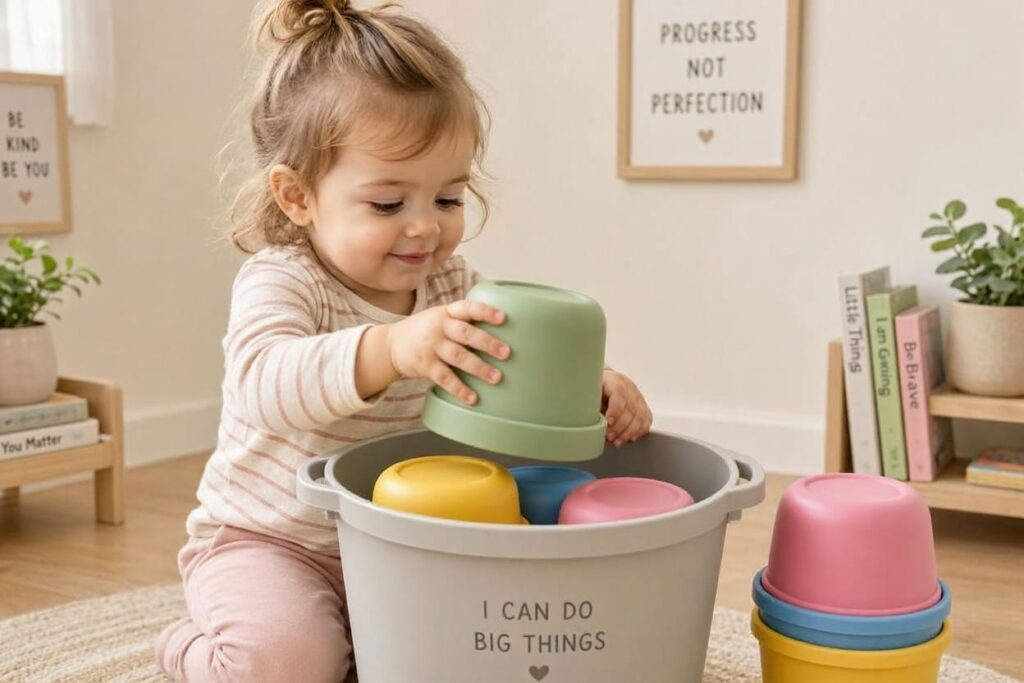
Nesting cups offer more than tower-building: children can compare sizes, put one cup inside another, carry them between places or use them during supervised water play. Choose a simple set with no cracks, sharp edges or detachable small parts, and follow the age label.
A child might:
- Put one cup inside another
- Turn a cup upside down
- Knock down a small tower
- Carry cups around
- Put objects inside a cup
- Try to stack pieces
There is no need to expect a 1-year-old to build a perfect tower. At this age, the process is more important than the finished result.
A parent can make the play interactive by describing what is happening:
“Big cup.”
“Little cup.”
“You put it inside.”
“It fell down!”
Simple language during play gives the child more opportunities to hear words connected with real objects and actions.
3. Simple Pretend-Play Toys
Pretend play does not need a large play kitchen or an expensive set.
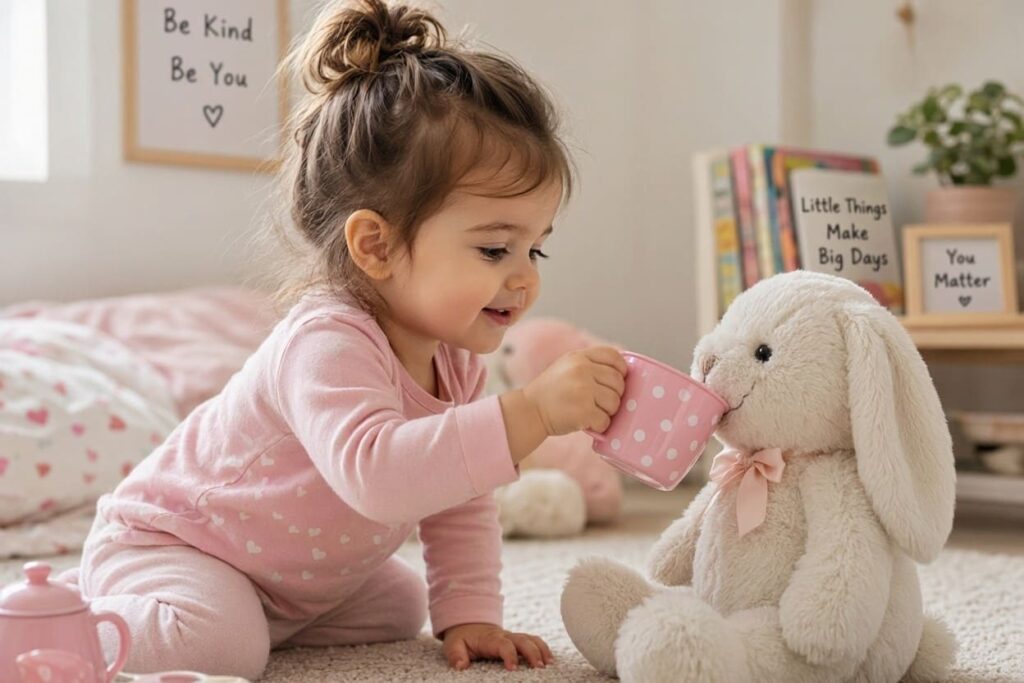
A sturdy toy cup, spoon, doll, stuffed animal, or simple household-themed toy can give a young toddler opportunities to copy familiar actions.
For example, a parent might pretend to give a stuffed animal a drink and then offer the cup to the child.
The child may imitate the action, make sounds, or create their own variation.
This is also a good reminder that the adult can be part of the educational value of the toy. Instead of leaving the child alone with a toy and expecting it to teach a skill, join in occasionally and follow the child’s lead.
You can name objects, describe actions, sing a simple song, or take turns.
The AAP notes that the most valuable play experiences for young children involve supportive interaction rather than simply providing a product marketed as educational.
4. Large-Piece Puzzles
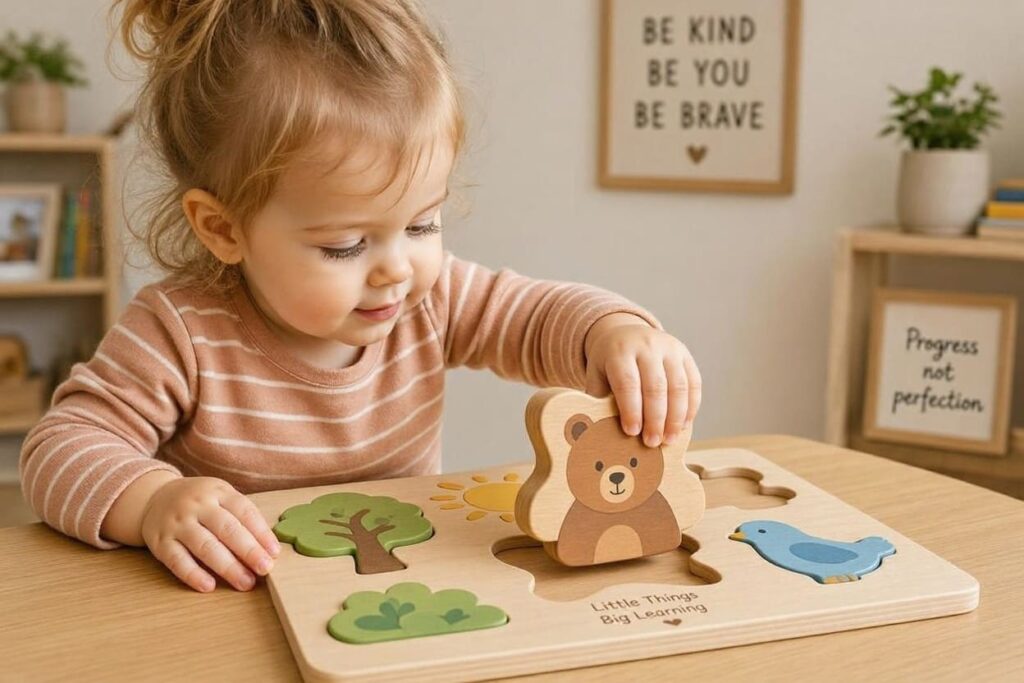
A simple picture-matching activity can be introduced when it matches the child’s current ability. Start with a large, sturdy board and only a few easy-to-handle pieces; the aim is shared exploration, not completing the puzzle without help.
For a young 1-year-old, look for:
- Very large pieces
- Easy-to-grasp knobs or handles
- A sturdy wooden or thick-board construction
- A small number of pieces
- Simple familiar pictures or shapes
The purpose is not to make the child complete a difficult puzzle independently.
At first, your child may simply remove the pieces, turn them over, or place them back without matching them correctly.
simple wooden puzzles for toddlers
That’s fine.
You can help by pointing to the picture and saying what it is:
“Dog.”
“Where does the dog go?”
Then give the child time to try.
If the puzzle becomes frustrating, put it away and try again another day.
5. Books That Invite Interaction
Books are sometimes overlooked when parents search specifically for “educational toys,” but they can be one of the most useful additions to a 1-year-old’s play area.
At this age, books do not need complicated stories.
Look for sturdy board books with:
- Clear pictures
- Familiar objects or animals
- Simple words
- Durable pages
- Opportunities to point and name things
You can ask very simple questions:
“Where’s the dog?”
“Can you find the ball?”
“What is this?”
Your child may not answer with words yet. Pointing, touching, looking, or making a sound can still become part of the interaction.
The AAP also recommends reading, talking, singing, and interacting with babies as everyday ways to support learning and development.
6. Simple Cause-and-Effect Toys
Another useful category is a toy where the child’s action produces an obvious result.
For example, a child might:
- Push a large button and hear a sound
- Turn a knob and see something move
- Drop a large object through an opening
- Open and close a simple door
- Pull a lever and watch a part move
The key is that the child controls the action.
A toy with a few meaningful actions can sometimes be more engaging than one that performs everything automatically.
This does not mean electronic toys are automatically bad. Rather, parents can ask a practical question:
“What does my child actually have to do?”
If the child simply presses one button while the toy produces continuous sounds and lights, there may be less opportunity for exploration than with a toy that requires several hands-on actions.
What About Electronic and Flashing Toys?
Bright lights, music, and buttons can certainly attract a young child’s attention. But “attention-grabbing” and “educational” are not the same thing.
AAP guidance emphasizes real-world interaction for children under 18 months and recommends being thoughtful about what screen media may replace, such as talking, reading, playing, and exploring together.
For a 1-year-old, this makes hands-on toys, books, everyday objects, movement, and interaction with caregivers especially useful parts of the day.
You also don’t need to completely avoid every toy that makes a sound. A simple musical button or cause-and-effect feature can be perfectly reasonable when it is age-appropriate and used as part of active play.
The better question is whether the child is doing something with the toy or mostly watching it perform.
Everyday Household Objects Can Be Educational Too
Some of the most interesting “toys” in a home may not have been sold as toys at all.
Under close supervision, a child may enjoy exploring safe, age-appropriate household objects such as:
- A large wooden spoon
- A plastic measuring cup
- An empty, sturdy container
- A large mixing bowl
- A cardboard box
- A clean cloth
For example, give your child a large plastic cup and a suitable container and let them experiment with putting one inside the other.
This kind of play can also show you what your child is naturally interested in.
Important: Household objects are not automatically safe just because they are found in the home. Avoid anything sharp, breakable, very small, detachable, or otherwise unsuitable for a young child.
How to Choose an Educational Toy Before Buying
Before adding another toy to your child’s shelf, ask these questions:
1. Is it suitable for my child’s age and ability?
Age recommendations are a useful starting point, but your child’s individual abilities matter too.
2. Can my child physically use it?
A toy that is difficult to grip, too heavy, or too complicated may end up being ignored.
3. Does my child have to do something?
Look for toys that involve moving, fitting, stacking, opening, closing, carrying, pretending, or exploring.
4. Is it durable?
Young toddlers can drop, throw, chew, and repeatedly use their toys. Sturdy construction matters.
5. Is it easy to clean?
For toys used frequently, simple surfaces that can be cleaned according to the manufacturer’s instructions are practical.
6. Are there small or loose parts?
This is especially important for 1-year-olds because mouthing objects is still common.
The U.S. Consumer Product Safety Commission advises parents to follow age guidance and keep toys with small parts away from children younger than 3.
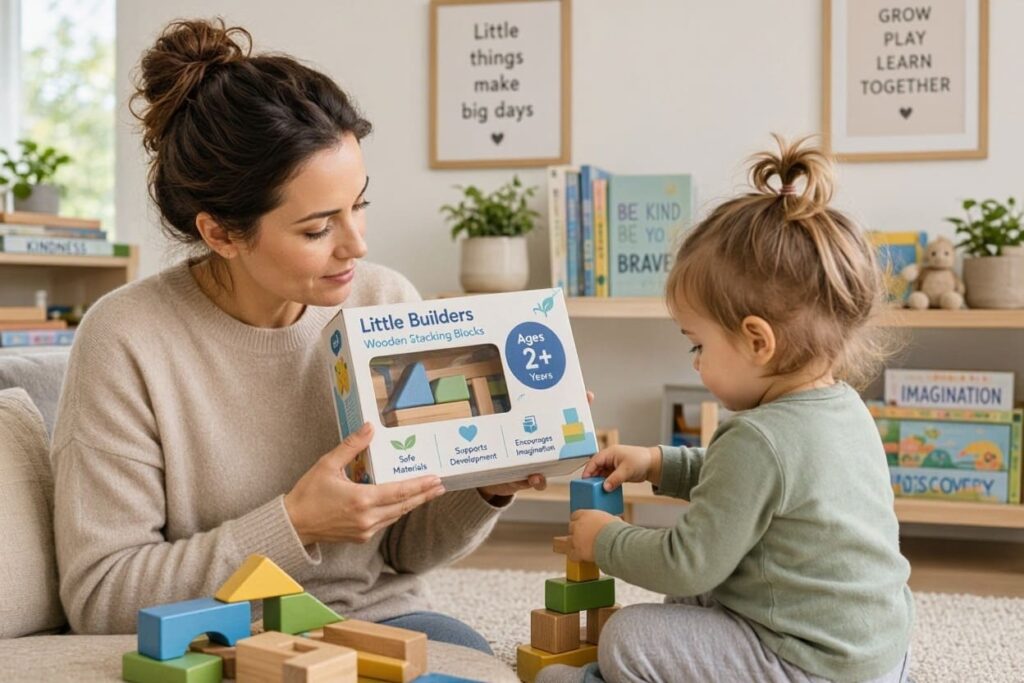
A Simple Toy Rotation Can Keep Your Shelf Manageable
You don’t need dozens of toys available at once.
Instead, you can keep a small selection accessible and put some other toys away for later.
For example, one shelf might contain:
- One nesting toy
- One simple puzzle
- One ball
- Two or three board books
- One pretend-play object
After your child has had plenty of time with those items, you can change one or two.
This isn’t a developmental requirement. It’s simply a practical way to keep the play area manageable and notice which toys your child actually returns to.
You may discover that the expensive toy with ten functions gets ignored while a simple set of cups becomes a daily favorite.
Safety Comes Before Educational Value
A toy can have excellent play possibilities and still be unsuitable if it creates a safety risk.
Before giving a toy to a 1-year-old:
- Check the manufacturer’s recommended age range.
- Inspect the toy for broken pieces.
- Look for loose parts.
- Avoid toys containing accessible small pieces.
- Check battery compartments and other removable components.
- Be cautious with long cords or strings.
- Follow the manufacturer’s cleaning and care instructions.
- Supervise play when the toy or activity requires it.
The CPSC recommends choosing toys according to the child’s age, skills, abilities, and interests, and checking toys periodically for damage.
If a toy becomes damaged, stop using it until it can be safely repaired or replaced.
Final Thoughts
The best educational toys for 1-year-olds don’t necessarily have the most buttons, lights, or features.
A good toy can be surprisingly simple: something to stack, something to put inside a container, a sturdy puzzle, a board book, or an object that encourages pretend play.
More importantly, the toy is only one part of the experience. Talking, demonstrating, taking turns, reading, and following your child’s interests can make ordinary play much richer.
Instead of asking, “Which toy will teach my child the most?”, try asking:
“What can my child actually do with this?”
That small change can make choosing toys much easier—and may help you build a play space filled with things your child genuinely wants to explore.
Frequently Asked Questions
What are the best educational toys for a 1-year-old?
Simple hands-on toys such as nesting cups, large stacking toys, age-appropriate puzzles, posting or fill-and-empty toys, board books, and simple pretend-play objects can provide useful opportunities for exploration.
Does a 1-year-old need expensive educational toys?
No. A toy does not need to be expensive to provide meaningful play. Simple objects that allow a child to stack, fill, empty, carry, match, pretend, or explore can be useful.
Are electronic toys bad for 1-year-olds?
Not necessarily. The important question is how the toy is used and what the child actually does with it. For children under 18 months, AAP guidance emphasizes real-world interaction and being mindful of what media may replace.
How many toys should a 1-year-old have?
There is no required number. A small selection of age-appropriate toys can be enough. Parents can rotate some items based on the child’s interests rather than keeping every toy available at once.
What should I avoid when buying toys for a 1-year-old?
Avoid toys with inappropriate small parts, damaged components, unsafe cords, or features that do not match the child’s age and abilities. Always check the manufacturer’s age guidance and safety information.
Can household objects be used instead of toys?
Some safe household objects can be used for supervised exploration, but they should be selected carefully. Avoid anything sharp, breakable, very small, or containing detachable parts.
🔗 External sources
- CDC – 1-Year Milestones: CDC 1-Year Milestones
- American Academy of Pediatrics – Digital Media Guidance: AAP Digital Media Guidance
- U.S. CPSC – Toy Safety: CPSC Toy Safety