

Seeing your baby pull up on the sofa, let go for a second, and take those first wobbly steps can be such an exciting moment. It can also make parents wonder whether there is anything they should buy to help with the next stage.
One product that often comes up is a baby walker. But there is an important difference between a traditional sit-in baby walker and a stand-behind push toy.
They may both have wheels, but they are not designed in the same way.
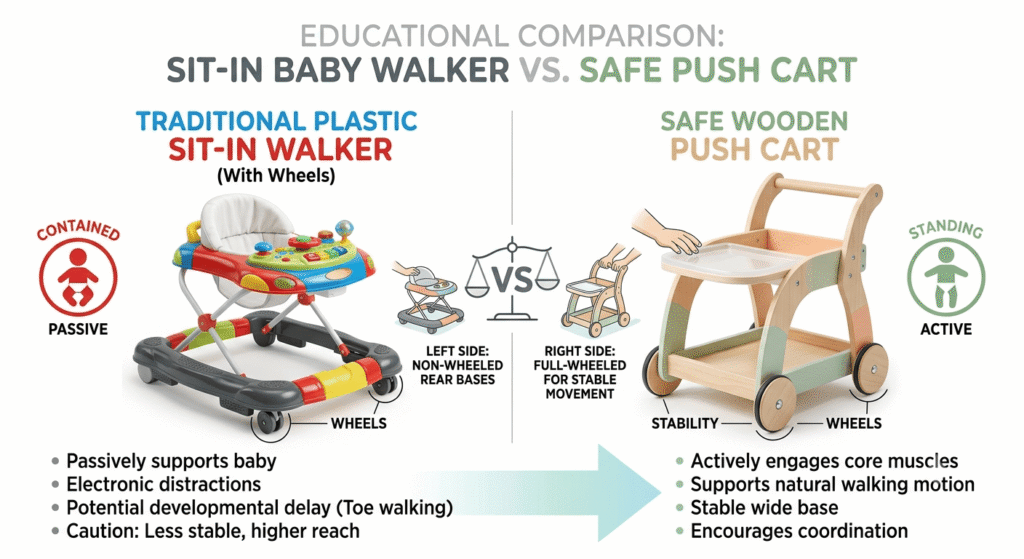
Traditional sit-in walkers place a baby inside a wheeled frame, while push toys are used from behind as a child stands and moves independently. Health professionals generally do not recommend sit-in walkers because of their injury risks, while some NHS physiotherapy guidance says a stable push-along toy can be useful once a child is developmentally ready to use one.
So, if your baby is getting ready to walk, what should you know before buying one?
Disclosure: This post contains Amazon affiliate links. As an Amazon Associate, I earn from qualifying purchases at no extra cost to you.
Table of Contents
What Is the Difference Between a Baby Walker and a Push Toy?
The word “walker” can make things confusing because it is used for two very different products.
Traditional sit-in baby walkers
A traditional baby walker usually has:
- A seat in the middle
- A plastic or metal frame
- Wheels underneath
- A tray or toy area around the baby
- Open space underneath for the baby’s feet
The baby sits inside the device and moves it around by pushing against the floor with their feet.
The problem is that this gives a baby access to a much larger area before they have the balance and awareness needed to move safely through that space.
The American Academy of Pediatrics warns about injuries involving stairs, hot surfaces, electrical cords and other household hazards. It also notes that walkers do not help babies learn to walk and may delay walking.
Stand-behind push toys
A push toy works differently.
Instead of sitting inside the product, the child stands behind it and holds a handle while pushing it forward. Examples include wooden push wagons, activity carts and sturdy push trolleys.
Your baby has to do more of the movement themselves:
pull up → stand → hold → shift weight → take steps → release
That makes the experience much closer to the movements a child is already practising while cruising around furniture.
Importantly, a push toy does not teach a baby to walk by itself. NHS guidance describes push-and-pull toys as optional toys that can be useful once a baby is developmentally ready, rather than something every baby needs.
Why Traditional Baby Walkers Are a Different Safety Issue
The biggest concern with traditional walkers isn’t simply that they have wheels. It is how quickly and freely a baby can move while sitting inside them.
A baby who is crawling may not be able to reach a hot drink on a table or get close to a staircase. Put that same baby in a wheeled walker, and suddenly their reach and mobility change.
The AAP lists several hazards associated with traditional walkers, including:
- Falls down stairs
- Burns from hot drinks or cooking surfaces
- Access to electrical cords and household objects
- Drowning hazards around pools or bathtubs
- Reaching objects that would normally be out of reach
This is also why simply saying, “I’ll watch my baby while they’re in it,” doesn’t completely solve the problem. The AAP notes that many walker injuries happen while adults are watching because the child can move faster than a caregiver can react.
Canada has gone further and prohibits wheeled baby walkers from being manufactured, imported, advertised or sold there.
Do Push Toys Help Babies Learn to Walk?
This is where it’s useful to keep expectations realistic.
A push toy isn’t a shortcut to walking.
Your baby doesn’t need one in order to reach the walking milestone, and buying one won’t necessarily make them walk sooner.
What a suitable push toy can provide is another opportunity to practise movement once the baby is already showing signs of readiness.
NHS physiotherapy guidance says push-along toys can help children practise balance, coordination, muscle control and confidence when they are ready to use them.
Think of the toy as a play opportunity rather than a piece of equipment that “teaches” walking.
That distinction makes a big difference.

Signs Your Baby May Be Ready for a Push Toy
Age alone isn’t the best way to decide.
Instead, look at what your baby is already doing.
Some useful signs include:
- Pulling themselves up on furniture
- Standing while holding onto something
- Cruising sideways along furniture
- Beginning to let go for short moments
- Showing reasonable balance while standing
- Taking supported steps
NHS child-development guidance similarly describes cruising, beginning to let go and having good standing balance as signs that a baby may be ready for a push-and-pull walking toy.
If your baby is still mainly sitting or crawling and isn’t interested in standing, there is no need to introduce a push toy simply because they have reached a certain age.
Let the next stage come naturally.
What Makes a Push Toy a Good Choice?
Not every push toy is equally useful for a new walker.
One of the most important things to look at is stability.
1. Choose a wide, stable base
A lightweight toy that shoots forward as soon as your baby pulls on it can be frustrating and potentially unsafe.
A heavier, wider push toy is generally easier for a new walker to control.
Some NHS physiotherapy guidance specifically recommends a solid, stable push-along toy and notes that heavier wooden trolley-style toys can provide more stability than lighter plastic options.
2. Look for controlled wheel movement
This is one of the details parents often overlook.
A push toy that rolls too easily can move away from your baby before they are ready to take another step.
Some wooden push toys have adjustable wheel resistance. This can be useful when introducing the toy on a smooth floor.
However, don’t assume that every toy with “adjustable wheels” is automatically safer. The actual construction, stability and your child’s ability to control it still matter.
3. Think about the handle height
Your baby should be able to hold the handle comfortably without leaning far forward.
If the handle encourages your baby to stretch or tip their body forward just to reach it, the toy may not be a good fit.
4. Check the wheels and base
Before each use, quickly check:
- Are all wheels secure?
- Is the handle firmly attached?
- Does the toy wobble?
- Are there loose screws or broken parts?
- Are there small detachable pieces?
- Does it roll unexpectedly fast?
These checks take less than a minute and are worth making part of your routine.

Start on the Right Surface
The floor underneath the push toy matters more than it may seem.
A very smooth floor can allow some push toys to move faster than expected.
For a baby who is just learning, a clear, level surface can make the first attempts easier to manage. NHS physiotherapy guidance suggests beginning with a stable push toy and, in some situations, using carpet rather than very smooth flooring while the child becomes familiar with the movement.
Avoid starting near:
- Stairs
- Doorways
- Slopes
- Swimming pools
- Open doors
- Sharp furniture corners
- Pets that may run across the baby’s path
Give your baby a clear route rather than placing the toy in the middle of a busy room.
Why Babies Still Need Floor Time
It can be tempting to think that once your baby discovers a push toy, they should spend lots of time using it.
They don’t.
Walking development involves much more than moving forward.
Your baby also needs opportunities to:
- Crawl
- Sit down and stand up
- Pull to stand
- Cruise sideways
- Squat down
- Reach for objects
- Shift weight from one foot to the other
- Move between different positions
These everyday movements help your baby learn how their body works.
NHS guidance on early movement recommends giving children plenty of opportunities to move and play on the floor rather than restricting movement for long periods.
A push toy can simply be one part of that bigger picture.
If you’re also looking for ideas for earlier-stage movement and floor play, take a look at our guide to The Best Baby Gyms of 2026.
What About Traditional Walkers If They Are Sold Where You Live?
It can be confusing when a product is available in stores and online but health organizations advise against using it.
Availability does not necessarily mean a product is recommended.
The AAP recommends against wheeled baby walkers because of their injury risks and says they do not provide a walking-development benefit.
The U.S. Consumer Product Safety Commission also has mandatory safety requirements for infant walkers because of risks including falls, tipping and falls between flooring levels.
So if you’re choosing between a traditional sit-in walker and another way to support early movement, it makes sense to look at alternatives rather than assuming the walker is necessary.
Other Ways to Encourage First Steps
You don’t actually need a special walking toy to encourage your baby’s first steps.
Furniture cruising
Place interesting toys on a sturdy sofa or low, secure surface.
Your baby can move sideways while holding the furniture.
Walking between two safe surfaces
Once your baby is becoming confident, place two stable surfaces relatively close together.
A small gap can encourage your baby to take a step from one support to another.
Walking with a parent
You can offer your hands for support while your baby practises stepping.
As their confidence improves, gradually reduce the amount of help.
Simple floor play
Even ordinary floor play gives babies opportunities to move, reach, turn, crawl and change positions.
These activities don’t look as exciting as a new toy, but they can be just as valuable.
What About Stationary Activity Centers?
A stationary activity center is another option, particularly if you want a contained play space without giving your baby the mobility of a wheeled walker.
The important distinction is that a stationary activity center stays in one place.
The AAP recommends stationary activity centers as an alternative to wheeled baby walkers.
However, these products are not a replacement for free movement either. Your baby should still have plenty of opportunities for floor play and movement.

Push Toy Safety Checklist for Parents
Before letting your baby use a push toy, run through this quick checklist:
✔ Is the toy stable when your baby pulls up on it?
✔ Does it move slowly enough for your baby’s current ability?
✔ Is the floor clear of toys, cords and other obstacles?
✔ Are there stairs or open doors nearby?
✔ Is an adult close enough to intervene if necessary?
✔ Are the wheels and handle secure?
✔ Is your baby already showing signs of standing and cruising readiness?
✔ Is the toy being used for short periods rather than replacing normal floor play?
NHS guidance recommends supervising babies when using push-and-pull walking toys and keeping their path free of obstacles, steps and doors.
A Simple Way to Introduce a Push Toy
You don’t need to make the first session complicated.
Place the push toy on a clear, level surface.
Let your baby explore it first.
If they pull themselves up and hold the handle, stay nearby. You may need to steady the toy initially so it doesn’t roll away before your baby is ready.
Once they become more confident, allow them to decide how far they want to go.
And don’t worry if they push it once and then crawl away.
That is completely fine.
The goal isn’t to make your baby “train” for walking. The goal is to give them a safe opportunity to explore movement when they’re ready.
Once your baby becomes more confident on their feet, you may also enjoy our guide to educational toys for 1-year-olds.
Final Thoughts
Those first steps don’t need to be rushed.
A baby’s path from crawling to walking usually includes lots of little stages—pulling up, cruising, standing, wobbling, sitting back down and eventually taking those first independent steps.
A traditional sit-in baby walker isn’t necessary for this process and carries well-documented safety concerns.
A stable stand-behind push toy can be a fun option for a baby who is already standing and cruising, but it should be treated as a play tool rather than a shortcut to walking.
Choose a sturdy design, start in a safe area, stay close and let your baby set the pace.
Sometimes the best thing we can do as parents is simply give them a safe space to practise—and wait for that little step forward.
FAQ
Are push toys better than traditional baby walkers?
They are different types of products. Traditional sit-in walkers are not recommended by the AAP because of their injury risks and lack of walking-development benefit. A stable push-along toy can be used as an optional play tool once a baby is developmentally ready.
What age can a baby use a push walker?
There isn’t one exact age that works for every baby. Look for signs such as pulling to stand, cruising and being able to stand with reasonable balance.
Can a push toy make my baby walk sooner?
Not necessarily. Push toys don’t teach babies to walk, and they aren’t essential for reaching the walking milestone. They can, however, give a developmentally ready baby an enjoyable opportunity to practise balance and movement.
Are wooden push toys safer than plastic ones?
Not automatically. A well-designed push toy should be stable and appropriate for your child’s abilities. Heavier wooden trolley-style toys can provide more stability than lightweight designs, but construction and wheel movement matter more than the material alone.
Should I supervise my baby with a push toy?
Yes. Push toys should be used with adult supervision, on a clear surface away from stairs, doors and other hazards.
What if my baby doesn’t want to use a push toy?
That’s fine. A baby doesn’t need a push toy to learn to walk. Give them opportunities to crawl, pull up, cruise and play on the floor instead.
Sources
AAP – Baby Walkers:Baby Walkers: A Dangerous Choice
CPSC – Infant Walkers:Infant Walker Safety
Health Canada:Baby Walker Regulations
NHS:Learning to Walk
NHS Physiotherapy:Standing and Stepping