

This post contains Amazon affiliate links. As an Amazon Associate, I earn from qualifying purchases at no extra cost to you.
At nine months, babies often become much more interested in what happens when they touch, shake, tap, or drop something. A toy that makes a sound can turn an ordinary play session into a little experiment: What happens if I do that again?
That is one reason musical toys can be enjoyable at this age. They give babies a chance to explore sound while also practising simple movements such as grasping, tapping, pressing, and passing objects from one hand to another.
The goal is not to teach a nine-month-old to play an instrument. It is simply to give them safe opportunities to make sounds, listen, repeat actions, and play with a parent.
Table of Contents
What Makes Musical Toys Interesting at 9 Months?
By 9 months, many babies are becoming more active during play. The CDC lists making different sounds and banging two things together among the milestones that most babies reach by this age.
That makes this a fun stage for toys that respond to a baby’s actions.
For example:
- A shaker makes a sound when it is moved.
- A small drum responds when it is tapped.
- A button produces a sound when pressed.
- A simple musical toy can encourage your baby to repeat an action.
- Playing back and forth with a parent adds a social element to the experience.
These simple interactions are more important than having a toy with dozens of lights, songs, and buttons.
1. Baby Shakers and Simple Musical Rattles
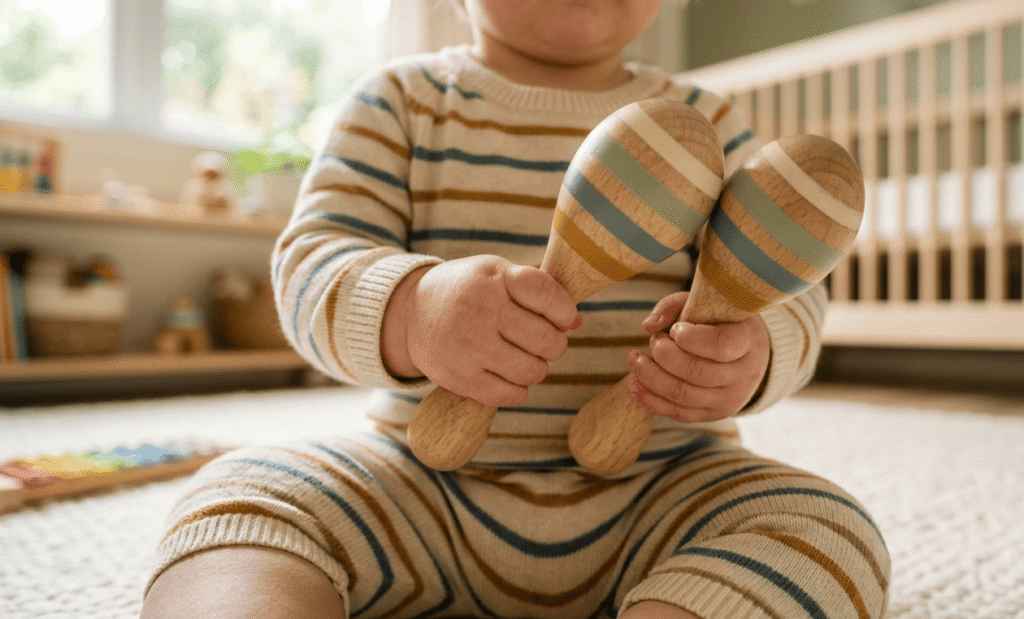
A simple shaker can be one of the easiest musical toys for a nine-month-old to understand.
Your baby can hold it, move it, stop it, and then try again. This creates a very straightforward connection between movement and sound.
When choosing one, look for:
- A size that is easy for small hands to hold
- A securely enclosed sound-making section
- No loose pieces
- Smooth or comfortable edges
- An age recommendation suitable for your baby
You can also make the activity more interactive by copying your baby’s movements. If your baby shakes the toy, shake yours too. Then stop and see whether your baby starts again.
This turns a toy into a simple back-and-forth game.
2. Small Baby Drums for Tapping and Exploring
At this age, tapping can be more interesting than trying to follow a rhythm.
A small baby drum gives your child an easy way to discover that different movements can create different sounds. You might tap the drum once and wait. Your baby may respond with a tap of their own.
You do not need to correct their rhythm or show them the “right” way to play.
Instead, try simple games such as:
One tap → wait → baby’s turn
or
Tap-tap → pause → baby’s turn
The important part is the interaction. Your baby is listening, watching, moving, and responding to you.
For a nine-month-old, choose a baby-friendly design without detachable parts. If a toy comes with a mallet, check whether the manufacturer specifically recommends it for your baby’s age. A toy that can be tapped safely with the hands may be a simpler choice at this stage.
3. Simple Musical Keyboards and Sound Buttons
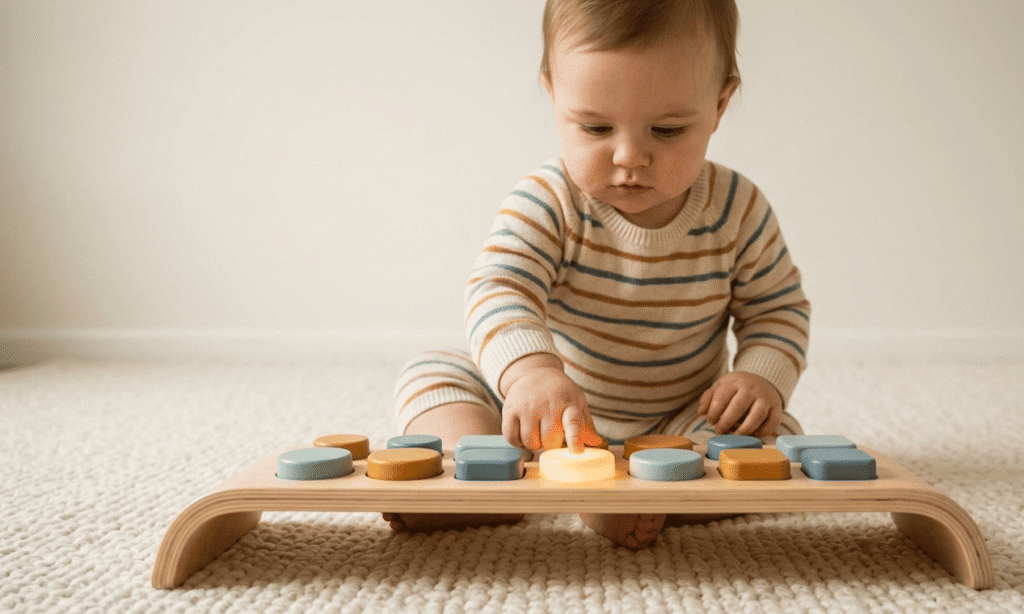
Some babies enjoy pressing buttons simply because something happens immediately afterward.
A small infant keyboard or sound toy can provide this kind of exploration. Your baby may press the same button repeatedly, move between two buttons, or simply explore the surface with their fingers.
That repetition is perfectly normal.
Instead of expecting your baby to learn notes or musical patterns, use the toy as an opportunity to talk:
“You pressed the button!”
“I hear the music.”
“Again?”
This gives you a natural way to combine play with everyday language.
The National Institute on Deafness and Other Communication Disorders notes that babies’ speech and language development occurs in a sound-rich environment with consistent exposure to speech and language.
So the parent interaction around the toy matters just as much as the electronic sounds coming from it.
4. Musical Stacking and Activity Toys
Some toys combine music with another activity, such as stacking, placing, turning, or pressing.
These can be interesting when your baby is beginning to enjoy simple actions that produce a response.
However, you do not need to buy a toy simply because it promises to teach a long list of developmental skills.
A better question is:
Can my baby easily understand how to interact with it?
For a nine-month-old, a toy with one or two obvious actions may be more enjoyable than a complicated toy with many functions.
You can also give your baby time to figure things out without immediately showing them what to do.
If they press a button and hear a sound, let them try again. If they stop, give them a moment before helping.
That little pause can make the play feel like their own discovery.
5. Musical Toys for Floor Play
Not every musical toy needs to be an activity table.
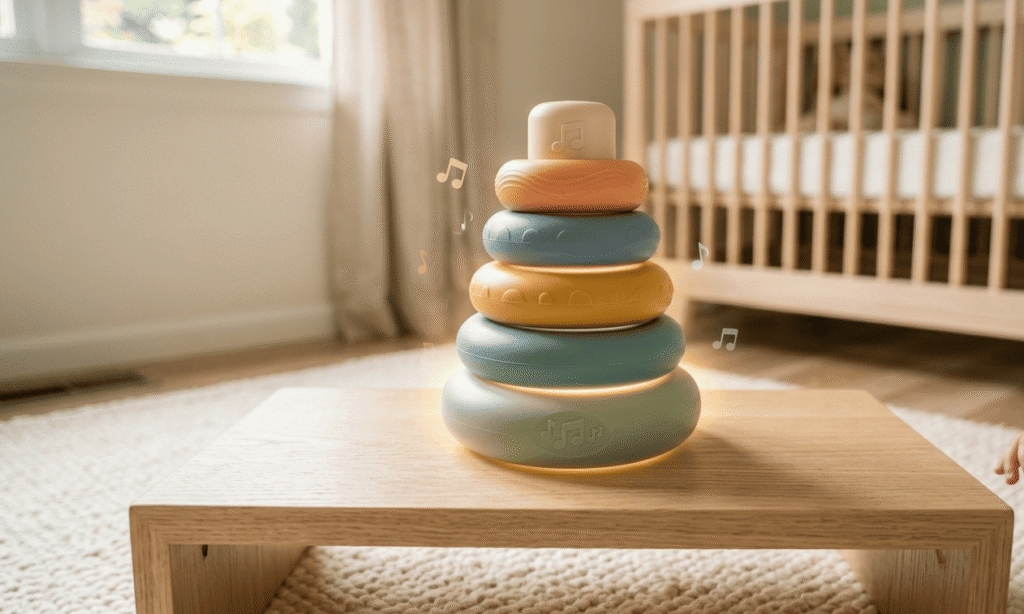
For a nine-month-old, a toy that can be used while sitting and moving around on the floor can be a practical choice.
Place a musical toy slightly away from your baby and let them decide whether to reach, move, or crawl toward it. The CDC also recommends placing safe toys a little out of reach to encourage babies to move toward them.
Keep the setup simple.
One musical toy on the floor can be enough. You do not need to surround your baby with several noisy toys at once.
Musical Toys Don’t Have to Be Loud
A musical toy does not need to be loud to be interesting.
In fact, very loud sounds can make play uncomfortable, especially when a toy is held close to your baby’s ears.
When choosing an electronic musical toy, listen to it yourself before giving it to your baby. If the sound feels harsh or uncomfortably loud from a short distance, look for a quieter option.
It is also useful to choose toys with:
- Adjustable volume when available
- A simple on/off switch
- Clear controls
- No unnecessarily loud sound effects
- A design that does not encourage holding the speaker directly against the ear
The aim is enjoyable sound exploration, not maximum volume.
How to Play With Musical Toys Together
You do not need a special activity plan.
Try one of these simple ideas.
Copy Your Baby
If your baby shakes a toy twice, shake yours twice.
Then stop.
Wait and see what happens.
This can become a simple turn-taking game without needing your baby to understand any instructions.
Make a Sound and Pause
Tap a drum once and pause.
Your baby may look at you, reach for the drum, or make a sound.
Give them time to respond instead of immediately making another sound.
Sing Along
You can sing a familiar nursery rhyme while your baby plays with a shaker or taps a drum.
The toy does not need to play the song. Your own voice gives the activity a personal and interactive element.
Let Your Baby Lead
If your baby keeps returning to one button or shaking one toy repeatedly, there is no need to move them on to another activity.
Repetition is part of how babies explore.
How to Choose the Best Musical Toys for a 9-Month-Old
When you are comparing products, focus on simplicity, safety, and suitability rather than the number of features.
1. Check the Age Recommendation
A toy designed for an older child may contain parts or features that are not appropriate for a nine-month-old.
Use the manufacturer’s age recommendation as one of your first checks.
2. Avoid Small Loose Parts
Nine-month-olds commonly explore objects with their mouths.
For this reason, avoid musical toys with small parts that can detach or break off.
CPSC guidance notes that toys intended for children under three should not contain small parts that create a choking hazard.
3. Check the Battery Compartment
Electronic musical toys deserve an extra battery check.
If a toy uses button or coin batteries, make sure the battery compartment is properly secured. CPSC warns that swallowed button batteries can cause severe internal injuries and that toy battery compartments need secure closures.
4. Look for Sturdy Construction
A baby will probably drop, bang, shake, and mouth the toy.
Choose something that feels solid and does not have easily detachable decorative pieces.
5. Keep the Controls Simple
A toy does not have to contain 20 buttons to keep a nine-month-old interested.
A few large, easy-to-use controls can be enough.
Three Musical Toys Are Plenty
You do not need a large collection of musical toys.
A small rotation could include:
Toy 1: A simple shaker for holding and shaking.
Toy 2: A small drum for tapping.
Toy 3: A simple electronic keyboard or sound toy for pressing.
You can keep the others away and switch them every few days.
This also makes an old toy feel interesting again when it comes back into the play area.
What About Musical Activity Tables?
Musical activity tables can be entertaining, but they are not necessary for every nine-month-old.
Some babies will enjoy standing at one later on, while others may prefer toys they can use while sitting on the floor.
If you choose an activity table, check its recommended age and stability carefully. Make sure it cannot easily tip when your baby pulls on it.
For this article, I would treat an activity table as an optional toy, rather than something every nine-month-old needs.
Safety Tips for Musical Toys
Before giving a musical toy to your baby:
- Check the recommended age.
- Inspect it for loose or broken pieces.
- Make sure battery compartments are securely closed.
- Avoid toys with accessible button batteries.
- Avoid very loud sounds.
- Check toys regularly for damage.
- Supervise your baby during play.
- Follow the manufacturer’s cleaning instructions.
- Put damaged toys away rather than continuing to use them.
Remember that no toy replaces supervision.
A Musical Toy Can Be Simple
The best musical toy for your nine-month-old may not be the most expensive one or the one with the most buttons.
A simple shaker, drum, or sound button can give your baby plenty to explore.
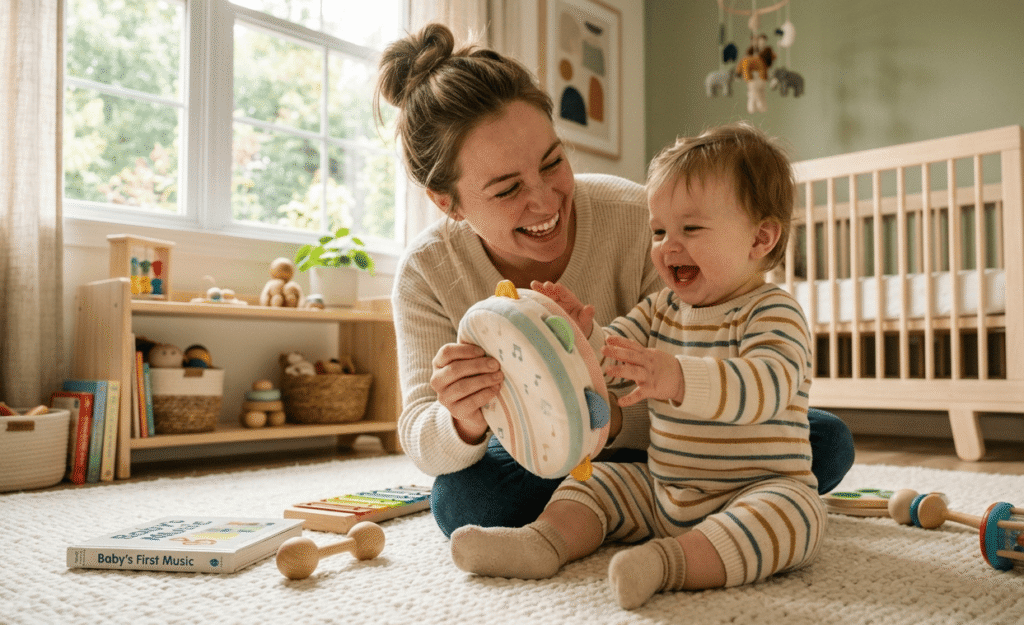
At this age, the most valuable part of musical play is often the interaction around the toy. You shake, your baby watches. Your baby taps, you copy. You sing, your baby listens.
Those small moments can make an ordinary toy much more enjoyable.
Final Thoughts
When choosing musical toys for 9-month-olds, look for safe and age-appropriate ways for your baby to explore sound through their own actions.
Shakers, simple drums, keyboards, and interactive toys can all be useful choices, but you do not need to buy everything.
Start with one or two simple toys and see what your baby naturally enjoys.
And whenever possible, join in. Your voice, facial expressions, and response to your baby’s actions can turn a simple musical toy into a shared play experience.
sensory balls and blocks for babies
Frequently Asked Questions
What are the best musical toys for a 9-month-old?
Simple shakers, baby drums, easy-to-press musical toys, and age-appropriate keyboards are good options. Look for sturdy designs without small detachable parts.
Are musical toys good for 9-month-old babies?
Musical toys can give babies opportunities to explore sound, movement, repetition, and cause and effect. They can also provide an enjoyable way for parents and babies to play together.
Should musical toys be loud?
No. A musical toy does not need to be loud to be interesting. Choose comfortable sound levels and avoid placing loud toys directly next to your baby’s ears.
Are electronic musical toys better than wooden toys?
Not necessarily. Both can offer different types of play. A wooden shaker may encourage simple movement and sound exploration, while an electronic toy may offer buttons and different sounds. The important things are age suitability, safety, and how your baby interacts with the toy.
How many musical toys does a 9-month-old need?
There is no specific number. A few well-chosen toys are enough. Rotating them can keep play interesting without filling the play area with too many toys.
Can a 9-month-old play with a musical toy independently?
A baby can explore an age-appropriate toy for short periods while a parent or caregiver is nearby. Active supervision is especially important with toys containing batteries or any parts that could become loose.