
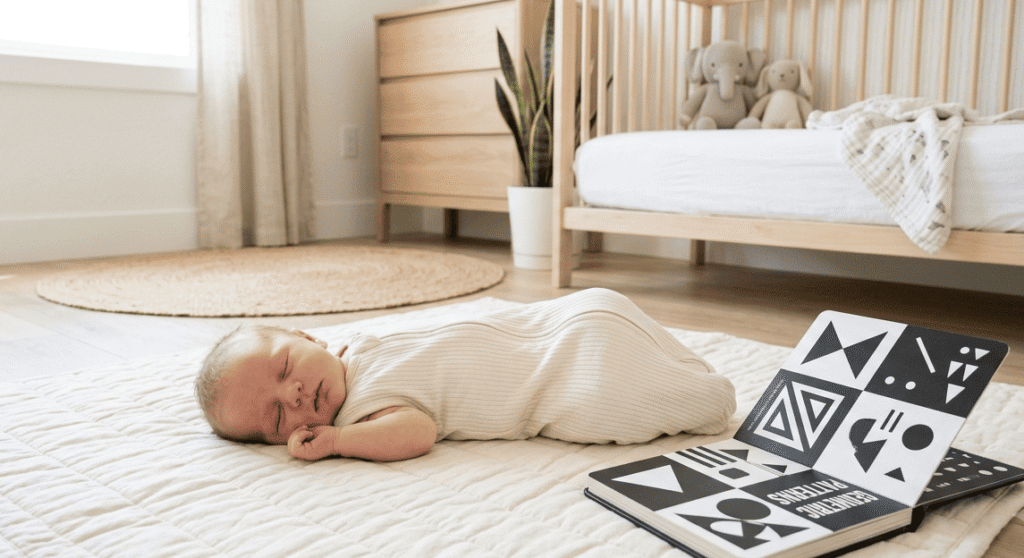
When you start shopping for newborn toys, it is easy to feel like you need a whole collection of them. In reality, a few simple toys can give your baby plenty to look at and explore.
High-contrast toys are especially interesting during the early months because young babies tend to notice bold patterns more easily than very detailed or closely matched colors. The American Academy of Pediatrics notes that babies around 1 month can focus about 8 to 12 inches away and often prefer black-and-white or other high-contrast patterns.
That does not mean you need to fill your home with black-and-white toys. A small selection of well-made books, cards, mirrors, rattles, or hanging toys can be enough.
Here are some practical things I would look for when choosing them.
Disclosure: This post contains affiliate links. As an Amazon Associate, I earn from qualifying purchases at no extra cost to you.
Table of Contents
What Makes a Good High-Contrast Toy for a Newborn?
Not every black-and-white baby product is automatically a useful toy. When I look at toys for a young baby, I would pay attention to a few simple details.
Look for clear, simple patterns
Bold stripes, circles, checkerboard designs, faces, and other simple shapes are easier to notice than very busy pictures.
A toy does not need dozens of different patterns to keep a newborn interested. Sometimes one simple black-and-white design is enough.
Choose baby-safe materials
Newborns do not have the coordination to play with toys independently in the same way an older baby does. Look for toys made specifically for the baby’s age, with securely attached parts and no small pieces that could become loose.
The AAP also recommends paying attention to age recommendations and avoiding toys with small batteries, loose magnets, or other parts that could become dangerous if detached.
Think about how the toy will actually be used
A beautiful toy that is difficult to hold, clean, or position may end up sitting on a shelf.
For a newborn, I prefer toys that can be used during short periods of awake time—for example, while a parent is holding the baby, during supervised floor play, or during a quiet diaper-changing routine.
1. High-Contrast Books and Cards
Black-and-white cards and simple board books are probably the most familiar high-contrast toys for newborns.
They are useful because you can bring them close to your baby’s face for a few moments and then put them away when your baby loses interest.
The important part is not to turn it into a lesson. Your baby does not need to “finish” a set of cards.
You might show one simple picture, pause for a few seconds, and talk naturally:
“Look at the stripes.”
Then give your baby time to look.
The AAP lists high-contrast images and books among appropriate toys and activities around 2 months.
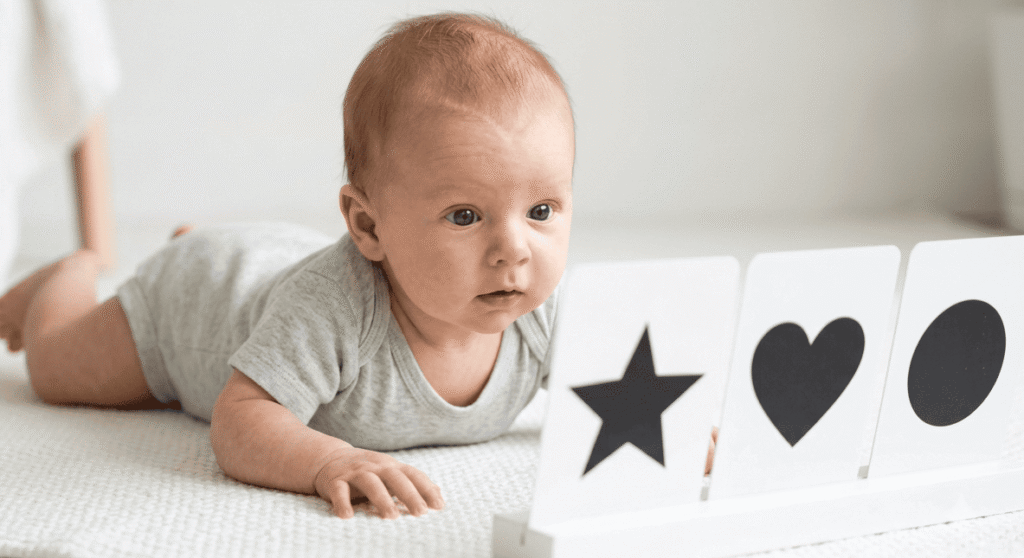
If you want to learn more about using black-and-white cards with a newborn, see our guide to Black and White Flashcards for Newborns.
2. High-Contrast Activity Gyms
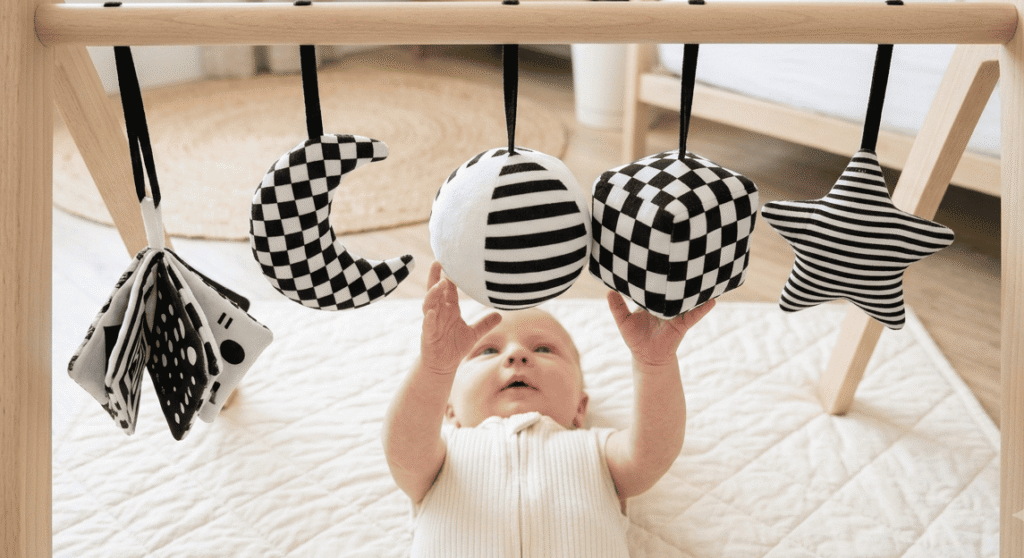
An activity gym can give a baby something interesting to look at while they are lying on the floor.
For a newborn, I would not worry about having lots of complicated hanging toys. A simple gym with a few clearly visible shapes can be easier to use.
As your baby gets older, the same gym can become more interactive. They may start looking at the hanging toys for longer, moving their arms toward them, and eventually reaching for them.
The CDC lists “looks at a toy for several seconds” and “watches you as you move” among milestones most babies reach by 2 months.
A small tip
You do not need to leave every toy hanging at once. Removing a few toys can make the remaining ones easier for your baby to notice.
3. Baby-Safe Contrast Mirrors
A mirror gives you something different from a printed card.
Instead of looking at a flat black-and-white picture, your baby can notice a face-like image that changes as they move or as you move beside them.
For younger babies, a mirror can simply be something interesting to look at during supervised floor play. As babies get older, mirrors can become more interactive.
The AAP lists an unbreakable plastic or mylar mirror among appropriate toys around 4 months.
For this reason, do not use an ordinary glass mirror as a baby toy. Choose a product designed for infant use and follow its age and safety instructions.

4. High-Contrast Rattles and Crinkle Toys
This is one category that makes the new article more useful because it is not just about looking.
A soft rattle or crinkle toy can combine visual interest with gentle sound.
For a very young baby, the toy can be held by the parent and moved slowly from one side to another. You can pause when your baby looks toward it rather than constantly moving it.
Later, when your baby begins gaining more control over their hands, a lightweight rattle can become something they try to hold.
The AAP lists sturdy rattles as appropriate around 2 months and also mentions see-through rattles and textured toys around 4 months.
What I would look for
- Lightweight construction
- No loose pieces
- No sharp edges
- Gentle sound rather than a very loud noise
- Easy-to-clean material
- Age-appropriate design
- A size that cannot easily become a choking hazard
5. High-Contrast Mobiles
A mobile can be another simple way to give a baby something interesting to look at while they are awake.
The AAP includes mobiles with contrasting colors and patterns among toys appropriate for a 1-month-old. However, there is an important safety point here: a mobile should not be treated as a toy that stays within the baby’s reach.
A hanging mobile should be securely installed according to its instructions and positioned safely.
Most importantly, hanging crib toys and mobiles need to be removed once the baby can push up on their hands and knees, or by 5 months at the latest, according to the AAP’s toy-safety guidance.

How to Use High-Contrast Toys During the Day
You do not need a special “visual stimulation session” every day.
These toys can fit naturally into small moments.
During supervised floor play
Place one toy where your baby can comfortably see it. Give them time to look before changing the toy.
While holding your baby
Hold a high-contrast card or book about 8–12 inches away. This is roughly the distance newborns can focus on most clearly according to the AAP.
During a quiet play break
Instead of putting several toys around your baby, try one toy at a time.
This makes it easier to notice whether your baby is actually interested in it.
Follow your baby’s cues
Some days your baby may look at a toy for several seconds. Other times they may turn away almost immediately.
That is completely fine.
If your baby looks away, becomes fussy, or seems tired, there is no need to keep trying.
How to Use Visual Flashcards With Your Baby
Do Newborns Need High-Contrast Toys?
Not necessarily.
High-contrast toys are an option, not a requirement for healthy development.
Babies also learn through looking at faces, listening to voices, being held, moving their bodies, and interacting with the people around them.
The CDC’s 2-month milestones include looking at a caregiver’s face, watching someone move, and looking at a toy for several seconds.
So I would think of high-contrast toys as one small part of everyday play rather than something your baby needs in order to develop properly.
When Do Babies Start Seeing More Color?
Newborn vision changes gradually during the first months.
You may notice that your baby becomes more interested in colorful toys as their visual abilities develop. There is no need to suddenly replace all black-and-white toys with colorful ones at a particular age.
Instead, you can gradually introduce different colors, textures, shapes, sounds, and types of toys as your baby grows.
The AAP’s recommendations for 2- and 4-month-olds already show this progression: high-contrast images are appropriate early on, while colorful books, mirrors, soft balls, and textured toys become useful as babies get older.
High-Contrast Toy Safety Tips
A few simple rules matter more than having a large toy collection.
- Always check the manufacturer’s recommended age.
- Inspect toys regularly for loose parts, tears, or damage.
- Avoid toys containing accessible button or coin batteries.
- Avoid toys with loose magnets.
- Keep toys out of the baby’s sleep space unless they are specifically designed and securely attached according to safety instructions.
- Keep hanging mobiles and crib toys out of reach.
- Remove hanging crib toys when your baby starts pushing up on their hands and knees, or by 5 months at the latest.
- Supervise play with toys that are not designed to remain with the baby independently.
The AAP specifically warns about small batteries, loose magnets, and hanging crib toys, including mobiles and crib gyms.
A Simple High-Contrast Toy Rotation
You do not need five toys sitting in front of your baby at the same time.
A simple rotation could look like this:
Morning:
High-contrast board book
Floor play:
Activity gym
Another awake period:
Baby-safe mirror
Later:
Soft rattle or crinkle toy
Hanging option:
High-contrast mobile used safely and only while appropriate for your baby’s stage
This also gives you a chance to notice which toys your baby actually seems interested in.
Final Thoughts
Choosing high-contrast toys for a newborn does not have to become another overwhelming part of parenting.
A few simple options—a black-and-white book, an activity gym, a baby-safe mirror, a soft rattle, or a well-positioned mobile—can give your baby different things to look at, listen to, and eventually reach for.
The most important thing is not having the biggest collection of toys. It is giving your baby safe opportunities to look, move, listen, and interact with you.
And sometimes, the most interesting “toy” in the room is still your face.
Frequently Asked Questions
Are high-contrast toys necessary for newborns?
No. They are optional toys that can provide interesting visual patterns during awake play. Babies also learn through faces, voices, movement, and everyday interaction.
What colors are best for newborn toys?
Black-and-white and other strongly contrasting patterns are often easier for young babies to notice. As vision develops, you can introduce a wider range of colors and patterns.
How far should I hold a high-contrast card from a newborn?
About 8–12 inches is a useful starting point because this is the approximate distance newborns can focus on clearly.
Can newborns use mirrors?
A baby-safe, unbreakable mirror can be used during supervised play. The AAP lists unbreakable plastic or mylar mirrors among appropriate toys around 4 months.
Are rattles suitable for young babies?
The AAP lists sturdy rattles among appropriate toys around 2 months. Always choose an age-appropriate rattle that is securely made and free of loose parts.
Are crib mobiles safe for newborns?
They can be used when installed and positioned according to the manufacturer’s instructions, but they should be kept out of reach. The AAP recommends removing hanging crib toys when a baby begins pushing up on their hands and knees, or by 5 months at the latest.
How many high-contrast toys does a newborn need?
There is no required number. A small selection is enough. You can rotate one or two toys at a time instead of putting everything in front of your baby.
Sources / External Links
- American Academy of Pediatrics – Developmental Milestones at 1 Month
High-contrast patterns, 8–12 inch focus distance, mobiles & gentle-sound toys AAP: Developmental Milestones at 1 Month - American Academy of Pediatrics – Developmental Milestones: 1–4 Months
High-contrast books, mobiles, rattles, mirrors, textured toys AAP: Developmental Milestones 1–4 Months - CDC – Milestones by 2 Months
Baby watches you move & looks at a toy for several seconds CDC: Milestones by 2 Months - AAP – How to Buy Safe Toys
Batteries, magnets, hanging crib toys & mobile safety AAP: How to Buy Safe Toys