
Welcome to The Sprout Minds!
As a parent, I’m happy to share my first article with you. I hope you find it helpful, informative, and useful for your parenting journey.
Let’s get started!
The first few weeks with a newborn are full of small discoveries. Your baby may spend a surprising amount of time looking at your face, a window, a dark piece of furniture, or the edge of a nearby object.
At this age, your baby’s vision is still developing. Newborns do not see the world with the same clarity and color perception as older children and adults. Their distance vision is blurry, and they tend to notice certain visual patterns more easily than others.
One simple option parents often use is a black and white flashcard for newborns. High-contrast cards can give a young baby an interesting visual target during quiet, supervised play.
But what does the science actually tell us?
Do black-and-white flashcards really improve brain development? How should you use them? And when should you move beyond simple black-and-white patterns?
Let’s take a closer look.

Disclaimer: This post contains affiliate links. As an Amazon Associate, I earn from qualifying purchases at no extra cost to you.
Table of Contents
How Newborn Vision Develops
A newborn’s visual system is still maturing after birth.
According to the American Academy of Pediatrics, newborns can see light, shapes, faces and movement, but their distance vision is quite blurry. They can generally see best at about 8 to 12 inches (20 to 30 cm) from their face.
That distance happens to be similar to the space between a baby’s face and a parent’s face during feeding.
Young babies also don’t initially see the full range of colors as clearly as older infants do. The AAP notes that newborns can distinguish light from dark and may show particular interest in black-and-white or sharply contrasting patterns.
This is one reason high-contrast baby cards can be interesting during the newborn stage.
Why Does Contrast Matter?
Contrast refers to the difference between light and dark areas.
A black shape against a white background creates a much stronger visual boundary than two very similar pastel colors. Research into infant vision has found that newborns tend to pay attention to high-contrast edges and patterns.
That doesn’t mean a flashcard is “training” your baby’s brain in a special way. Rather, it gives your baby a visual target that may be easier to notice while their visual system is still developing.
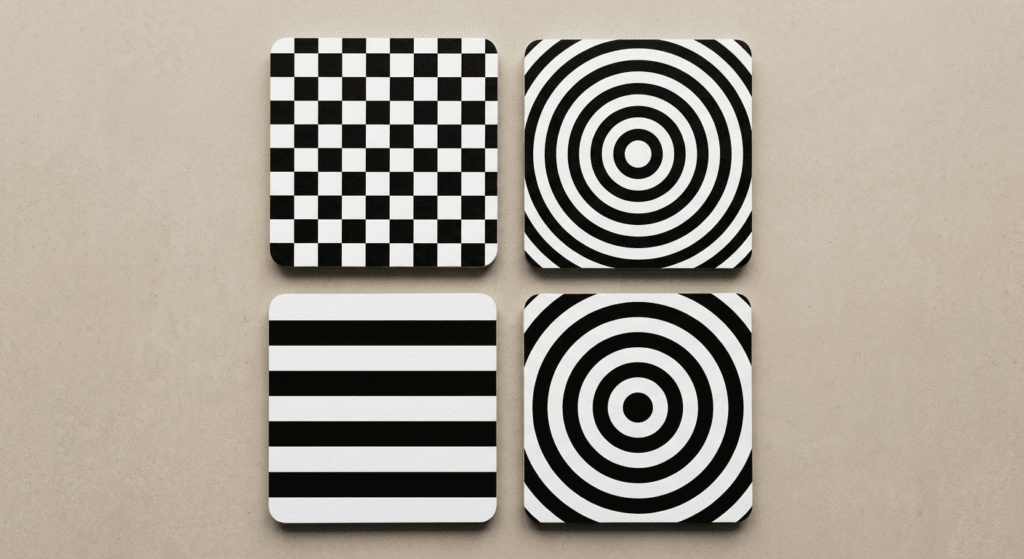
Can Black and White Flashcards Help Newborns?
This is where it’s important to separate what we know from exaggerated claims sometimes used to market baby products.
There is good evidence that young infants notice high-contrast visual patterns. There is also extensive research showing that visual abilities develop rapidly during the first months of life.
However, there is not good evidence that simply showing a newborn black-and-white flashcards will make the baby smarter, accelerate brain development, or increase intelligence.
So rather than thinking of flashcards as a brain-development treatment, it is more accurate to think of them as a simple visual play activity.
A card can give your baby something interesting to look at while you interact with them.
1. They Can Encourage Visual Attention
Newborns naturally spend time looking at interesting visual information.
High-contrast patterns can be particularly noticeable during the early months. The AAP specifically notes that young infants may study black-and-white or sharply contrasting patterns with interest.
You can use this natural interest during a short, relaxed play session.
Hold a card where your baby can see it and give them time to look at it. There is no need to keep moving the card constantly or expect your baby to stare at it for a specific amount of time.
Some babies may look for several seconds. Others may quickly look away.
Both can be completely normal.
2. They Can Provide a Simple Visual Tracking Activity
As babies grow, they become better at following objects with their eyes.
By around 3 months, babies should generally be able to focus on faces and nearby objects and follow a moving object with their eyes.
You can make a simple visual-tracking game from a high-contrast card.
Hold the card about 8–12 inches from your baby’s face.
Wait for your baby to notice it.
Then, while keeping the movement slow and gentle, move it slightly from one side to the other.
If your baby follows the card, pause. If they lose interest, stop and try again later.
The goal isn’t to “train” the eyes. It’s simply an age-appropriate opportunity to interact with your baby’s developing vision.
3. High-Contrast Cards Can Be Useful During Tummy Time
Tummy time is an important part of early movement development.
When your baby is awake and supervised, you can place a high-contrast card where they can see it from their tummy-time position.
The interesting pattern may give your baby another reason to look forward or lift their head.
You don’t need an elaborate setup.
A single card with a bold pattern can be enough.
A Simple Tummy-Time Setup
- Place your baby on their tummy while they are awake and supervised.
- Position a high-contrast card in front of them.
- Keep the card within their comfortable viewing distance.
- Let your baby look at it naturally.
- Stop when your baby becomes tired or frustrated.
Always follow your pediatrician’s guidance for tummy time, and remember that tummy time is for awake, supervised babies—not for sleep.

Other Easy Ways to Use Newborn Flashcards
You don’t need a strict daily schedule.
A few cards can simply become part of your baby’s normal awake-time routine.
During Quiet Play
Hold one card in front of your baby while talking gently to them.
You can move between looking at the card and looking at your baby’s face. Your voice and interaction are just as important as the card itself.
During Floor Play
Place a card where your baby can see it while lying on their back during supervised awake time.
Give them plenty of time to look around rather than constantly changing the visual target.
During Diaper Changes
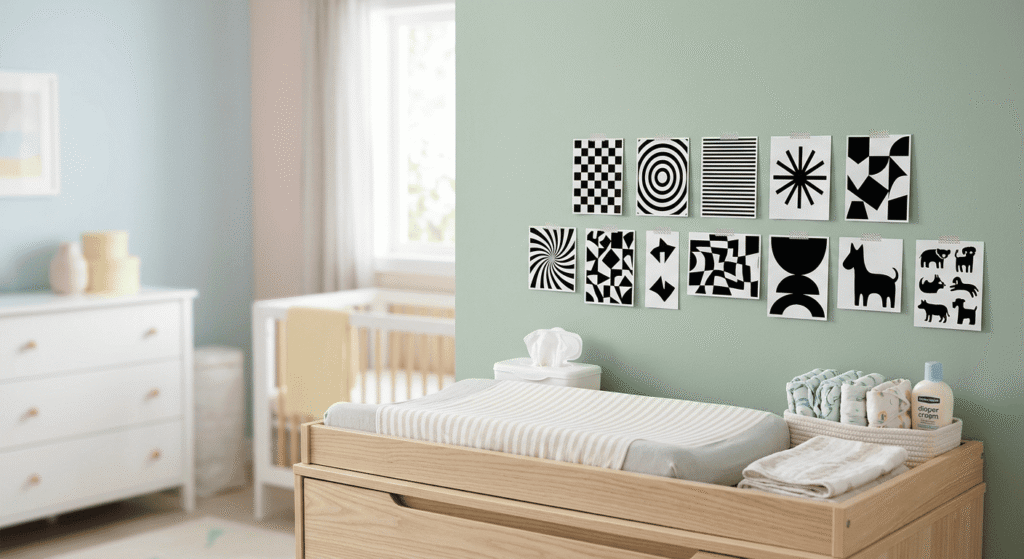
A high-contrast image can sometimes provide something interesting for a baby to look at during a diaper change.
If you display cards near a changing area, make sure they are securely mounted and completely out of your baby’s reach. Loose cards, tape or small objects should never be left where a baby could grab or swallow them.
What to Look for When Choosing Black and White Flashcards
You don’t need an expensive set to give your baby interesting visual patterns.
When shopping for high-contrast flashcards for newborns, consider these features.
1. Strong Contrast
Look for clear black-and-white patterns with easily distinguishable shapes.
Simple stripes, circles, geometric designs and bold outlines can work well.
2. Age-Appropriate Designs
Newborns don’t need complicated illustrations.
Simple shapes are often easier to visually distinguish than a crowded picture containing many small details.
As your baby’s vision develops, you can gradually introduce more varied patterns and colors.
3. Safe Materials
Look for products that are designed specifically for babies and follow the manufacturer’s age recommendations.
Avoid damaged cards with peeling surfaces, loose pieces or sharp edges.
4. Easy-to-Clean Surfaces
Baby products can get messy quickly.
A durable card or board-book-style format may be more practical than something that tears easily.
5. Appropriate Size
A card should be large enough for your baby to see comfortably without needing to be placed extremely close to their face.
A Black-and-White Flashcard Set to Consider
If you’re looking for a commercially available option, you can compare the features of different sets rather than choosing a product simply because it claims to “boost brain development.”
For example, this beiens High Contrast Baby Flashcards set is marketed for young babies:
beiens High Contrast Baby Flashcards
When evaluating a product like this, check the current Amazon listing for its recommended age, number of cards, materials, dimensions and safety information before purchasing.
When Should Babies Move Beyond Black and White?
Black-and-white cards don’t need to disappear once your baby starts seeing more clearly.
Visual development continues quickly during the first several months.
The AAP notes that by around 4 months, babies are better at seeing colors and different shades, and they may show interest in patterns such as circles and spirals.
Research also shows that color vision improves substantially during the first three months.
That means you can gradually introduce:
- Black-and-white patterns
- Black, white and red combinations
- Bold primary colors
- Simple animal shapes
- Larger colorful pictures
- More detailed patterns
There’s no need to suddenly replace every black-and-white card.
Instead, think of it as a gradual expansion of the visual world your baby can explore.
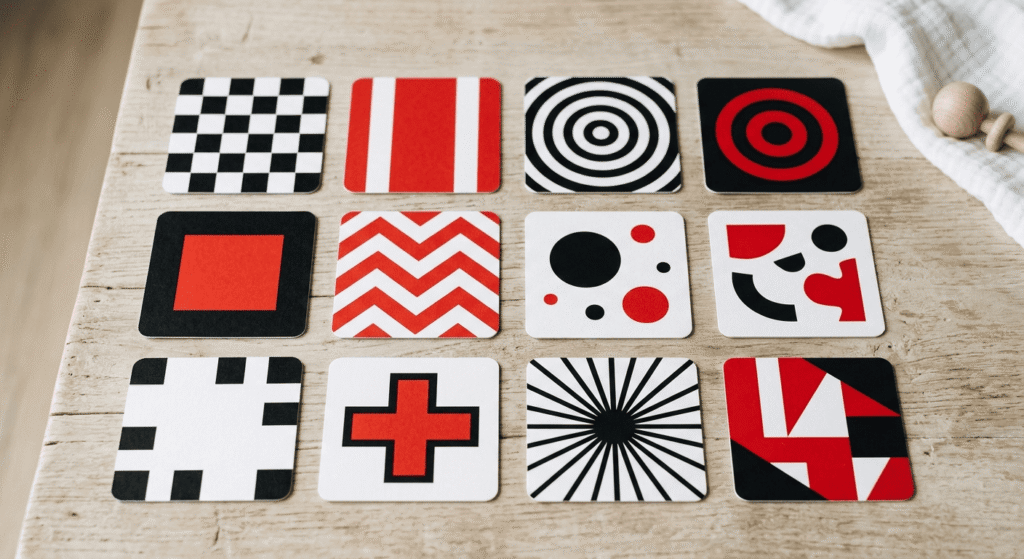
A Contrast Flashcard Set That Grows With Your Baby
If you prefer a set that includes different stages rather than buying separate packs, you may also come across products such as:
hahaland Contrast Flash Cards for Infants
The product is marketed as an 80-piece set covering multiple developmental stages, including high-contrast patterns for younger babies and more colorful designs for older children.
Because product specifications and availability can change, check the current Amazon listing for the latest age range, contents and safety information before purchasing.
What Parents Should Realistically Expect
This is perhaps the most important part of using baby flashcards.
A black-and-white card is a visual play tool, not a developmental shortcut.
You shouldn’t expect flashcards to:
- Increase your baby’s intelligence
- Make your baby learn faster
- Strengthen the optic nerve
- Guarantee better cognitive development
- Replace interaction with parents
- Replace tummy time or other normal infant activities
Instead, use them as one small part of a larger environment filled with faces, voices, movement, touch and age-appropriate play.
Your baby doesn’t need an expensive collection of developmental products.
Sometimes a few minutes of looking at a simple pattern while you talk, smile and interact with them is enough.
When to Talk to Your Pediatrician About Vision
Every baby develops at a slightly different pace, but parents should pay attention to important visual milestones.
According to the AAP, by around 3 months, babies should generally be able to follow a moving object with their eyes. If your baby cannot make steady eye contact by this age or seems unable to see, you should discuss it with their pediatrician.
Regular pediatric visits are also important because vision problems are easier to address when identified early.
Flashcards should never be used as a way to diagnose or treat a vision problem.
Final Thoughts: A Simple Way to Explore the Visual World
Black-and-white flashcards are popular for a good reason: young babies tend to notice high-contrast patterns, and these simple cards can give them something interesting to look at during supervised awake time.
But you don’t need to think of them as a tool that magically boosts brain development.
Your newborn’s vision is already changing rapidly during the first months of life. A simple high-contrast card can simply give them another interesting part of the world to explore.
Hold it nearby. Let your baby look at it. Talk to them. Smile back when they look at you. Follow their cues and stop when they’ve had enough.
The most valuable part isn’t the flashcard itself.
It’s the interaction between you and your baby.
Frequently Asked Questions
Are black-and-white flashcards good for newborns?
They can be a simple visual-play option for newborns. Young infants may show interest in black-and-white and other sharply contrasting patterns.
How far should I hold a flashcard from a newborn?
Newborns generally see best at about 8–12 inches (20–30 cm) away.
Do black-and-white cards make babies smarter?
There isn’t good evidence that flashcards make babies smarter or directly increase intelligence. They can provide an interesting visual target while a baby’s vision is developing.
When do babies start seeing colors?
Color vision develops rapidly during the early months. The AAP notes that by around 4 months, babies are better at seeing colors and different shades.
How long should a newborn look at flashcards?
There is no need to aim for a particular number of seconds or minutes. Follow your baby’s cues. If they look away, become tired or fussy, give them a break.
Can I leave flashcards in my baby’s crib?
No. Keep loose cards, toys and other objects out of the baby’s sleep space. Use flashcards during supervised awake time instead.
Sources
- American Academy of Pediatrics — Infant Vision Development: What Can Babies See?
- American Academy of Pediatrics — How Your Newborn Behaves
- American Academy of Pediatrics — Developmental Milestones at 1 Month
- American Academy of Pediatrics — Warning Signs of Vision Problems in Infants & Children
- NIH/PubMed — research on infant contrast sensitivity and visual development
- Research review — How Infants Learn About the Visual World
“While fine motor skills can be developed at the dinner table, you might be looking for tools that teach more broadly. Check out our selection of the [Best Educational Toys for 1-Year-Olds] to foster deeper learning.”
“Choosing the right toy for the high chair involves prioritizing safety and ease of cleaning. Explore our article on [Wooden Toys vs. Plastic Toys] to discover which material is best suited for your mealtime routine.”