
A science kit can give children a practical way to investigate questions that might otherwise remain abstract. A simple microscope, a circuit board or a crystal-growing activity each offers a different kind of exploration. The right choice depends on the child’s age, interests, the adult support available and the kit’s instructions—not simply the number of experiments in the box.
Table of Contents
“Disclaimer: This post contains affiliate links. As an Amazon Associate, I earn from qualifying purchases at no extra cost to you.”

Why STEM Experiment Kits Matter for Growing Minds
Watching a child’s eyes light up during a simple chemical reaction reminds us how magical learning can be. Hands-on exploration encourages children to ask big questions, test their ideas, and think critically about how the world functions. When children assemble circuits or watch crystals form, they build foundational cognitive skills that extend far beyond science class.
The National Association for the Education of Young Children (NAEYC) encourages families to explore science through everyday observations, questions and simple investigations. A kit can provide materials and a starting point, while an adult helps the child notice what changes and talk through the results.
A shared activity can also create time for conversation. Ask what the child thinks might happen, let them observe the result and discuss why it may have happened. The aim is not to produce a perfect result; it is to make room for questions and careful observation.
How to Choose a Home Science Kit
Not all experiment sets suit every age group or skill level. Matching the kit to your child’s current development stage ensures they stay motivated without feeling overwhelmed.
1. Match Age and Skill Level
Choose a kit using the age range printed by its manufacturer, then read the instructions before buying. Some kits contain small parts, powders, liquids, glass slides or tools that are unsuitable for younger children. An age label is a starting point, not a substitute for an adult checking whether the activity fits the child.
2. Prioritize Safety and Clear Instructions
Read the full warning label and materials list rather than relying on broad phrases such as “non-toxic” or “child-safe.” Check whether adult supervision, protective equipment or special storage is required. The U.S. Consumer Product Safety Commission explains that science kits intended primarily for children are subject to children’s product safety requirements; see its children’s products guidance. Children should not handle chemicals, heat sources, sharp tools or glassware without close adult supervision.
3. Focus on Repeatable Experiments
Check how many activities can actually be completed with the included materials. Some experiments use up powders, solutions or other consumables, while reusable equipment may support several investigations. Look for refill availability and whether common household materials are genuinely required.
To explore top-rated starter chemistry and physics sets, check out the current selection of the science kits on Amazon.
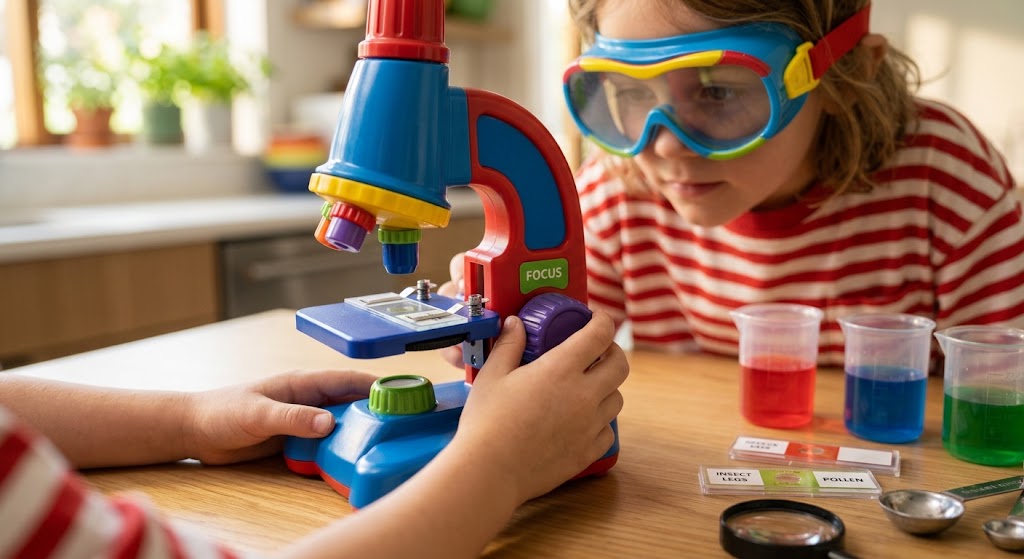
Top 7 Home Science Kits for Hands-On Learning
The table below compares broad kit categories rather than ranking specific brands. The age ranges are indicative only; always follow the age guidance and warnings on the exact product you are considering:
| Science Kit Category | Primary Learning Focus | Recommended Age Range | Best Feature |
| Erupting Volcano Kits | Earth Science & Geology | Often aimed at school-age children; check the product label | Dynamic chemical reaction visual |
| Beginner Microscope Sets | Biology & Microscopy | Often aimed at older children; check the product label | Pre-prepared slides & blank slides |
| Circuit & Electronics Boxes | Physics & Engineering | Often aimed at school-age children; check the product label | Snap-together safe electronic components |
| Crystal Growing Laboratories | Mineralogy & Chemistry | Often aimed at older children; check the product label | Colorful crystal formations in days |
| Sensory Slime & Polymer Labs | Chemical Reactions | Varies by ingredients and instructions; check the product label | Tactile, mess-friendly sensory play |
| Solar Power Robot Builds | Renewable Energy & Coding | Often aimed at older children; check the product label | Solar-panel powered motorized builds |
| Gross Science & Anatomy Sets | Human Body Biology | Varies by model and small parts; check the product label | Humorous, hands-on organ models |
If your child enjoys hands-on chemistry and colorful reactions, take a look at the popular choices for the science kits chemistry labs on Amazon.

Detailed Breakdown of Top STEM Toys
1. Earth Science Volcano Eruption Sets
Volcano kits remain a classic choice for good reason. Children love sculpting their own landforms and triggering safe fizzing eruptions using simple acid-base reactions.
2. Beginner Optical Microscopes
Opening up the microscopic world changes how kids view everyday objects. Looking at onion skins, fabric fibers, or pond water slides sparks endless questions about biology. The science kits featuring optical lenses include sturdy focus knobs tailored for small hands.
3. Snap-Together Electronic Circuit Kits
Electronics kits teach the basics of currents, switches, and sound modules without any soldering. Kids quickly learn how everyday appliances function by building working alarm systems or mini fans. Finding the science kits focused on circuitry builds spatial awareness and logical processing skills.
4. Fast-Growing Crystal Laboratories
Patience pays off when kids watch tiny crystals transform into colorful gemstones over several days. This process teaches environmental factors like temperature and evaporation while producing impressive display pieces.
To discover electronics and snap-circuit options, view the top-rated choices for the science kits electronics sets on Amazon.
5. Polymer Slime and Squishy Chemistry
Sensory play combined with basic polymer chemistry creates an ideal entry point for younger children. Mixing liquids to form bouncy gels illustrates how molecules bond together in an entertaining, hands-on fashion.
6. Solar-Powered Motorized Robots
For young engineers, building a working solar robot provides a rewarding challenge. These sets introduce clean energy concepts while sharpening fine motor skills through intricate mechanical assembly.
7. Human Body Anatomy & Gross Science
Anatomy kits featuring removable organs or humorous experiments demystify biology. Children gain a clearer understanding of how their own digestive and respiratory systems work through tactile model building.
For ideas that do not require a packaged kit, NAEYC’s guide to nurturing a child’s curiosity suggests making observations, asking questions and trying simple investigations together. These everyday activities can complement a purchased science set.
Browse complete sensory and geology collections by searching for the science kits crystal sets on Amazon.

Tips for Setting Up an At-Home Science Station
A home science activity does not need a dedicated laboratory. Prepare a stable, easy-to-clean surface and keep the kit’s instructions nearby. Before starting, check the activity’s specific precautions and gather only the supplies it requires:
- Designate a Mess-Friendly Zone: Use a kitchen counter or plastic tablecloth to catch spills during liquid mixing.
- Use only listed materials: Do not substitute household chemicals or mix cleaning products. Follow the kit instructions exactly.
- Encourage a Science Journal: Give your child a dedicated notebook to draw observations, write down hypotheses, and record results.
- Use protective equipment when specified: If the instructions require goggles, gloves or other protection, use the correct equipment. Keep food and drinks away from the work area.
Using the science kits consistently encourages children to step up as independent thinkers who welcome new challenges.

Nurturing Lifelong Curiosity Through Play
A well-chosen science kit can turn a child’s question into an activity they can observe, discuss and revisit. Compare the actual materials, age guidance, instructions and number of usable activities before choosing one. A simple investigation with an interested adult can be just as worthwhile as an elaborate boxed set.
“To spark early curiosity in science and math through play, read our recommendations on [Early STEM Toys for Toddlers: Fun Introduction to Science and Math].”
Questions and Answers
What age is suitable for a home science kit?
It depends on the individual kit. Follow the manufacturer’s age recommendation and consider whether the steps and materials suit the child’s abilities.
Should children use science kits alone?
No. An adult should supervise, especially when a kit includes liquids, heat, small components, tools, or chemicals.
What makes a good beginner science kit?
Look for clear instructions, repeatable activities, age-appropriate materials, and experiments that explain what children can observe.
Can simple household activities teach science?
Yes. With adult guidance, activities such as observing melting ice, sorting natural objects, or growing a plant can introduce scientific questions.
Related reading: Read our related guide