
Disclosure: As an Amazon Associate, I earn from qualifying purchases at no extra cost to you.
You have a little stack of black-and-white cards sitting on the table, and your baby is lying nearby, looking around the room. You pick up one of the cards and hold it out.
For a moment, your baby looks at it.
Then they look at you.
Then they decide the ceiling is much more interesting.
If that sounds familiar, don’t worry. Using visual flashcards with a baby does not have to feel like a lesson or a carefully planned activity. At this age, a few quiet minutes of looking, talking, and being together can be enough.
The key is to follow your baby’s pace rather than trying to make them look at a card for a certain amount of time.
Table of Contents
Start With a Comfortable Play Space
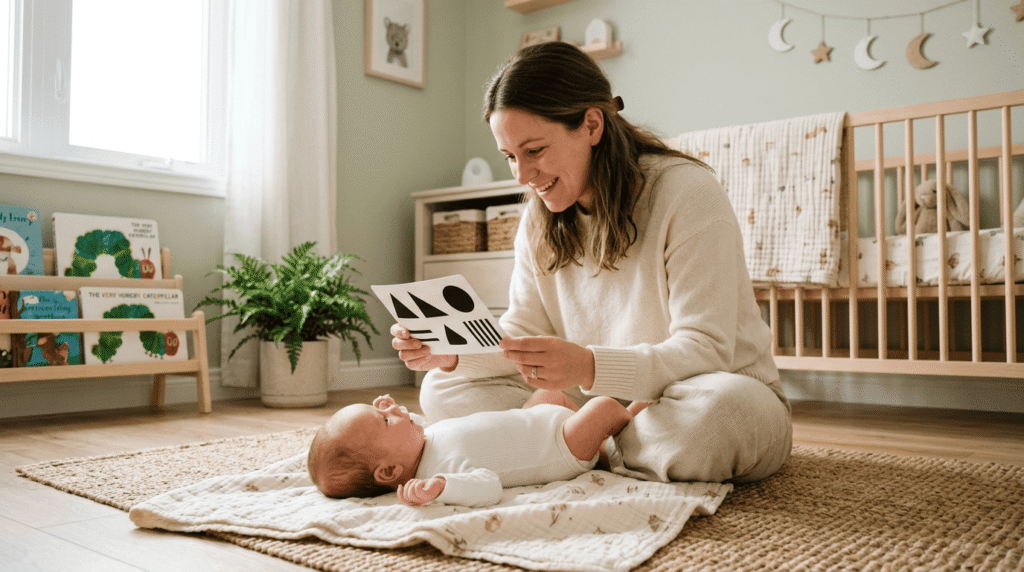
You don’t need a special setup for flashcard play. A clean play mat, a comfortable floor space, or even your lap can work well.
Choose a time when your baby is awake and reasonably settled. If your little one is hungry, very sleepy, or already fussy, there is no need to push through the activity. There will always be another opportunity later.
For a newborn, your face may still be the most interesting thing in the room. That is perfectly fine. You can hold a card nearby, let your baby look at it, and then return your attention to them.
Show One Card at a Time
When you have a whole set of beautiful cards, it can be tempting to show several at once. But you don’t need to.
Try choosing one card and giving your baby a chance to look at it. Hold it comfortably in front of them and wait. Sometimes they will look straight at it. Other times, their eyes may wander before returning to the picture.
There is no need to keep changing cards just to keep the activity moving.
A quiet pause can be part of the activity too.
Keep the Card Within Your Baby’s Comfortable Viewing Range
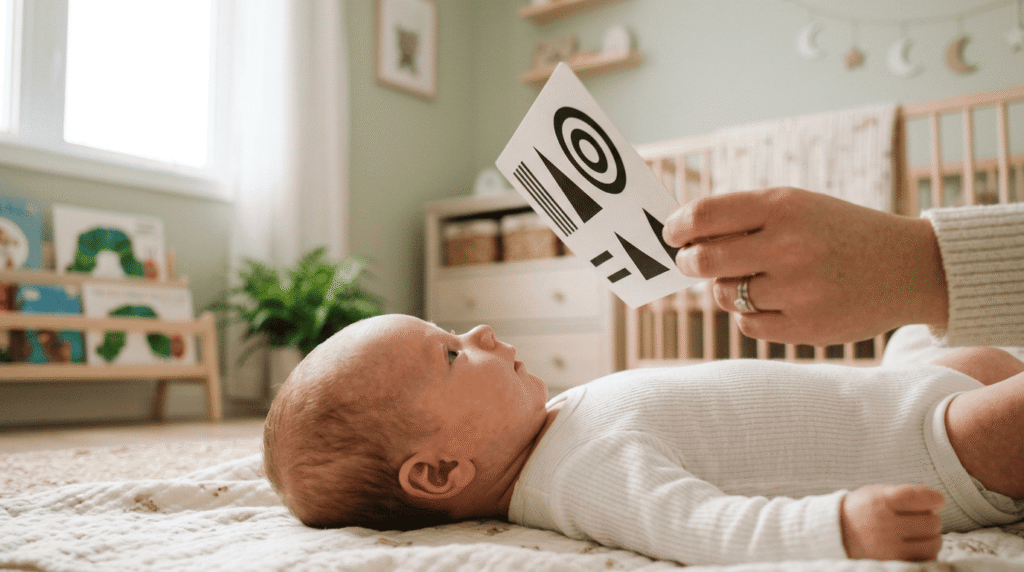
Newborns see best at close range. The American Academy of Pediatrics notes that babies can see objects most clearly at about 8 to 12 inches (20 to 30 cm), roughly the distance between a baby’s face and a parent’s face during feeding.
That makes this a useful starting point when showing a visual card.
You don’t have to measure the distance with a ruler. Just keep the card reasonably close and watch how your baby responds.
If your baby is looking comfortably at the card, give them a moment. If they seem uninterested, simply move on or try again another time.
Turn Flashcard Time Into a Conversation
This is one of the easiest ways to make flashcard play feel less like an exercise.
You can talk about whatever is on the card.
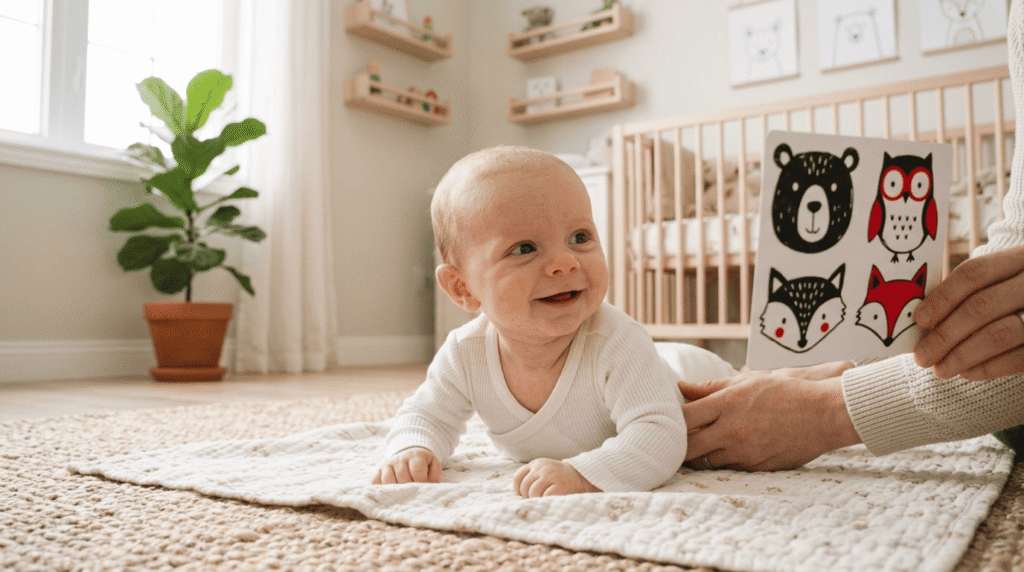
If it shows a simple animal, you might say:
“Look, it’s a little cat.”
If it is a circle:
“Can you see the big circle?”
Your baby won’t be able to answer you, of course. But they can listen to your voice, watch your face, and take part in a simple back-and-forth interaction.
The card doesn’t have to do all the work. You are part of the activity.
The American Academy of Pediatrics also emphasizes the importance of parents playing and interacting with infants as part of early learning.
Let Your Baby Decide How Long to Look
One of the easiest mistakes to make is assuming that a baby should look at a card for a particular amount of time.
Instead, watch what your baby is doing.
If they are looking at the card, give them time.
If they look away, pause.
If they turn back, you can continue.
And if they have clearly moved on, let the activity finish.
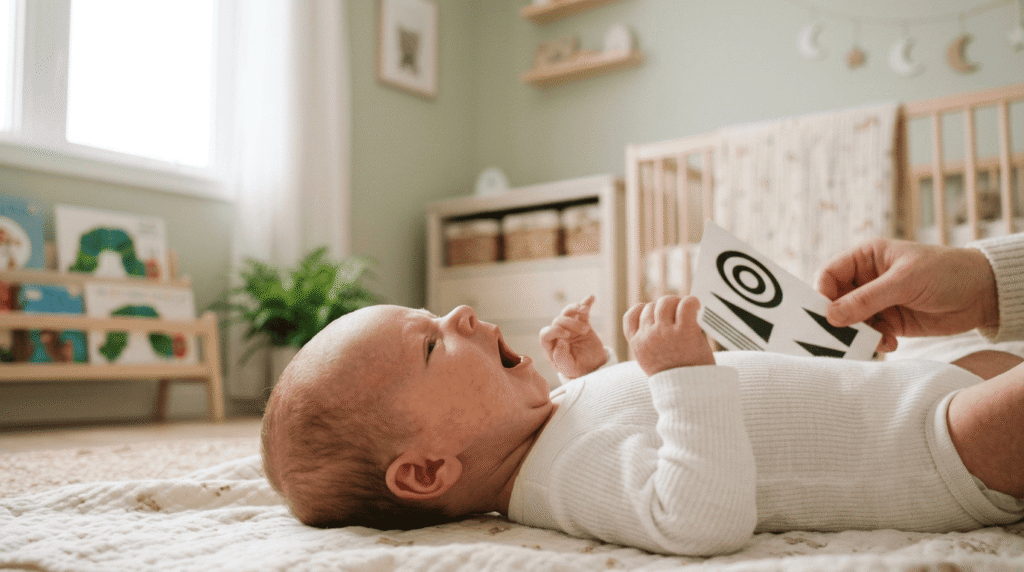
A baby turning their head away isn’t necessarily a sign that something went wrong. Sometimes they are simply ready to look at something else.
Try Moving the Card Slowly
Once your baby is comfortably looking at the card, you can try moving it very slowly from one side to the other.
Don’t make big or sudden movements. Give your baby enough time to notice the card before moving it again.
By around 3 months, babies are generally expected to be able to follow a moving object with their eyes.
At younger ages, you may see only a small amount of following. Your baby might look toward the card, lose it, and then find it again. That’s okay.
Think of this as a simple way to share something interesting with your baby rather than an eye-training exercise.

Make Room for Your Baby’s Favorite Cards
You may have a favorite card in the set, but your baby may have a completely different opinion.
Perhaps they keep looking at a simple pattern. Maybe they seem interested in an animal shape. Or perhaps they ignore the cards altogether one day and seem fascinated by them the next.
You don’t have to use the entire set every time.
Keep a few cards nearby and rotate them naturally. This keeps the activity simple for you and gives your baby something familiar to look at without turning playtime into a routine they have to complete.
Use Flashcards as Part of Everyday Moments
Flashcard play doesn’t need its own place on the daily schedule.
You might use a card:
- while your baby is lying comfortably on a play mat
- during a quiet morning play session
- after changing your baby’s diaper
- while sitting together and talking
- for a few minutes before moving on to another activity
The goal is not to fit in a certain number of cards.
It is simply to find small moments when your baby is awake, comfortable, and interested.
Know When It’s Time to Put the Cards Away
Babies are usually quite good at showing us when they have had enough.
Your baby may look away, become fussy, stop paying attention, or simply become more interested in something else.
When that happens, put the cards away.
You don’t need to persuade your baby to keep looking. A cuddle, a smile, or a change of activity may be exactly what they need.
And if your baby isn’t interested in flashcards at all that day, that’s okay too.
A Simple Flashcard Routine for New Parents
If you like having a loose routine, keep it very simple.
Choose one card.
Hold it where your baby can comfortably see it.
Pause.
Give your baby time to notice the picture.
Talk.
Describe what you see in a calm, natural voice.
Move slowly.
If your baby is interested, move the card gently from side to side.
Follow their cues.
If they look away or become unsettled, finish the activity.
That’s really all you need.
There is no test at the end, and your baby doesn’t need to “complete” the activity.
Flashcards Are Only One Way to Play
Visual cards can be a simple addition to playtime, but they don’t need to become the main event.
Your baby’s face, your voice, a cuddle, a song, a soft toy, and everyday interaction all give your baby things to notice and respond to.
If you’re looking for more ideas for engaging a young baby, you can also read our guide to sensory play for 3-month-olds.
That guide covers a wider range of sensory activities, while this article focuses specifically on making visual flashcard time simple and comfortable.
Final Thoughts
Learning how to use visual flashcards doesn’t have to mean following a strict routine.
Choose a card. Sit close. Talk to your baby. Give them time to look. If they want to look away, let them.
Some days your baby may stare at a card for a few moments. Other days they may be much more interested in your face.
Both are perfectly normal parts of early play.
The most important thing is not how many cards you show or how long your baby looks at them. It is the little moment you spend together while exploring something new.
A Note for Parents
Every baby develops at their own pace. If you have concerns about your baby’s vision, eye movements, or ability to see and track objects, speak with your pediatrician. The American Academy of Pediatrics recommends discussing developmental or vision concerns with your child’s doctor.
Frequently Asked Questions
How far should I hold a visual flashcard from my newborn?
Newborns generally see best at about 8 to 12 inches (20 to 30 cm). You can use this as a comfortable starting distance when showing a card.
How long should I use visual flashcards with my baby?
There is no need to follow a strict number of minutes. Keep the activity brief and follow your baby’s cues. If your baby looks away or becomes unsettled, take a break.
Should I move the flashcard while my baby is looking at it?
You can try moving it slowly from side to side once your baby has noticed it. The idea is simply to give your baby an opportunity to look toward a moving object, not to force them to follow it.
What if my newborn doesn’t seem interested in flashcards?
That’s completely fine. Babies have different interests and moods. Try again during another calm moment, or simply spend time talking and interacting with your baby.
Can I talk to my baby while showing flashcards?
Yes. Talking naturally about the picture can make the activity more interactive. Your baby can listen to your voice while looking at the card and your face.
When should I stop showing the cards?
Stop when your baby seems tired, fussy, or no longer interested. Looking away can be a simple sign that your baby wants a break.
Are black-and-white cards suitable for newborns?
High-contrast black-and-white patterns can be visually interesting to young infants. The AAP notes that young babies may show interest in black-and-white or sharply contrasting patterns.
When should I talk to a doctor about my baby’s vision?
If you are concerned that your baby cannot see, make steady eye contact, or follow moving objects at an age when those skills are expected, discuss your concerns with your pediatrician.
Sources
- American Academy of Pediatrics (HealthyChildren.org) – Infant Vision Development: What Can Babies See?
- American Academy of Pediatrics (HealthyChildren.org) – How Your Newborn Behaves
- American Academy of Pediatrics (HealthyChildren.org) – Warning Signs of Vision Problems in Infants & Children