

Between 6 and 12 months, babies become much more interested in the things around them. They reach for toys, grab them, turn them over, squeeze them, and—very often—put them straight into their mouths.
That makes this a fun stage for introducing toys with different textures, shapes, and surfaces.
Sensory balls and soft blocks can give your baby simple ways to explore with their hands and mouths while practicing everyday skills such as grasping, holding, transferring objects, and knocking things together.
They can also be useful during the teething stage, when babies naturally want something appropriate to chew.
The key is not to buy every sensory toy you see. Instead, look for toys that are easy for little hands to hold, made for your baby’s age, and free from loose or easily detachable parts.
Disclosure: This post contains affiliate links. As an Amazon Associate, I earn from qualifying purchases at no extra cost to you.
Table of Contents
Why Sensory Balls and Blocks Can Be Useful for 6–12 Month-Olds
Babies learn about objects by interacting with them.
At around 6 months, reaching for toys and putting objects in the mouth are normal parts of exploration. As babies get older, they become more interested in moving objects between their hands, banging objects together, and figuring out what happens when they drop or move something.
This is where simple sensory toys can be useful.
A textured ball feels different from a smooth block. A soft cube may be easier to squeeze, while an open ball can give little fingers several places to grip.
You don’t need complicated electronic toys to make play interesting. Sometimes a baby is perfectly happy sitting on the floor, holding one toy, turning it around, and discovering what it feels like.
And during teething, a toy that is designed for chewing can become a particularly useful addition to the play area.
A quick note about age
Every baby develops at their own pace. A toy that feels easy for one 7-month-old may still be difficult for another baby.
If your baby is younger and you’re just getting started with sensory activities, you may also enjoy our guide to:
Sensory Play for 3-Month-Olds: Safe and Simple Ideas for Early Exploration
What to Look for in Sensory Balls and Blocks
Before choosing a toy, take a minute to look beyond the colours and cute designs.
1. Age-appropriate design
Always check the manufacturer’s recommended age range.
Age recommendations are useful because they take into account both safety concerns and whether a child is likely to be able to use the toy appropriately.
2. Easy for little hands to hold
Look for balls with bumps, ridges, holes, or finger-friendly shapes.
For blocks, softer materials and manageable sizes can make them easier for babies to pick up and explore.
3. No loose or detachable parts
Avoid toys with parts that can easily come off.
This is especially important for babies who are at the stage of putting almost everything in their mouths. The AAP recommends avoiding small parts that can create choking hazards.
4. Easy to clean
Sensory toys can quickly become covered in drool, food, and whatever else happens to be on the floor.
A toy that can be cleaned easily is much more practical for everyday use.
5. Durable construction
Check the toy regularly for cracks, tears, loose pieces, or damage.
If a toy becomes damaged, replace it rather than continuing to use it.
The Best Sensory Balls for Texture and Grasping
Sensory balls come in many shapes and textures. You don’t need all of them. One or two well-designed balls may be enough to give your baby something new to explore.
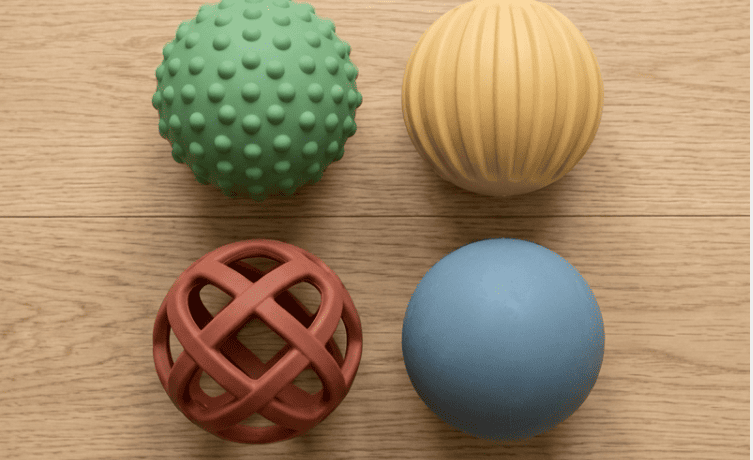
1. Nubby and Bumpy Sensory Balls
These balls have raised bumps or small rounded textures across the surface.
The uneven surface can make the ball interesting for little fingers to touch. It may also give babies several areas to grip instead of trying to hold a completely smooth ball.
For babies who like to mouth their toys, choose a ball specifically designed and labelled for their age and intended use.
Good for:
- Grasping and holding
- Exploring different textures
- Rolling and reaching
- Supervised mouthing
2. Ridged and Swirled Sensory Balls
Some sensory balls have grooves, ridges, or spiral patterns instead of small bumps.
These can give your baby another type of surface to feel. You can roll the ball slowly across the floor and let your baby reach for it, or simply place it nearby and let them investigate it at their own pace.
There is no need to turn every play session into an activity. Sometimes simply holding, turning, and chewing an age-appropriate toy is enough.
The American Academy of Pediatrics lists soft balls and textured toys among appropriate toy choices for babies in the 4–7 month stage.
3. Open-Design Sensory Balls
Open-design balls, sometimes called lattice or O-ball-style toys, have spaces that make them easier to grip.
Instead of wrapping the whole hand around a solid ball, a baby can place their fingers through the openings.
These can be especially interesting once your baby starts becoming more confident at reaching and grabbing.
They are also easy to roll across a play mat, giving your baby a reason to reach, turn, or move toward the toy.
Tip: Check the openings and construction carefully. The toy should be made for your baby’s age, and there should be no broken sections or pieces that can detach.
Soft Sensory Blocks for Exploring and Playing
Blocks become more interesting as babies start grabbing, banging, dropping, and experimenting with objects.
At around 9 months, for example, banging two things together and moving objects from one hand to the other are among the CDC’s listed milestones.
That doesn’t mean your baby needs to know how to build a tower yet.
At this stage, the fun is often in picking up a block, turning it around, squeezing it, banging it against another block, and eventually knocking it over.
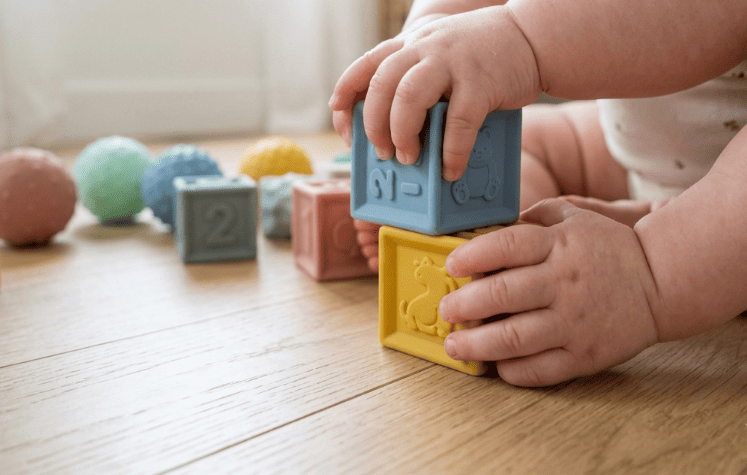
4. Embossed Soft Silicone Blocks
Soft silicone blocks can have raised numbers, shapes, letters, or simple textures on their sides.
For a young baby, the educational markings aren’t the main attraction. The different surfaces and easy-to-hold shape are what make the toy interesting.
Your baby may:
- Pick up a block
- Turn it around
- Squeeze it
- Chew on an appropriate teething surface
- Bang it against another block
- Drop it and watch where it goes
These small interactions are part of learning through everyday play.
5. Fabric Sensory Blocks With Crinkle Textures
Fabric sensory blocks offer a completely different experience from silicone toys.
They may include soft fabrics, ribbons, crinkle sections, different colours, or simple patterns.
A baby can squeeze the block, feel the different materials, and listen to the crinkle sound.
If you choose a fabric toy, pay particular attention to stitching, ribbons, tags, and any attached pieces. Everything should be securely made and appropriate for your baby’s age.

Good for:
- Touching different fabrics
- Squeezing and grasping
- Exploring sounds
- Two-handed play
Simple Ways to Play With Sensory Balls and Blocks
You don’t need a complicated activity plan.
A few simple games can turn these toys into part of your baby’s normal playtime.
1. Roll and Reach
Sit your baby on a safe play surface and slowly roll a sensory ball a short distance away.
Give your baby time to notice it and reach for it.
You can move the ball closer if they are struggling to reach it.
2. Talk About the Texture
While your baby is holding a toy, use simple words to describe it.
Try:
- “Bumpy.”
- “Soft.”
- “Smooth.”
- “Round.”
- “Rough.”
- “You found the blue ball.”
Your baby doesn’t need to repeat the words. Hearing you talk while they explore gives you a simple way to make ordinary play more interactive.
3. Let Them Explore a Block
Give your baby one soft block and let them investigate it.
They may squeeze it.
They may put it in their mouth.
They may bang it on the floor.
They may drop it and look at you.
All of these reactions are normal ways babies explore objects.
4. Knock the Blocks Down
Once your baby is showing interest in several blocks, place two or three soft blocks together.
Older babies may enjoy knocking them over.
You can say, “Down they go!”
Then build them again.
The point isn’t to teach your baby to build a perfect tower. It’s simply an easy way to make play interactive.
Teething: What Parents Should Keep in Mind
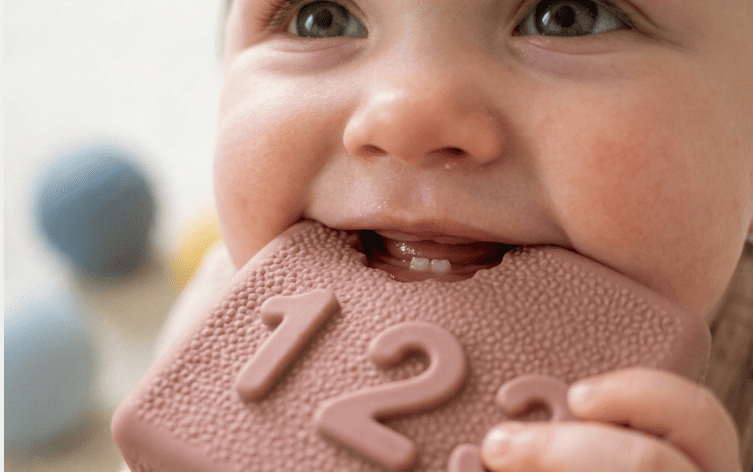
Teething often becomes part of everyday life during this stage, and many babies want to chew on objects.
A suitable teething toy can give them something specifically designed for chewing.
The FDA notes that a firm rubber teething ring can be used for teething discomfort and advises against frozen teething rings because they can become too hard.
The American Academy of Pediatrics also recommends avoiding liquid-filled teething toys that can leak if damaged.
So when choosing a sensory toy that your baby may chew, look for:
- A product clearly intended for babies
- The correct age recommendation
- A sturdy, intact construction
- No loose pieces
- No liquid-filled sections that can leak
- Easy-to-clean surfaces
And remember that a sensory ball is not automatically a teether just because a baby can chew it. Follow the manufacturer’s instructions for how the product is intended to be used.
Sensory Toy Safety Tips
Because babies at this age explore with their mouths, toy safety deserves extra attention.
Always check the age label
A toy may look simple, but the recommended age range still matters.
Check for small parts
Don’t give your baby a toy if pieces can break or pull away easily.
Inspect toys regularly
Look for cracks, tears, broken sections, loose stitching, or damaged silicone.
Supervise mouthing
If your baby is chewing a toy, stay nearby and watch them.
Keep toys clean
Follow the manufacturer’s cleaning instructions, especially for toys that are regularly mouthed.
Avoid teething necklaces
Teething necklaces and bracelets can create choking and strangulation hazards and are not recommended by the FDA or AAP.
Skip numbing gels for teething
The FDA warns against using benzocaine-containing products for teething in infants and young children.
If your baby seems unusually unwell or you are concerned about their symptoms, speak with your pediatrician rather than assuming everything is caused by teething.
Do You Really Need Sensory Balls and Blocks?
No.
Your baby does not need a collection of specialised sensory toys to develop normally.
Everyday safe objects and simple interaction can also provide opportunities to explore.
However, a few well-chosen sensory balls or soft blocks can be useful because they are specifically designed for little hands and can offer different textures, shapes, and ways to play.
The American Academy of Pediatrics recommends choosing toys that match a child’s developmental abilities and encourage new skills.
So instead of buying a large collection, start with one textured ball and one soft block. See what your baby actually enjoys.
You can always add another toy later.
Frequently Asked Questions
Are sensory balls safe for babies?
They can be appropriate when they are designed for the baby’s age and have no small or loose parts. Always check the manufacturer’s age recommendation and inspect the toy regularly for damage.
What age can babies use sensory balls?
There isn’t one universal age for every sensory ball. Some are designed for younger babies, while others are intended for older children. Check the specific product’s age recommendation before buying.
Can babies chew sensory balls?
Babies commonly explore objects with their mouths, especially around the teething stage. However, only allow chewing on toys that are designed and labelled for that type of use. A regular sensory ball should not automatically be treated as a teether.
Are silicone blocks good for teething?
Some silicone blocks are specifically designed to be used as teethers, while others are simply building or sensory toys. Check the product description and manufacturer’s instructions before allowing your baby to chew on one.
How do I clean sensory toys?
Cleaning instructions depend on the material and design. Follow the manufacturer’s instructions. For fabric toys, pay particular attention to washing and drying instructions, while silicone toys may have different cleaning recommendations.
Does my baby need lots of sensory toys?
Not at all. A small number of safe, age-appropriate toys can provide plenty of opportunities for exploration. Your interaction with your baby is just as important as the toy itself.
What should I avoid when buying sensory toys?
Avoid toys with loose small parts, damaged materials, accessible batteries or magnets, and products that aren’t appropriate for your baby’s age. The AAP recommends paying close attention to age labels and choking hazards when choosing toys.
Final Thoughts
Sensory balls and soft blocks don’t have to be complicated.
For a baby between 6 and 12 months, a simple textured ball can become a toy to squeeze, roll, hold, and explore. A soft block can be picked up, turned around, chewed, dropped, and eventually knocked over.
That’s part of what makes this stage so enjoyable.
Rather than looking for a toy that promises to make your baby smarter or speed up development, choose something safe, age-appropriate, easy to clean, and interesting for your little one to explore.
Sometimes the simplest toys are the ones that stay in the play basket the longest.
Sources
- CDC — 6-Month Developmental Milestones — reaching for toys and exploring objects with the mouth.
- CDC — 9-Month Developmental Milestones — transferring objects and banging objects together.
- HealthyChildren.org — Movement Milestones: Babies 4 to 7 Months — appropriate examples include soft balls and textured toys.
- HealthyChildren.org — How to Buy Safe Toys — age recommendations, choking hazards and toy safety.
- FDA — Safely Soothing Teething Pain in Infants and Children — teething-ring and teething-product safety.