
There is something surprisingly satisfying about watching a baby drop a ball into a wooden box and then wait for it to appear again.
This post contains Amazon affiliate links. As an Amazon Associate, I earn from qualifying purchases at no extra cost to you.
To an adult, the activity looks almost too simple to be called a toy. But for a baby who is beginning to understand that things can still exist when they are out of sight, that little disappearing-and-reappearing game can be genuinely interesting.
An object permanence box gives babies a simple way to explore that idea with their hands. It does not need lights, batteries, music, or a complicated set of instructions. The baby puts the ball in, watches it disappear, and then discovers where it has gone.
Around this age, many babies are becoming more interested in where objects go when they disappear. The CDC lists looking for an object after it has dropped out of sight as one of the cognitive milestones at 9 months. The American Academy of Pediatrics also describes object permanence as an important part of cognitive development between 8 and 12 months.

Table of Contents
What Is Object Permanence?
Object permanence is the understanding that an object continues to exist even when you cannot currently see it.
You can see the beginnings of this understanding during ordinary play.
For example, you place a toy beside your baby and then move it behind a cushion. A younger baby may simply lose interest because the toy has disappeared from view. As babies develop, they become more likely to look for the hidden object.
Peekaboo is a familiar example. A parent’s face disappears behind their hands and then comes back. The baby gradually learns that disappearing from view does not mean disappearing completely.
At around 8 months, this kind of searching can become much more noticeable. The exact timing is different for every child, so there is no need to treat eight months as a deadline.
What Does an Object Permanence Box Look Like?
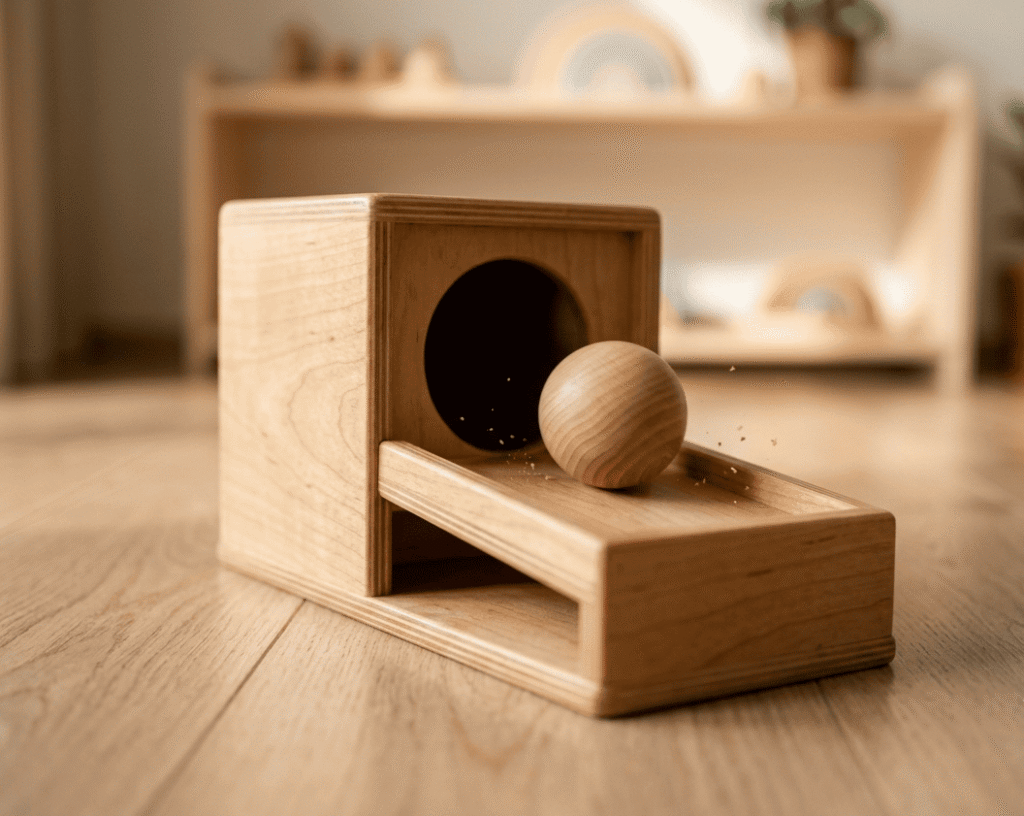
A traditional object permanence box is a small wooden box with an opening on top and a tray or ramp where the ball comes back out.
The activity is simple:
- The baby picks up the wooden ball.
- The ball is placed over the opening.
- The baby drops it inside.
- The ball disappears from view.
- It rolls out into the tray.
- The baby can pick it up and try again.
That short sequence gives the child something very concrete to investigate.
American Montessori Society lists the Object Permanence Box among Montessori learning materials for infants and toddlers and describes it as a material that helps young children explore hand-eye coordination and become familiar with the idea that objects continue to exist when they cannot be seen.
The Montessori Foundation’s infant curriculum also places object permanence box work within the 9–12 month period, alongside activities involving hand and finger control and eye-hand coordination.
Why Can This Activity Be Interesting at 8 Months?
Eight months is not a magic age for this toy.
Some babies may enjoy an object permanence activity earlier, while others may become interested closer to 9 or 10 months. What matters more than the number on the calendar is whether your baby is showing interest in reaching, grasping, dropping, and searching for objects.
The CDC’s 9-month milestones include looking for an object after it disappears from sight, moving objects from one hand to another, and sitting without support. These skills fit naturally with a simple ball-and-box activity.
Your baby does not need to complete the activity perfectly.
They may:
- drop the ball beside the box
- put the ball in their mouth
- knock the box over
- watch you do it without trying
- put the ball into the opening once and then lose interest
- repeat the same action many times
All of these responses can be normal parts of exploring a new object.
What Can a Baby Practise With an Object Permanence Box?
The box is designed around one simple idea, but the activity involves several small actions.
1. Reaching and Grasping
The baby has to reach for the ball and bring it toward their body.
Depending on their current abilities, they may use their whole hand at first and gradually become more precise with their fingers.
The goal isn’t to force a particular grip. Give your baby time to handle the object in the way that feels natural to them.
2. Releasing an Object on Purpose
Picking something up is only part of the activity.
The baby also has to let go of the ball over the opening. That makes the activity slightly different from simply holding or shaking a toy.
Repeated opportunities to pick up and release safe objects can give babies useful practice with voluntary hand movements.
3. Watching What Happens Next
The most interesting part may be the moment when the ball disappears.
The baby has just seen the ball in their hand. Then it is suddenly hidden inside the box.
A moment later, it appears in the tray.
That gives the child an easy-to-follow sequence: put it in → it disappears → it comes back.
4. Searching
Once the baby begins to understand the pattern, they may start looking toward the tray before the ball appears.
That searching behaviour is particularly relevant because looking for an object that has gone out of sight is part of the CDC’s 9-month cognitive milestone list.
5. Repetition
Babies often repeat an interesting action far more times than an adult expects.
The same ball can be dropped again and again.
Rather than thinking, “They already know how this works,” it can be useful to see repetition as part of how babies explore a predictable activity.
Montessori environments commonly allow infants to repeat an activity while they remain interested rather than constantly moving them from one activity to another.

How to Introduce an Object Permanence Box at Home
You don’t need a complicated lesson.
Choose a quiet area on the floor where your baby can sit comfortably and where the box cannot easily slide away.
Start by Showing the Action
Sit close to your baby and slowly place the ball into the opening.
You can say something simple such as:
“The ball went in.”
Then wait for it to appear in the tray.
You don’t need to explain object permanence to your baby. The activity itself gives them something to observe.
Give Your Baby a Turn
Place the ball where your baby can reach it.
If they pick it up, let them investigate.
If they drop it somewhere else, that’s okay.
If they don’t understand the opening immediately, demonstrate it again rather than moving their hand for them.
Let the Baby Repeat It
Once your baby discovers how the activity works, give them time.
You don’t need to add new challenges every few minutes. Sometimes the simple version is exactly what the baby wants to explore.
What If My Baby Doesn’t Understand the Box?
That’s completely fine.
An object permanence box is not a test.
Your baby may be more interested in chewing the ball, banging it against the floor, turning the box around, or reaching for something else nearby.
Try again another day.
You can also make the idea of disappearing and reappearing part of ordinary play. The AAP recommends simple games such as peekaboo to help babies explore object permanence during this stage.
The important thing is to follow your baby’s interest rather than trying to make the activity look perfect.
A Simple Progression as Your Baby Gets Older
Once the basic ball-drop activity becomes familiar, you can gradually offer activities that require a little more action from the child.
For example:
Ball into an open tray: The child drops the ball and watches it return.
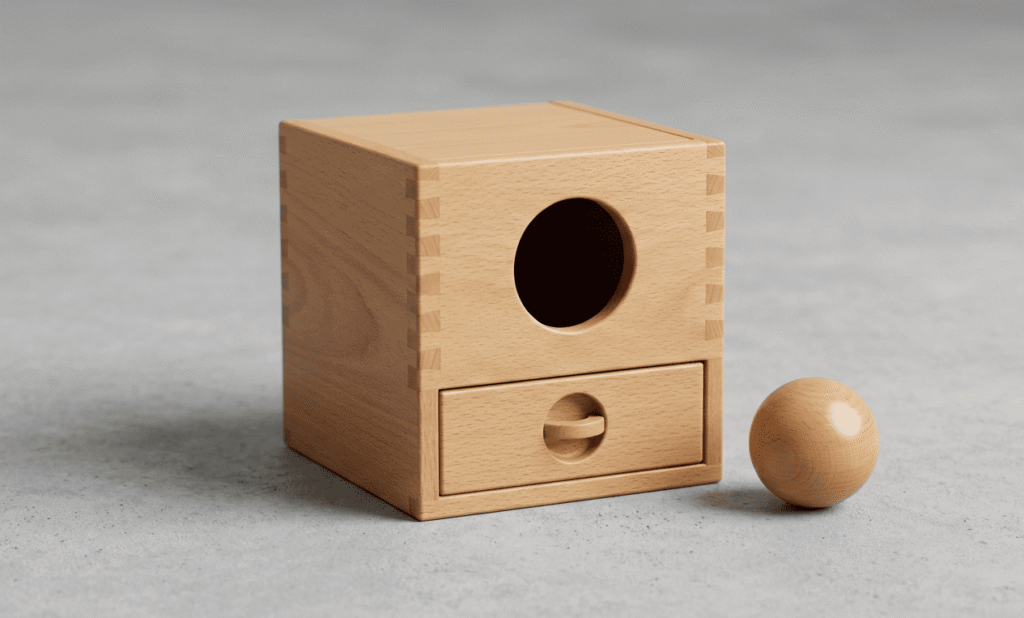
Ball into a box with a drawer: The child eventually has to discover how to open the drawer to retrieve the ball.
Posting activities: The child places a larger object through an appropriately sized opening.
Simple object hiding games: Hide a familiar toy partly under a cloth and let the baby search for it.
These activities don’t have to be introduced according to a strict timetable. Watch what your child can comfortably manage and introduce a new challenge when the current one becomes easy.
Object Permanence Box vs. Everyday Hide-and-Find Games
You don’t have to buy a Montessori box to help your baby explore object permanence.
Everyday activities can provide similar opportunities.
Try:
- hiding a toy partly under a cloth
- placing a toy inside a large, safe container
- rolling a ball behind a cushion and looking for it together
- playing peekaboo
- placing a toy just outside your baby’s immediate reach
The advantage of an object permanence box is that the activity is contained in one predictable sequence.
For parents who enjoy Montessori-style materials, that simplicity can make it an appealing addition to a small play area.
If you’re also looking for simple ways to encourage independent exploration, you may enjoy our guide to Best Musical Toys for 9-Month-Olds.
What Should You Look for When Buying One?
If you’re considering buying an object permanence box, look beyond the word “Montessori” on the product listing.
Check the Recommended Age
Age guidance varies between products. Choose one that is specifically intended for your baby’s developmental stage.
Look at the Construction
The box should feel sturdy, with smooth surfaces and no obvious loose pieces, sharp edges, or splinters.
Check the Ball Size
The included ball should be appropriate for the intended age range and securely made.
For babies, small loose parts and small balls can create serious choking hazards. Check the product’s age label and the CPSC’s small-parts guidance before buying. Do not use a ball that is small enough to fit through a choking-test cylinder, and keep any loose ball under an adult’s control during play.
Avoid Decorative Features That Add Unnecessary Risk
For this particular activity, you don’t need a box with lots of tiny accessories, detachable pieces, or complicated mechanisms.
A simple, well-made design is enough.
f you’re choosing toys for different types of hands-on exploration, you can also compare our guide to sensory balls and blocks for babies.

Object Permanence Box Safety Tips
Because the activity involves a loose ball, supervision matters.
Keep these points in mind:
- Always supervise your baby during play.
- Follow the manufacturer’s age recommendation.
- Check the ball and box regularly for damage.
- Use only the ball supplied for the specific product and only if it meets the manufacturer’s age and safety guidance. Do not substitute a smaller ball or another household object.
- Stop using the product if a part becomes loose or damaged.
- Keep the activity away from stairs and other hazards.
- When play ends, remove the ball and store it out of reach, especially if your baby is still mouthing objects or the ball is not suitable for unsupervised access.
The CPSC recommends choosing toys according to a child’s age, abilities and interests and checking toys regularly for damaged or missing parts.
You Don’t Need a Shelf Full of Montessori Toys
One of the nice things about this activity is that it doesn’t require a large collection of materials.
A baby can spend several minutes exploring one simple object while a parent sits nearby.
That can be easier to manage than constantly bringing out new toys.
And if your baby doesn’t enjoy the box, there is no reason to force it. Object permanence develops through many ordinary experiences, not through one particular toy.
Final Thoughts
An object permanence box is a small, simple activity that fits nicely with the changes many babies experience during the second half of their first year.
The appeal isn’t that the wooden box magically teaches a complex concept. Its value is that it gives a baby a clear physical experience: an object goes somewhere, disappears from view, and comes back.
At around this age, babies are increasingly interested in where things go and what happens when they can’t see them. The CDC and AAP both describe searching for hidden or out-of-sight objects as part of this stage of cognitive development.
If your baby enjoys dropping the ball again and again, let them. Sometimes a very simple activity gives a baby plenty to think about.
FAQ
Is an object permanence box suitable for an 8-month-old?
It can be, provided the particular product is designed for that age and your baby can safely interact with it. Eight months is not a strict starting age, and babies develop at different rates.
What does an object permanence box teach?
It gives babies an opportunity to explore object permanence, while also involving reaching, grasping, releasing, watching, and searching.
Does my baby need a Montessori object permanence box?
No. You can explore object permanence through peekaboo and simple hide-and-find games at home. The box simply provides a structured way to explore the idea.
How long should my baby play with it?
There is no required amount of time. Follow your baby’s interest. A few minutes of focused exploration is perfectly reasonable, and some babies may want to repeat the activity many times.
What if my 8-month-old is not interested?
Put it away and try again later. Babies have different interests and abilities, and one toy is not a measure of development.
Can I make a simple version at home?
You can create simple object-hiding activities using large, baby-safe objects and containers, but avoid homemade versions with loose small parts or objects that could become choking hazards. For an infant, a commercially made product with clear age guidance may be the easier option.