
The toddler years represent one of the most explosive periods of brain development in human life. Between 12 and 36 months, young minds transform from passive observers into active explorers. Every touch, drop, push, and stack is an experiment in physics, spatial awareness, and logic.
Among the vast ocean of modern toys, two classic categories continue to stand out for child developmental psychologists and early educators: shape sorters and stacking toys. Far from simple distraction tools, these fundamental playthings are cognitive powerhouses designed to build early problem-solving skills, hand-eye coordination, and emotional resilience.
In this comprehensive guide, we will explore the science behind these classic toys, highlight the top choices for growing toddlers, and share actionable strategies for parents to maximize play-based learning at home.
In This Article

Why Early Problem-Solving Skills Matter for Toddlers (And How Shape Sorters & Stacking Toys Help)
When we think about “problem-solving,” we often imagine adult scenarios like solving math equations or navigating career challenges. However, for a toddler, figuring out how to fit a triangular wooden block into a matching hole is the equivalent of solving a complex puzzle.
Early problem-solving skills lay the groundwork for executive function—the mental processes that enable us to plan, focus attention, remember instructions, and juggle multiple tasks. According to research published by the Harvard University Center on the Developing Child, supportive play experiences in early childhood directly shape the neural architecture responsible for lifelong learning and adaptability.
When toddlers engage with hands-on, manipulative toys, they practice several core cognitive steps:
- Trial and Error: Experimenting with different orientations until a piece fits.
- Hypothesis Testing: Predicting that a large ring won’t fit on top of a small ring.
- Spatial Processing: Mentally rotating shapes to understand angles and geometry.
- Emotional Regulation: Learning to manage small frustrations when a tower topples.
How Shape Sorters and Stacking Toys Build Cognitive and Motor Skills
Shape sorters are often a child’s first introduction to geometry, spatial reasoning, and categorization. The simple task of matching a shape to a cutout involves a surprisingly complex sequence of brain activations.
1. Spatial Awareness and Geometry Foundations
To solve a shape sorter, a toddler must analyze three-dimensional attributes: edges, curves, corners, and depth. They learn to differentiate between a square (four equal sides) and a circle (continuous curve). This visual-spatial discrimination is a foundational skill needed later in life for reading, writing, and mathematics.
2. Fine Motor Precision and Wrist Rotation
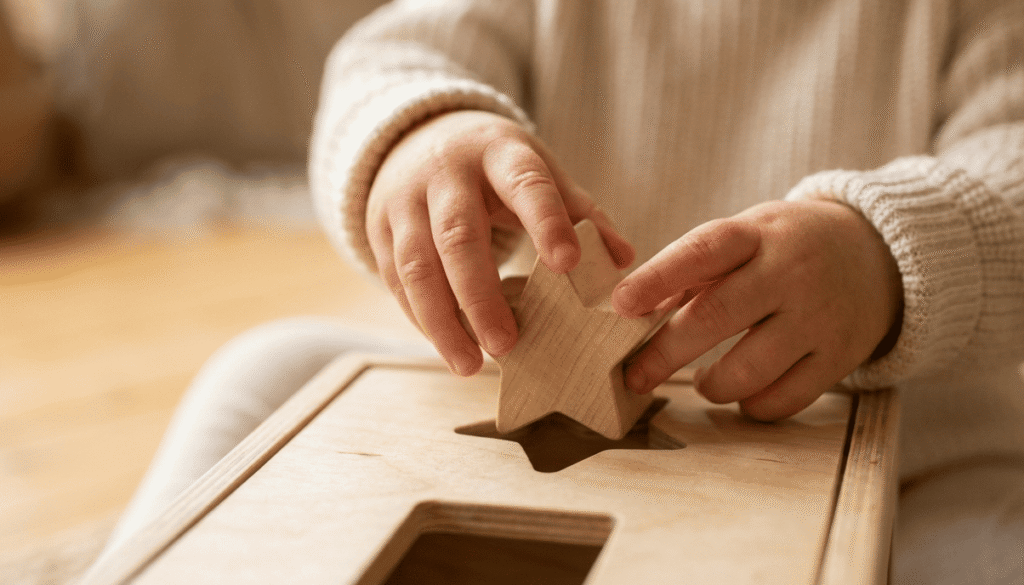
Manipulating a shape sorter block requires more than just pushing; it requires precise finger placement and wrist rotation (pronation and supination). Turning a star shape until its points align with the board strengthens the small muscles in the hands, preparing children for holding pencils and using utensils.
3. Cause-and-Effect Understanding
The immediate feedback of a shape sorter is deeply satisfying. When the correct shape is inserted, it drops inside with a rhythmic “clack.” This clear feedback teaches toddlers that their intentional actions produce predictable results.
The Science of Shape Sorters and Stacking Toys: From Balance to Logic
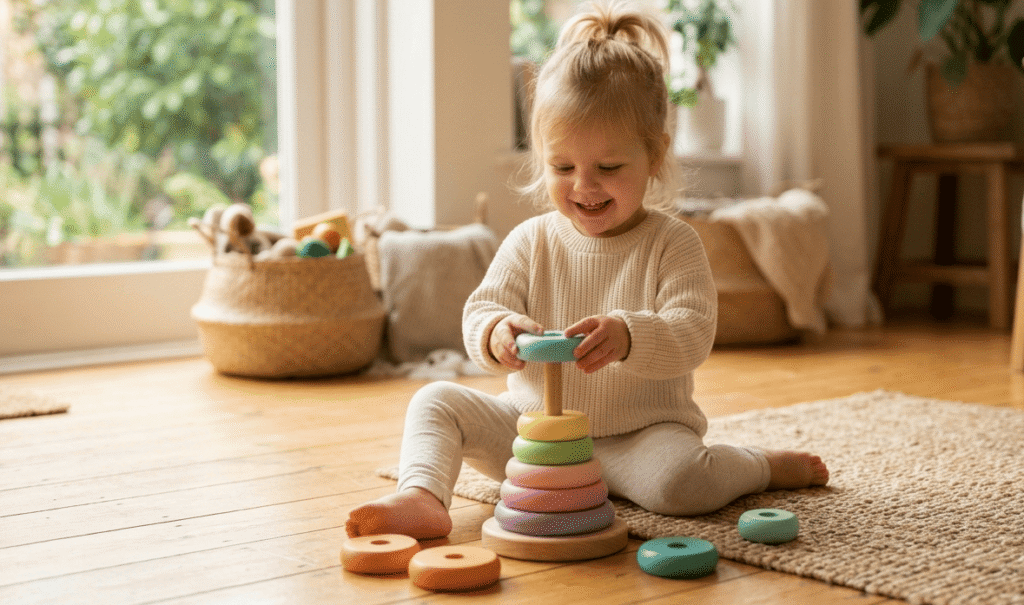
While shape sorters focus on spatial matching, stacking toys challenge a child’s understanding of balance, gravity, scale, and sequencing. Whether using classic stacking rings, nesting cups, or wooden blocks, toddlers must organize objects relative to one another.
Key Cognitive Milestones Developed Through Shape Sorters and Stacking Toys
- Size Grading: Identifying concepts like bigger, smaller, top, and bottom.
- Sequencing and Logic: Understanding that a foundation must be wide to support a narrow peak.
- Hand-Eye Coordination: Aligning a center hole with a vertical peg while keeping hand movements steady.
Guidance from the American Academy of Pediatrics (AAP) highlights that simple, non-electronic manipulative toys foster richer parent-child communication and deeper cognitive engagement than active digital screen toys.
Top 5 Shape Sorters & Stacking Toys for Toddlers
To help you curate the best play environment for your child, here are the top shape sorters and stacking toys recommended for different developmental stages:
+————————————+——————+————————————–+
| Toy Type | Ideal Age Range | Primary Developmental Focus |
+————————————+——————+————————————–+
| 1. Classic Wooden Shape Sorting Cube| 12 to 24 Months | Spatial Matching & Shape Recognition |
| 2. Rainbow Wooden Stacking Tower | 10 to 18 Months | Size Sequencing & Hand-Eye Control |
| 3. Nesting & Stacking Cups | 9 to 36 Months | Versatile Spatial & Bath/Sand Play |
| 4. Geometric 3D Board Sorter | 18 to 36 Months | Advanced Logic & Fine Motor Control |
| 5. Soft Silicone Stacking Blocks | 6 to 18 Months | Tactile Exploration & Safe Teething |
+————————————+——————+————————————–+
1. Classic Wooden Shape Sorting Cube
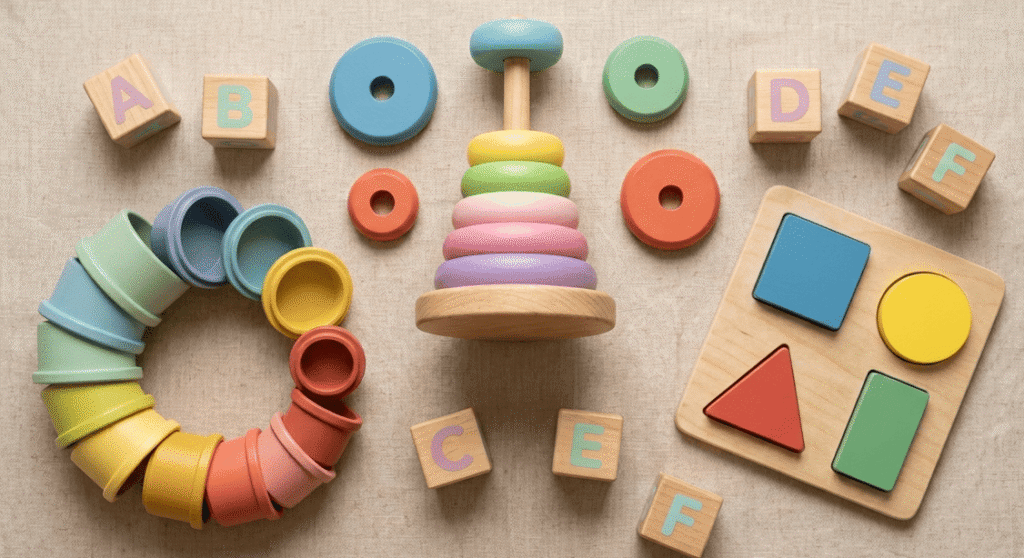
The ultimate timeless classic. Featuring solid wooden construction with primary shapes (circle, square, triangle, star), this toy introduces basic categorization without overwhelming visual distractions.
2. Rainbow Wooden Stacking Rings
A vertical peg holding smooth, graduated wooden rings. Toddlers learn to sort by size, building patience as they try to fit the largest ring at the base and the smallest on top.
3. Nesting and Stacking Cups
Extremely versatile and budget-friendly. These lightweight cups can be stacked upward into a tall tower or nested inward for compact storage, teaching children inverse spatial relationships.
4. Geometric 3D Board Sorter
Unlike enclosed cubes, flat geometric boards feature multiple pegs where children must align shapes with single, double, or triple holes. This introduces counting alongside shape sorting.
5. Soft Silicone Stacking Blocks
Designed for younger toddlers, soft food-grade silicone blocks offer rich sensory textures, squeaky engagement, and non-toxic safety for teething babies who are just starting their stacking journey.
Parent’s Guide: Encouraging Play with Shape Sorters and Stacking Toys
It is natural for parents to want to step in and fix a toy when they see their toddler struggling. However, intervening too quickly can rob children of the valuable “lightbulb moment” when they solve a problem on their own.
Here is how you can support your child’s problem-solving skills using scaffolding techniques:
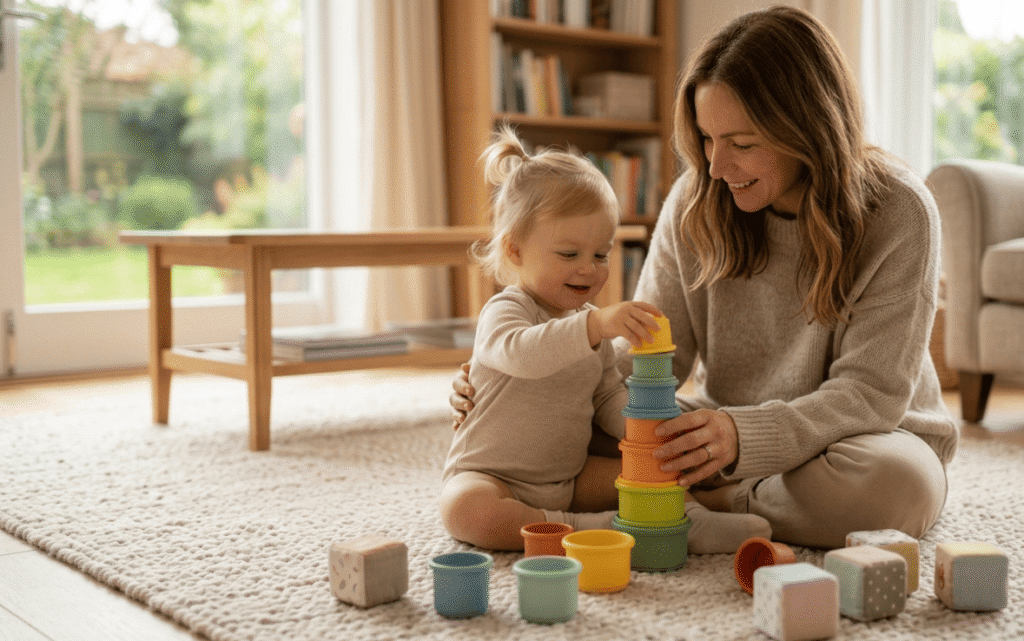
- Observe Before Acting: Pause for 10-15 seconds when your toddler gets stuck. Watch their thought process before offering help.
- Use Descriptive Language: Instead of saying “Put the blue one there,” try saying “Look, this block has three sharp corners. Where do you see three corners on the box?”
- Praise Effort, Not Outcome: Celebrate persistence! Say “You kept trying different sides until it went in!” rather than just “Good job.”
- Model Mistakes: Intentionally try putting a square block into a round hole and say “Hmm, that didn’t fit. Let me try another hole.” This normalizes trial-and-error.

Choosing the Right Toy: Safety, Material, and Age Appropriateness
When shopping for shape sorters and stacking toys for your toddler, keep these essential safety and quality guidelines in mind:
- Material Safety: Prioritize sustainably sourced hardwoods with non-toxic, water-based stains, or food-grade BPA-free silicone.
- Choking Hazard Prevention: Ensure all individual shapes and rings exceed 1.75 inches in diameter to prevent accidental swallowing.
- Weight and Edges: Choose pieces with smooth, rounded corners that won’t bruise delicate toes if a stacked tower falls over.
Final Thoughts: Building a Foundation for Lifelong Learning
Shape sorters and stacking toys may seem simple on the surface, but they represent the building blocks of early intellect. By encouraging trial-and-error, spatial reasoning, and fine motor precision, these classic toys empower toddlers to become confident, independent problem-solvers.
Investing in high-quality, open-ended manipulative play today gives your toddler the cognitive toolkit they need to navigate complex challenges tomorrow.
“While considering the material of your child’s toys, it’s also important to focus on their developmental stage. For insight into age-appropriate learning tools, read our guide on the [Best Educational Toys for 1-Year-Olds].”
“When selecting tools that teach, many parents prefer sustainable materials. Before you buy, read our in-depth comparison of [Wooden Toys vs. Plastic Toys] to make an informed choice for your little one.”