
When choosing educational toys, consider both material information and physical construction. Parents should be able to find the manufacturer’s details, age recommendation, care instructions and relevant safety information rather than relying on words such as “natural” or “non-toxic.”
This post contains affiliate links. As an Amazon Associate, I earn from qualifying purchases at no extra cost to you.
Young children may mouth toys, so it is sensible to check age guidance, recalls, product condition and the manufacturer’s safety information. Avoid assuming that a toy contains harmful chemicals simply because it is made from plastic or has a painted finish; compliance depends on the finished product and the rules that apply in its market.
In this comprehensive guide, we present an essential non-toxic checklist to help you evaluate toy safety, identify hidden hazardous chemicals, and select materials that promote healthy, worry-free learning.
In This Article
Why Toy Material Safety Matters
Young children may touch, handle, or mouth toys, so the age label, construction, and product-specific safety information matter. A material name or marketing phrase such as “natural” or “non-toxic” is not enough on its own to judge a toy. Check who made it, what age it is intended for, and whether the product has been recalled.
For toys sold in the United States, federal requirements include the mandatory toy-safety standard in 16 CFR part 1250, which incorporates ASTM F963, as well as rules for hazards such as small parts and certain chemical limits. See the CPSC toy-safety FAQ. Requirements differ in other markets.
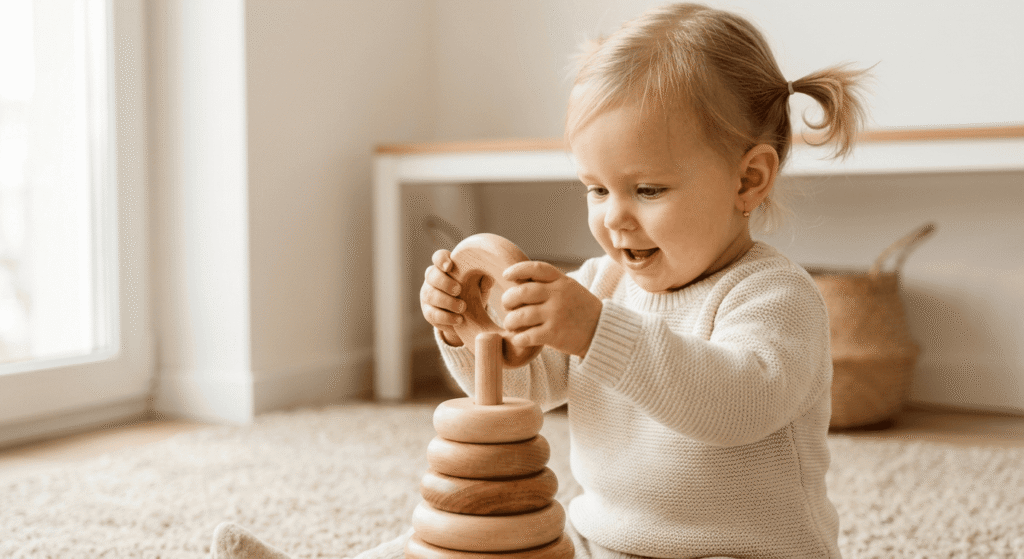
Common Hidden Toxins in Toys to Avoid
Some toy-safety concerns involve the chemicals used in materials, coatings or components. Rather than trying to identify risk from appearance alone, check product-specific information, applicable standards and recall notices:
- Lead in paint or accessible components: Regulatory limits apply to children’s products in markets such as the United States. Avoid toys with chipped or peeling paint and check for relevant safety information.
- Regulated phthalates: Some phthalates are restricted in children’s toys and child-care articles. A product’s compliance depends on its materials and applicable regulations.
- Small detachable parts: Loose pieces can create choking risks for young children, even when the base material itself is not a chemical concern.
- Unclear finishes or coatings: If the manufacturer does not identify the product or provide usable safety information, consider choosing a better-documented alternative.
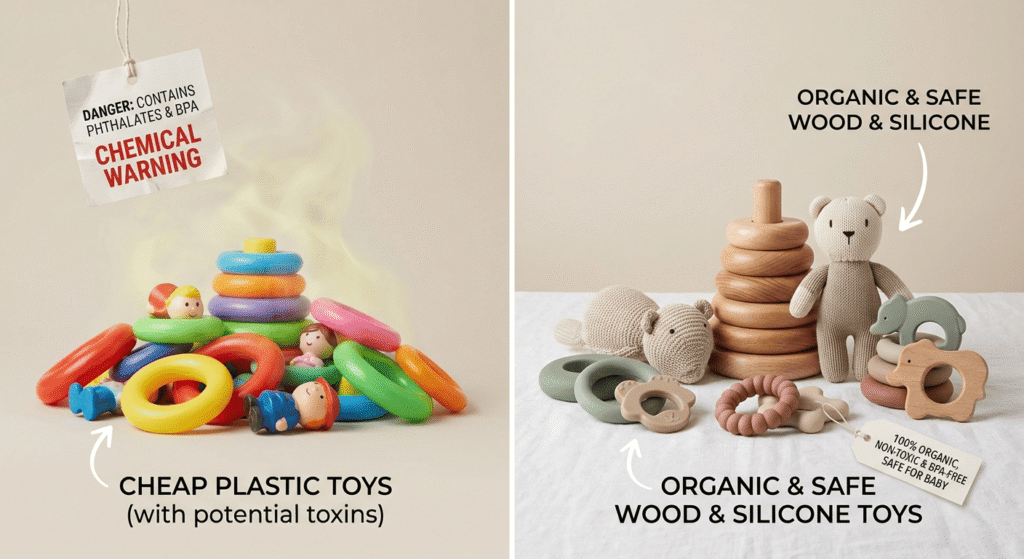
A Practical Checklist for Assessing Toy Materials
Use this practical checklist every time you shop for new learning tools or audit your child’s existing toy collection:
1. Opt for Unfinished or Natural Water-Based Finished Wood
Wood can be a durable choice, but safety depends on the finish, construction, and quality of the finished product. Look for smooth surfaces, securely attached parts, and clear manufacturer information about paints or coatings. Do not assume that an unfinished or “natural” item is automatically safe for mouthing.
2. Understand Plastic Identification Codes
Plastic resin codes identify the type of plastic used; they do not certify that a finished toy is safe or free from every chemical of concern. Do not use recycling numbers as a safety ranking. Instead, check the product’s age label, manufacturer details, applicable compliance information, and recall status.
3. Choose Food-Grade Silicone
Silicone products vary, and “food-grade” wording alone does not show that an item is designed as a toy or teether. Choose products specifically made for the intended use and age group, follow the care instructions, and stop using them if they tear or become damaged.
4. Look for Organic, Unbleached Textiles
For fabric toys, check seams, labels, washing instructions, and whether small decorations can detach. Textile certifications can provide information about how materials were assessed, but they do not replace toy-safety testing or age guidance.
5. Inspect Structural Quality and Edge Smoothness
Safety is physical as well as chemical. Inspect toys for sharp edges, loose small parts (choking hazards), weak seams on plush toys, or exposed magnets and batteries.
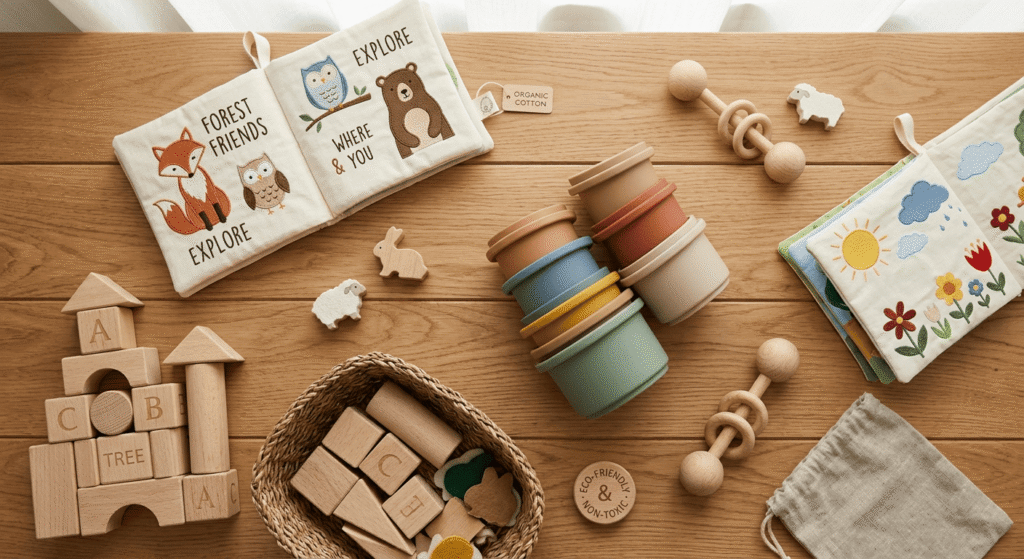
Understanding Toy-Safety Standards and Material Certifications
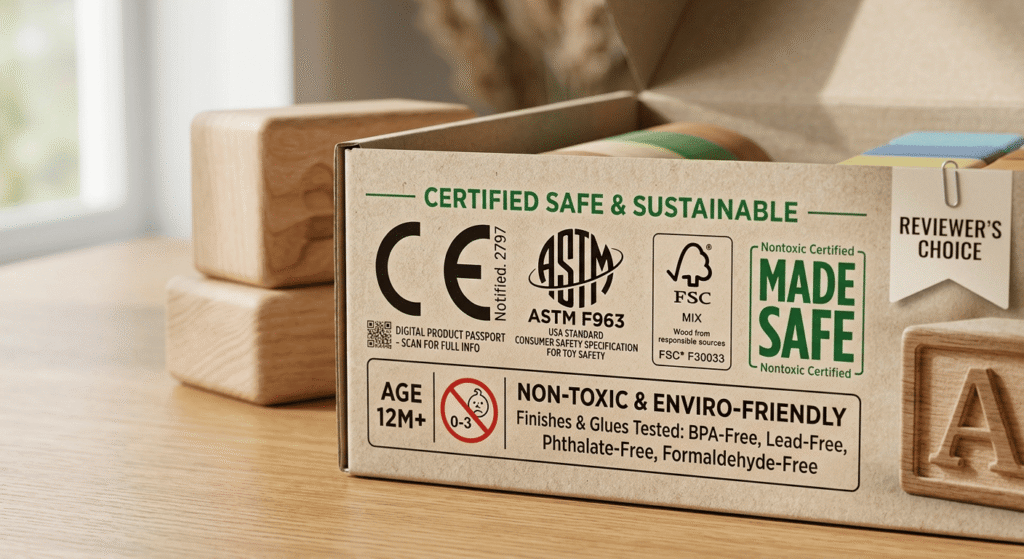
These marks do not all certify the same thing. In the EU, CE marking is the manufacturer’s declaration that the toy meets applicable EU requirements; it is not a third-party quality award. ASTM F963 is part of the mandatory U.S. toy-safety framework. GOTS relates to organic textile processing and supply-chain criteria, while UL GREENGUARD relates to chemical emissions and indoor air quality. None of these labels removes the need to check the toy’s age guidance, construction and condition. For details, see the European Commission’s toy guidance and GOTS standard information.
- ASTM F963 (US Standard): Mandatory testing standard ensuring toys are free from hazardous heavy metals and physical choking hazards.
- EN71 (European Standard): Strict European toy safety specification regulating chemical content and structural safety.
- CE marking: For products covered by relevant EU legislation, the manufacturer uses this mark to declare conformity with the applicable requirements. It is not, by itself, proof of independent testing.
- GOTS (Global Organic Textile Standard): Sets requirements for organic fibres and environmental and social criteria across textile processing and supply chains. It is a textile certification, not a toy-safety test.
- UL GREENGUARD: Indicates that a product has been tested against chemical-emissions limits relevant to indoor air quality. It does not certify that a toy is mechanically safe or suitable for every age.
For additional resources on national safety standards and recent product recalls, visit the United States Consumer Product Safety Commission (CPSC).
How to Clean and Maintain Non-Toxic Toys Safely
Even non-toxic toys can collect dirt, bacteria, and allergens over time. Cleaning them with harsh chemical sprays defeats the purpose of choosing non-toxic materials! Follow these gentle cleaning methods instead:
- Wooden Toys: Wipe down with a cloth dampened in warm water and mild Castile soap. Never submerge wooden toys in water, as moisture can cause warping. Periodically coat with organic beeswax polish.
- Fabric Toys: Machine wash on a gentle cycle using fragrance-free, eco-friendly detergent, and air dry in the sun.
- Silicone and Plastic Toys: Wash according to the manufacturer’s care instructions. Warm water and mild soap may be suitable for some products, but not all toys can be boiled, soaked, or treated with disinfectants.

Final Thoughts: Prioritizing Safety in Play
No material or marketing label can guarantee that every toy is risk-free. A practical approach is to choose products with clear age guidance and manufacturer information, inspect them regularly, follow care instructions and check recall notices. Safe play depends on the finished product and how it is used, not simply whether it is wooden, plastic or labelled “non-toxic.”
Keep this checklist handy for your next shopping trip and enjoy peace of mind knowing your child is learning safely!
“To boost your child’s creativity and imagination through open-ended play, check out the [Best Building Blocks for Toddler Imagination].”
“If you want to support your child’s language skills, explore these [Top Language Development Toys for 18-Month-Olds to Encourage Early Speech].”
Questions and Answers
How can I check whether a toy is safe?
Read the age label, inspect the toy for loose or damaged parts, check the manufacturer’s safety information, and look for recalls. No material label alone guarantees that every product is safe.
Are wooden toys always safer than plastic toys?
Not automatically. Check the finish, construction, splinters, small parts, and the manufacturer’s safety information regardless of material.
Do recycling numbers prove that a toy is non-toxic?
No. Resin identification codes identify plastic types; they are not a toy-safety certification. Follow product-specific safety information.
Does food-grade silicone mean a toy is safe to chew?
Not by itself. Only use products specifically designed and labelled for the child’s age and intended use, and inspect them regularly.
Related reading: Read our related guide
Examples of Educational Toys to Check Before Buying
These are examples to help you compare product types, not safety endorsements. Check the current listing, manufacturer’s age guidance, warnings and relevant test information before purchasing.
- Wooden Montessori Shape-Sorting Toy — a wooden sorting toy; check the current age range and small-parts warnings.
- Wooden Montessori Sorting and Learning Puzzle — another wooden puzzle-style option; review the exact materials and finish.
- Fisher-Price Baby’s First Blocks — a plastic sorting set; review the current listing and age guidance.