

As infants cross the threshold into their eighth month, they undergo a monumental cognitive shift. If you have ever played a game of peek-a-boo with an eight-month-old, you have likely witnessed a profound transformation: instead of merely crying when you hide your face, they begin to reach out, giggle, and actively look for you. This magical phase marks the awakening of a crucial developmental milestone known as Object Permanence.
In the realm of early childhood education, particularly within the Montessori philosophy, this cognitive leap is nurtured not through flashing plastic toys or digital screens, but through elegant, purposeful materials. At the forefront of these tools is the Montessori Object Permanence Box. Though deceptively simple in its design, this classic apparatus provides an optimal environment for an 8-month-old to experiment with, understand, and master one of the most foundational concepts of human intelligence.
Understanding Object Permanence: The Cognitive Leap at 8 Months
To truly appreciate the value of an Object Permanence Box, we must first explore what happens inside a baby’s brain around the eighth month of life.
What is Object Permanence?
“Coined by the pioneering developmental psychologist during his research on [Jean Piaget’s cognitive development theory], object permanence is the understanding that objects continue to exist even when they cannot be seen, heard, or otherwise sensed.”
- The Early Months (0–7 Months): To a very young infant, the world operates on an “out of sight, out of mind” basis. If a parent leaves the room or hides a favorite rattle under a blanket, the infant genuinely believes the object has ceased to exist altogether. This is why a six-month-old might lose interest in a toy the moment it drops off their high chair.
- The Shift (Around 8 Months): Around the seven-to-eight-month mark, the infant’s brain develops the capacity to form mental representations of objects. They begin to remember a toy even when it is hidden. They realize their primary caregiver still exists when they walk into the kitchen.
While this realization is a major cognitive victory, it can also bring about a wave of developmental challenges, most notably separation anxiety. Because the baby now knows that their caregiver exists somewhere else when they leave, they actively long for their return. Nurturing this transition requires tools that allow infants to practice separation and return in a safe, controlled, and tangible format.
Anatomy of the Montessori Object Permanence Box
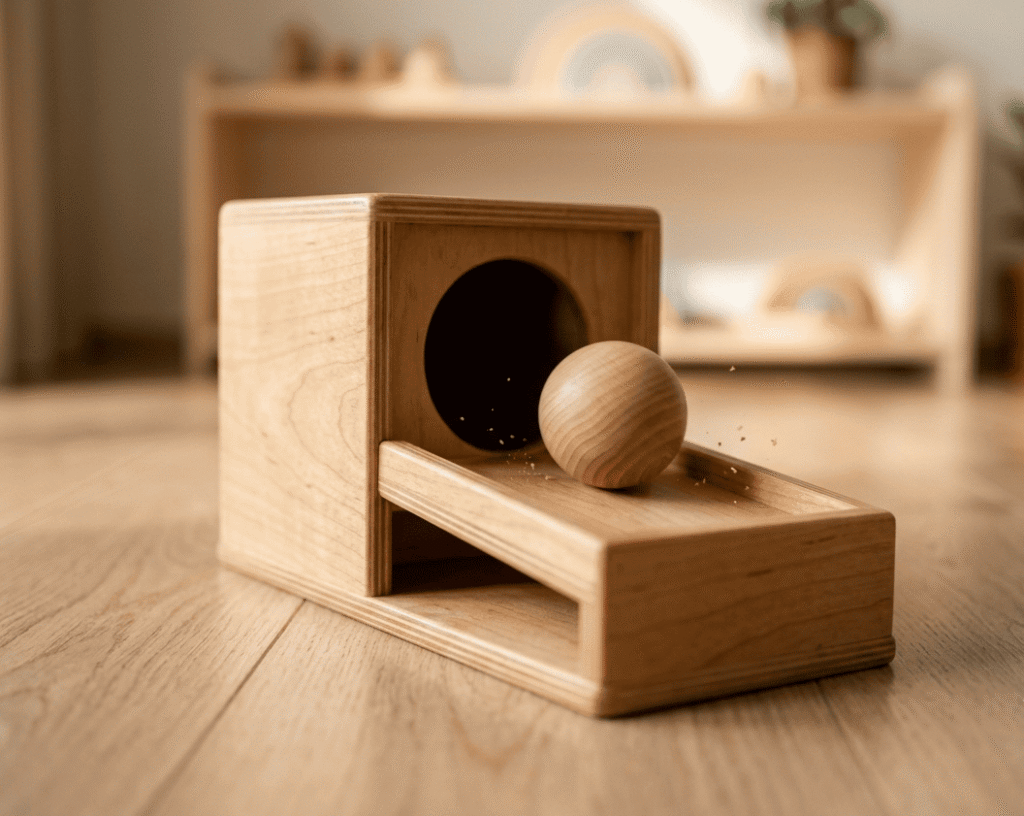
Developed by Dr. Maria Montessori and her early followers, the classic Object Permanence Box consists of a wooden box with a hole on top, an inclined ramp or tray connected to the box, and a single wooden ball.
The mechanics of the activity are straightforward:
- The infant drops the ball into the hole on top of the box.
- The ball momentarily disappears from the infant’s sight inside the box.
- Due to the internal incline of the box, the ball rolls out of an opening and comes to a gentle stop in the attached tray or ramp.
For an adult, this sequence is incredibly mundane. For an eight-month-old, however, it is a thrilling scientific experiment. The ball’s brief disappearance and subsequent reappearance validate their growing hypothesis about the physical world: just because something disappears from sight does not mean it is gone forever.
Why 8 Months is the Peak Window of Opportunity
In Montessori education, a “sensitive period” is a transient window of time during which a child is uniquely driven and psychologically primed to acquire a specific skill or concept. The sensitive period for object permanence peaks intensely between 8 and 12 months.
Physical Readiness
By eight months, most infants have achieved several physical milestones that make them perfectly suited for this specific material:
- Independent Sitting: They can sit upright without support, freeing up both of their hands to manipulate objects.
- The Pincer and Palmar Grasps: They have moved away from primitive reflexes and can intentionally grasp a ball using their hands and fingers.
- Hand-Eye Coordination: They can align their hand with a target—in this case, guiding the ball directly over the hole.
Introducing the Object Permanence Box at precisely eight months perfectly matches their neurological hunger to explore object existence with their physical capacity to execute the activity independently.
The Multifaceted Developmental Benefits
While the primary objective of this Montessori tool is to teach the preservation of objects, its benefits ripple across multiple areas of physical, cognitive, and emotional development.
1. Fine Motor Skill Refinement
Manipulating the ball requires a coordinated effort from the muscles in the fingers, hand, and wrist. An eight-month-old must practice the palmar grasp (using the whole hand) or begin transitioning to the pincer grasp (using the thumb and index finger) to pick up the ball. Releasing the ball directly into the hole also refines their voluntary release mechanism—a skill that requires immense neurological control for an infant.

2. Gross Motor Skills and Core Strength
Because the box sits on the floor, the infant must maintain a stable sitting posture while reaching forward, rotating their torso, and bending slightly to retrieve the ball. If the ball accidentally rolls away from the tray, it provides a natural, highly motivating incentive for the infant to lurch forward, pivot, or crawl to retrieve it, thereby supporting gross motor progression.
3. Visual Tracking and Spatial Awareness
When the ball rolls out of the box and into the tray, the infant must use their eyes to track the moving object. Visual tracking is an essential prerequisite for later academic skills, such as reading from left to right. Furthermore, it teaches the baby about spatial relationships—understanding concepts like in, out, through, and behind.
4. Introduction to Cause and Effect
The Object Permanence Box serves as an early, screen-free introduction to the laws of physics. The baby learns: “If I perform Action A (dropping the ball), it will always cause Result B (the ball rolling out).” This predictable, repetitive outcome builds logic, reasoning skills, and a fundamental trust in the physical laws of their environment.
5. Cultivating Concentration and Focus
One of the most profound sights in a Montessori environment is the deep concentration exhibited by an infant using this box. It is not uncommon for an eight-month-old to repeat this loop twenty, thirty, or even forty times in a single sitting. This self-directed repetition is critical for building a child’s attention span. Unlike electronic toys that distract infants with chaotic external stimuli, the Object Permanence Box fosters an internal, quiet focus.
6. Building Psychological Confidence
When a toy lights up or plays music on its own, the baby is merely a passive observer. When using the Object Permanence Box, the baby is the active agent. Achieving the goal independently provides an immense sense of accomplishment. The child thinks, “I did that!” This dynamic builds foundational self-esteem and a lifelong love for problem-solving.
The Beauty of Montessori Purposeful Simplicity
Parents often wonder why a plain wooden box is superior to the bright, musical “Parents often wonder why a plain wooden box is superior to the bright, musical toys filling modern toy aisles. The answer lies in the fundamental Montessori isolation of difficulty principles, which state that a child absorbs concepts best when unnecessary distractions are stripped away.”toys filling modern toy aisles. The answer lies in the Montessori principle of the Isolation of Difficulty.

When a toy flashes lights, plays music, speaks words, and moves all at once, an infant’s sensory system becomes overloaded. The brain struggles to determine what it is supposed to be learning. Is it learning about the color red? The sound of a bell? Or the concept of cause and effect?
The Montessori Object Permanence Box isolates a single concept: disappearance and reappearance.
- The box is usually made of plain, natural wood so the child is not distracted by loud graphics.
- It makes no artificial electronic noises; the only sound is the natural, satisfying acoustic “thud” of wood meeting wood.
- The ball moves slow enough for an infant’s undeveloped tracking skills to follow.
By stripping away unnecessary distractions, the material respects the infant’s cognitive limits, allowing them to absorb the intended lesson with absolute clarity.
How to Introduce the Object Permanence Box
If you are introducing this tool to an eight-month-old at home, how you present it matters just as much as the object itself. In Montessori, this presentation is done with minimal words to allow the child to focus entirely on the movements.
Step-by-Step Presentation:
- Prepare the Space: Invite your infant to sit comfortably on a low floor mat. Place the Object Permanence Box directly in front of them, ensuring the tray faces the child.
- Model Slowly: Sit across from or beside your child. Pick up the ball using three fingers (demonstrating a precise grasp). Hold the ball over the hole, pause for a moment to draw their eyes to it, and gently drop it.
- Observe the Movement: Keep your eyes fixed on the box. Watch the ball roll out into the tray together. Let the natural sound of the ball rolling do the talking.
- Invite the Child: Gently pick up the ball from the tray, place it in front of the infant or offer it to their hand, and gesture toward the hole.
- Step Back: Once the child understands the premise, step back and become an observer. Do not praise them loudly every time they succeed, as external praise can interrupt their deep state of internal concentration. Let the self-correcting nature of the toy be their reward.
Progressive Variations: The Object Permanence Journey
The classic box with a simple open tray is just the first step in a beautifully calculated sequence of materials. As your child grows and masters the basic box, their brain will require greater challenges. Montessori design accounts for this progression through advanced variations:
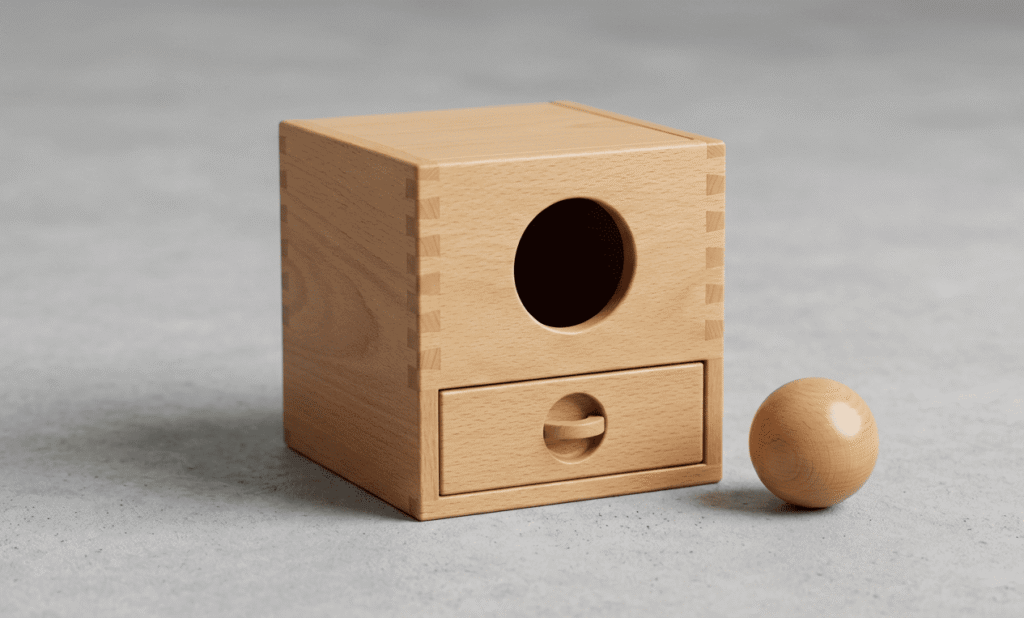
| Tool / Variation | Estimated Age | Added Challenge / Purpose |
| Classic Open Tray Box | 8–9 Months | Foundational concept of object permanence; visual tracking. |
| Box with a Drawer | 11–12 Months | The ball does not roll out automatically. The child must intentionally pull open a wooden drawer using a small knob to find the hidden ball, adding a step to the problem-solving process and building finger strength. |
| Box with a Flip Lid or Door | 12+ Months | The child must flip open a lid or push open a small swinging door to access the object, introducing varied mechanical actions. |
| Coin Box (Imbrication) | 12–14 Months | Replaces the round ball with flat wooden coins. The child must now align the orientation of the coin with a thin slot, refining their advanced spatial awareness and fine motor control. |
Conclusion: A Small Investment with Infinite Returns
In a world filled with ephemeral, plastic baby products that are outgrown in weeks, the Montessori Object Permanence Box stands as an enduring testament to the power of thoughtful, child-centered design.
By offering an eight-month-old this elegant tool, you are providing them with far more than a simple plaything. You are giving them a laboratory to explore the laws of nature, a sanctuary to build deep focus, and a comforting psychological blueprint that reassures them that what is lost will eventually be found. It is a quiet, profound foundational stone upon which a lifetime of cognitive curiosity, emotional resilience, and independent learning is built.
“Along with sensory play, when your toddler is ready to take their first steps, learn about [safe push toys vs traditional baby walkers] to support their movement.”
“As your newborn grows and starts reaching for objects, you can introduce tactile play using [safe texture sensory toys and blocks].”