
A ride-on truck with chunky tires may look ready for the backyard, but grass, dirt and gravel place very different demands on a small electric vehicle. Some models are intended for smooth, level pavement only. Others may be approved for short, firm grass. The useful question is not whether a truck looks rugged; it is whether the manufacturer specifies that it can be used on the surface you have.
Disclaimer: This post contains affiliate links. As an Amazon Associate, I earn from qualifying purchases at no extra cost to you.
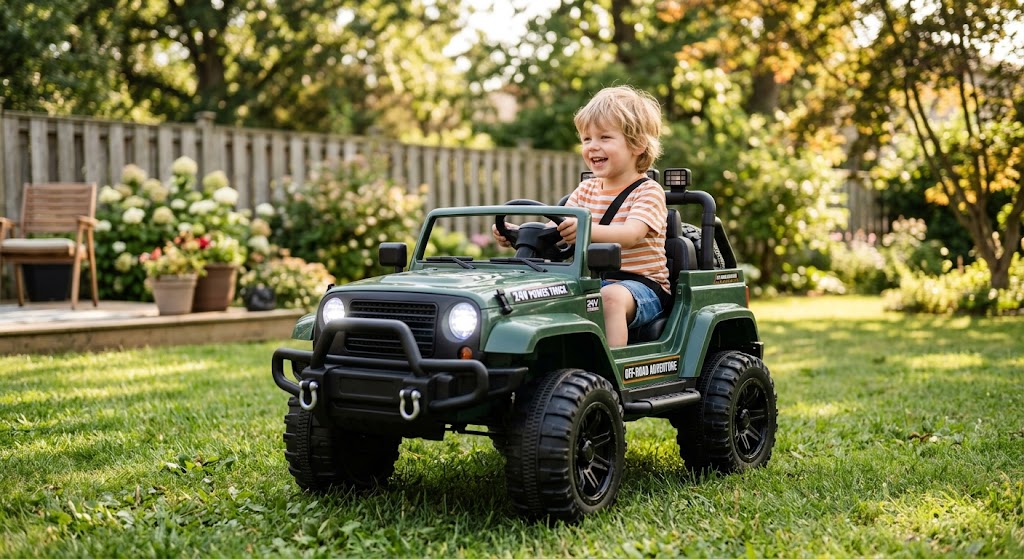
Start with the surface, not the appearance
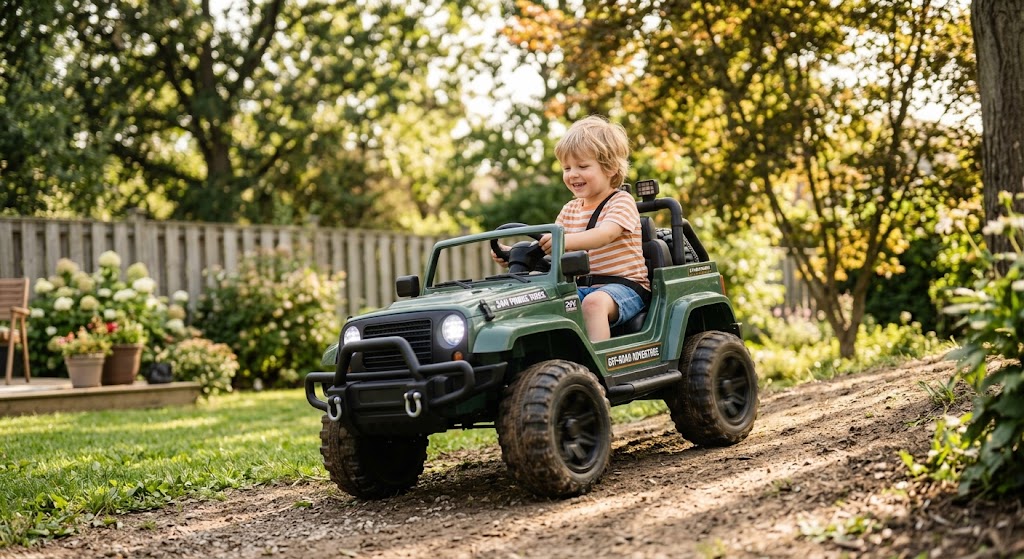
Walk the route where your child will ride. Is the grass short and dry, or long and soft? Is the dirt packed and level, or loose and rutted? Are there roots, stones, drainage channels or slopes? Small ride-on wheels have limited clearance, and a low battery-powered vehicle can become stuck or tip if it is driven across unsuitable ground. Keep play to a private, level area that is away from traffic and hazards.
What to inspect on an off-road-style ride-on
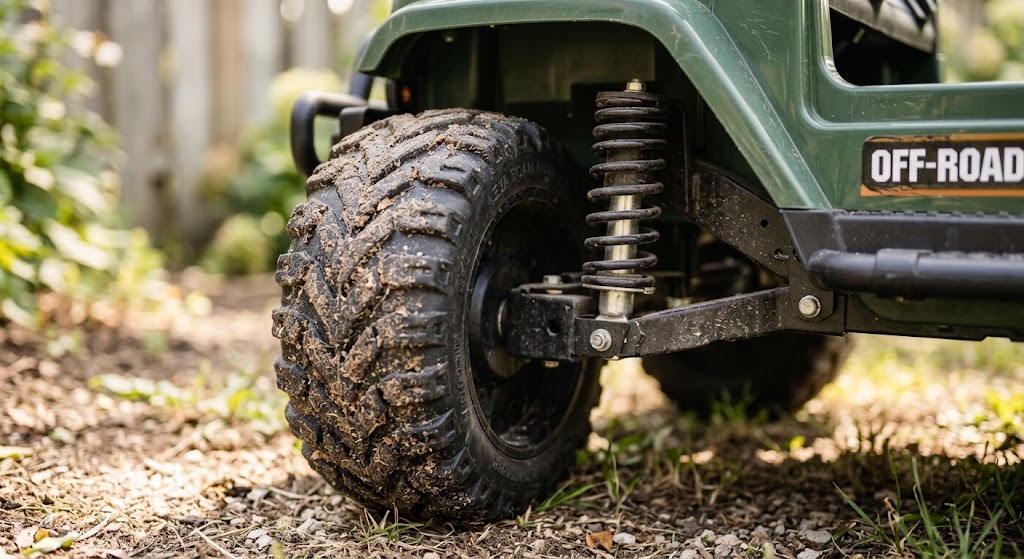
Ground clearance and wheel size
Look underneath the vehicle and compare the lowest point of its chassis with the surface. A low body can scrape on uneven ground even when the tires look large. Larger wheels may roll over small surface irregularities more easily, but they do not turn a toy into an all-terrain vehicle.
Tire material and tread
Hard plastic wheels can be noisy on concrete and may have limited grip on some outdoor surfaces. EVA foam or rubber-style tires can alter noise and traction, but tread pattern, wheel width, weight distribution and ground conditions also matter. A tire label alone is not proof that the vehicle is suitable for mud, wet grass or gravel.
Motor layout and battery specification
A listing may describe a 12V or 24V battery, a pair of motors or four-wheel drive. These details help describe the design, but voltage by itself does not confirm speed, torque or the ability to climb a slope. Check the exact model’s manual for approved surfaces, maximum load and any restrictions on inclines. Do not use a ride-on on steep banks or uneven trails unless the manufacturer explicitly permits it.
A useful way to compare listings
- Confirm the stated minimum age and maximum child weight.
- Check the overall dimensions and ground clearance.
- Look for a clear description of the tire material and drive wheels.
- Find the manufacturer’s guidance for grass, dirt or gravel use.
- Check the stated speed, braking method and low-speed setting.
- Confirm whether a parent remote is included and what it can actually control.
- Read the charging instructions and warranty terms.
Outdoor safety is about the route and the adult nearby
Choose a dry, level, private space with a clear view. Keep the vehicle away from roads, driveways, stairs, pools, water features and steep edges. An adult should remain close enough to intervene throughout the ride. A parent remote is an additional control on models that include one; it does not make it safe to supervise from indoors or from a distance.
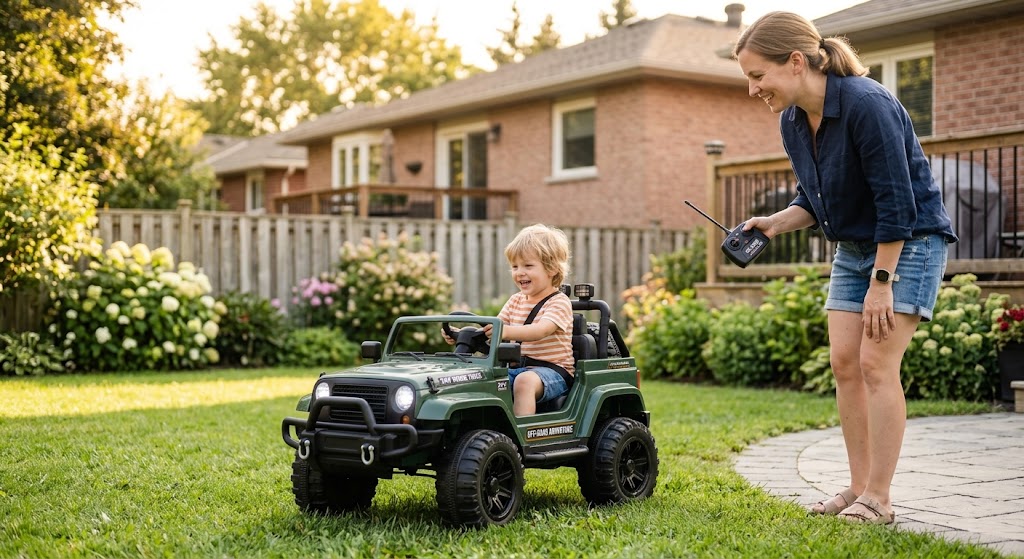
Before each session, check the steering, wheels, seat, fasteners and battery compartment. Stop using the vehicle if a part is loose, cracked, unusually hot or not working properly. Keep the child seated and follow the maker’s restraint and passenger instructions.
After the ride: cleaning and battery care
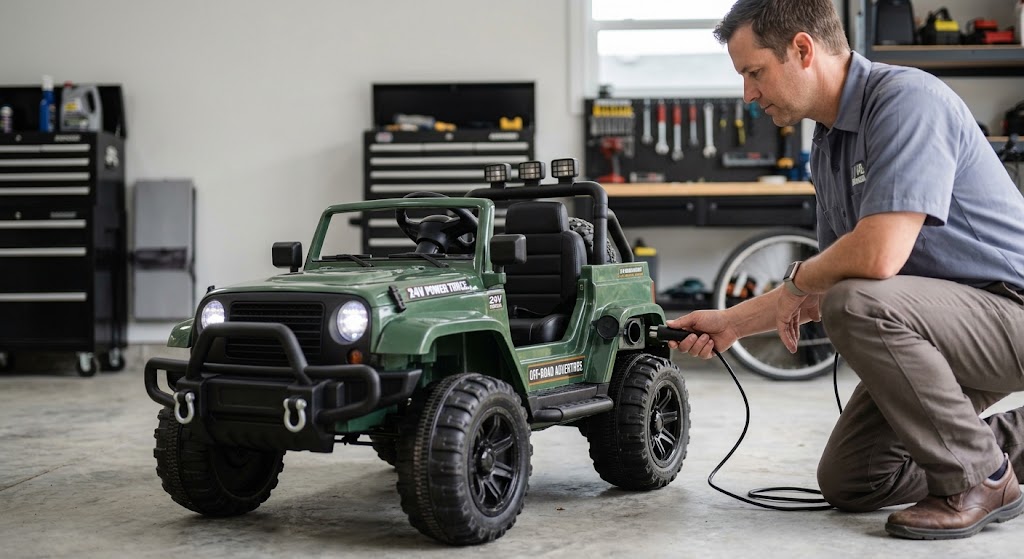
Brush off dry soil and remove grass or hair caught around the axles. Use only the cleaning method recommended in the manual; avoid spraying water into switches, motors, charging sockets or battery compartments. Dry the vehicle before storing it. Charge it with the supplied or manufacturer-approved charger and follow the specified charging and storage routine.
If you want to compare models with EVA-style tires, see off-road ride-on trucks with EVA-style tires on Amazon. For a higher-voltage listing, review 24V off-road-style ride-on trucks on Amazon. A model with adult control is also worth comparing: off-road-style ride-on trucks with a parent remote on Amazon.
Is an off-road ride-on right for your family?
An off-road-inspired truck can be a good fit when you have a suitable level outdoor area and a model whose manual allows use on that surface. If your route is mostly pavement, a standard ride-on may be easier to store and maintain. Choose according to the actual ground, the child’s size and ability, and the vehicle’s stated limits—not the rugged styling alone.
For general age and supervision considerations, read our ride-on car safety guide for 1-year-olds.
Frequently Asked Questions
Can every off-road-style ride-on drive on grass?
No. Grass thickness, dampness, slope, tire design, motor output and the vehicle’s stated surface limits all matter. Check the manual and start only on a level, dry area if that use is permitted.
Does larger ground clearance guarantee better off-road performance?
No. Ground clearance is only one factor. Tire grip, wheel size, drive system, weight, motor capability and the surface itself also affect how the vehicle performs.
Can an off-road ride-on be used on public roads?
Do not use a children’s ride-on on public roads. Choose a private, level play area away from traffic, driveways and other hazards, and supervise closely.
How should I clean an off-road ride-on after outdoor use?
Remove loose dirt and grass using the method allowed by the manufacturer. Keep water away from electrical parts and charging connections, then inspect wheels, axles and wiring before the next use.
Sources
Health Canada – Play Time: Ride-On Toys and Battery-Operated Toys
U.S. Consumer Product Safety Commission – Toy Safety