
Disclosure: This post contains Amazon affiliate links. As an Amazon Associate, I earn from qualifying purchases at no extra cost to you.
When comparing electric ride-on cars, battery labels such as 6V, 12V and 24V are easy to notice. They describe the nominal voltage of the battery system, but they do not tell you by themselves how fast a vehicle travels, how long it runs or which age group it suits. Motor design, gearing, controller settings, battery capacity, vehicle weight, load and riding surface all affect performance. Use the exact model’s instructions and specifications—not voltage alone—to decide whether it is appropriate for your child.

6V, 12V and 24V: what is the difference?
Voltage is one part of the electrical system. A higher number does not automatically mean a safer, more durable or more suitable toy. Two ride-ons with the same voltage can have different speeds, handling and runtime because their motors, gearing, controller, battery capacity, wheels and total weight may differ.
| Battery label | What to examine | Important reminder |
|---|---|---|
| 6V | Exact age range, seat fit, speed, controls and stopping behaviour. | Do not assume every 6V model is slow or suitable for toddlers. |
| 12V | Maximum load, stated speed, braking, remote functions and battery capacity. | 12V is not a standard age recommendation; models vary. |
| 24V | Speed settings, steering, brakes, permitted surfaces and the child’s ability to operate it. | A higher voltage may be associated with larger models, but does not prove suitability for an older child. |
What to check on a 6V ride-on
Some 6V vehicles are marketed as smaller beginner-style ride-ons, but the label is not a safety rating. Check the stated minimum age and maximum load, the seat depth and back support, whether the child can sit steadily, and how the vehicle starts and stops. Confirm whether the model has a parent remote or a selectable lower-speed mode; do not assume those features are included.

Browse 6V electric ride-on cars on Amazon as a starting point, then compare each model’s manual and specifications.
What to check on a 12V ride-on
12V appears across many different types of children’s cars and trucks. The number alone does not establish whether a vehicle is right for a three-year-old—or any particular age. Compare the child’s height and weight with the manufacturer’s limits, check legroom and steering-wheel reach, and find the stated speed and braking method. If a remote is supplied, read exactly which functions it controls and whether adult input overrides the child’s controls.

Browse 12V electric ride-on cars on Amazon and verify the exact model’s details before purchase.
What to check on a 24V ride-on
Some 24V products are larger vehicles or are marketed for children who can manage more complex controls. That is a product-category pattern, not a universal rule. Check the model’s age and weight limits, seat dimensions, top speed, lower-speed options, steering and stopping behaviour. Also read the surface and slope restrictions carefully. Four-wheel drive, chunky tires or suspension do not make a toy suitable for steep hills, roads, wet grass or rough terrain unless the manufacturer specifically permits that use.
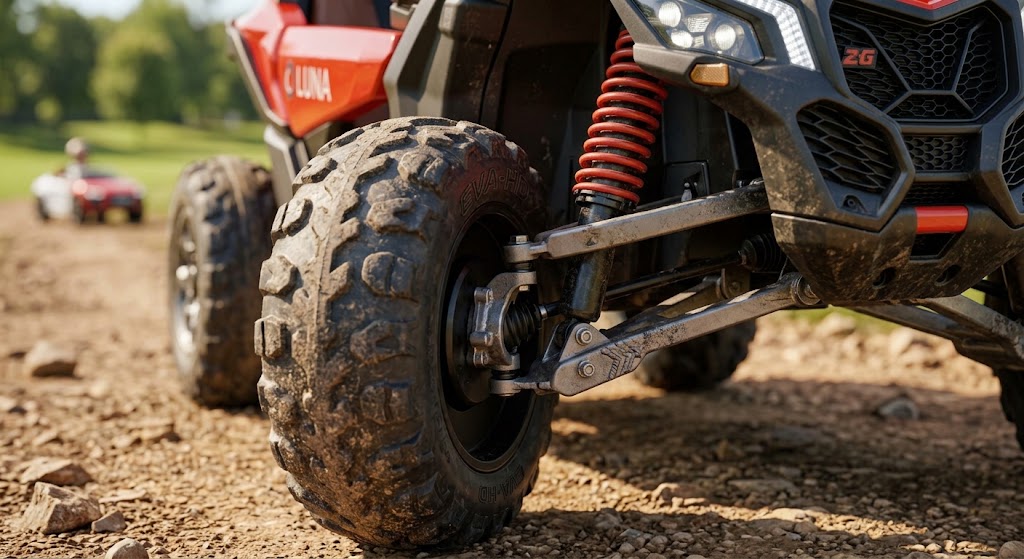
Browse 24V electric ride-on vehicles on Amazon only after checking the product’s age, load, speed and surface guidance.
Compare speed, starting and stopping—not just power
Find the manufacturer’s stated speed range and whether an adult can select a lower setting. Check whether the vehicle accelerates gradually, what happens when the pedal is released and how the brake or stop function works. A gradual-start feature may reduce abrupt movement, but it does not replace appropriate speed limits, a suitable riding area or adult supervision. Test the controls in an open space before the child uses the vehicle.
Also check the wheels and suspension against the surfaces the maker allows. Hard plastic wheels, EVA-style tires and spring suspension can change noise or ride feel, but none is a guarantee of traction or off-road capability.
Battery capacity and runtime
Voltage is not the same as battery capacity. Look for the battery type and capacity and treat the advertised play time as an estimate. Actual runtime can vary with the child’s weight, surface, temperature, battery age, speed setting and how often the vehicle starts and stops. Ask whether replacement batteries are available and whether the manufacturer provides clear charging instructions.
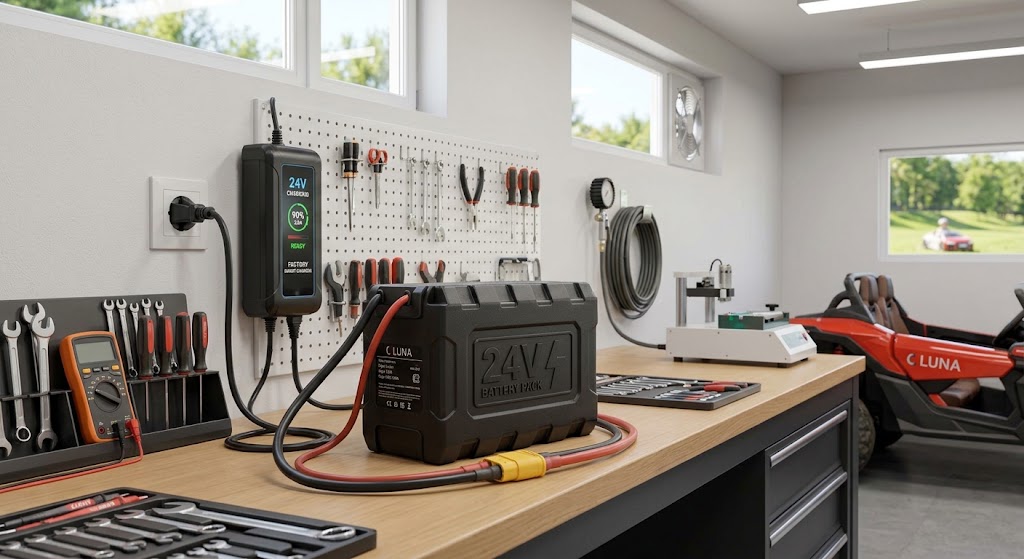
Use the supplied or manufacturer-approved charger, follow the specified charging time and keep the charging area dry. Do not use a charger simply because its plug fits. Stop using a battery or charger that is swollen, leaking, damaged or unusually hot.
A practical buying and safety checklist
- Read the exact model’s minimum age and maximum weight.
- Check seat dimensions, legroom, back support and control reach.
- Find the stated speed, lower-speed settings and stopping behaviour.
- Confirm whether a parent remote is included and what it controls.
- Inspect the seat restraint, steering, wheels and fasteners.
- Check the manufacturer’s permitted surfaces and slope restrictions.
- Read the battery capacity, charger and storage instructions.
- Use the ride-on only in a clear area away from roads, stairs, pools and pedestrians.
- Stay close and supervise continuously.
For more on adult remote controls, see our guide to licensed and remote-control ride-on cars. If you are comparing rugged-looking models, read our guide to off-road ride-on trucks and jeeps; always follow each model’s surface restrictions.
Before choosing, also check whether a replacement battery is available for the exact model and whether the manufacturer provides a clear part number or support route. This can matter when the original battery eventually loses capacity. Do not buy a replacement based on voltage or connector shape alone; confirm compatibility with the manufacturer.
Frequently Asked Questions
Is a 24V ride-on always faster than a 12V model?
Not necessarily. Voltage alone does not determine speed. Motor design, gearing, controller settings, vehicle weight and other specifications affect performance.
Are all 6V ride-on cars suitable for toddlers?
No. Check the specific model’s minimum age, maximum load, seat fit, controls and supervision instructions. A 6V label is not a safety rating.
Does a 12V ride-on automatically suit a three-year-old?
No. Models differ in size, speed and weight limits. Use the manufacturer’s guidance and check whether the individual child fits the seat and can operate the controls.
Can I use a different charger if it has the same voltage?
No. Use only the charger supplied or explicitly approved by the manufacturer for that exact model. Matching voltage or plug shape does not guarantee compatibility.
Sources
Health Canada – Play Time: Ride-On Toys and Battery-Operated Toys