
During early childhood, play is far more than just a fun pastime—it is the foundation of cognitive, emotional, and physical development. Among the various forms of play, open-ended play stands out as a powerful catalyst for creativity and problem-solving. When young children are given materials without fixed rules or single predetermined outcomes, their minds are free to explore, experiment, and invent. Choosing the best building blocks for toddler imagination provides young learners with an adaptable canvas where simple shapes turn into castles, spaceships, or bustling cities.
Understanding how open-ended play fosters critical thinking can help parents make mindful choices about toy selection. In this comprehensive guide, we examine the magic of unstructured creation and highlight the top building block options that encourage healthy toddler development.
In This Article
Open-Ended Play & the Best Building Blocks for Toddler Imagination
Open-Ended play refers to activities that have no rigid set of instructions, no right or wrong answers, and no defined end goal. A battery-operated toy that only plays a song when a button is pressed offers limited engagement. In contrast, a simple wooden block can become a car today, a phone tomorrow, and a bridge the next day.
According to developmental experts at Zero to Three, open-ended exploration allows toddlers to take charge of their learning, promoting independence and intrinsic motivation.
Key benefits of open-ended play include:
- Enhanced Spatial Awareness: Children learn about balance, gravity, scale, and geometry through hands-on experimentation.
- Cognitive Flexibility: Solving a collapsing tower teaches cause-and-effect and resilience.
- Language Expansion: Building together naturally introduces descriptive words like taller, under, heavy, and balanced.
- Fine and Gross Motor Mastery: Grasping, stacking, and aligning blocks refines hand-eye coordination and muscle control.
How the Best Building Blocks for Toddler Imagination Supercharge Play
Building blocks are the quintessential open-ended toy. Unlike single-use gadgets, a set of blocks grows alongside your child. An 18-month-old might start by banging two blocks together or knocking down towers. By age three, that same child is creating complex structural stories and imaginative landscapes.
When toddlers play with blocks, they engage in constructive play, which directly activates both logical and creative centers of the brain. They act as little engineers and artists simultaneously, testing physical boundaries while giving physical form to their inner thoughts.

Top Types of the Best Building Blocks for Toddler Imagination
Not all block sets serve the same developmental purpose. Depending on your child’s age, sensory preferences, and fine motor readiness, different materials offer distinct creative benefits. Here are the top categories of the best building blocks for toddler imagination:
1. Classic Unit Wooden Blocks
Wooden unit blocks are a staple in early childhood classrooms for good reason. Precision-cut from solid wood, they adhere to standardized math ratios (e.g., two small blocks equal one long block).
- Why they foster imagination: Their neutral design leaves everything to the child’s mind—no flashing lights or prescribed themes.
- Best for: Teaching early math concepts, spatial balance, and long-term durability.
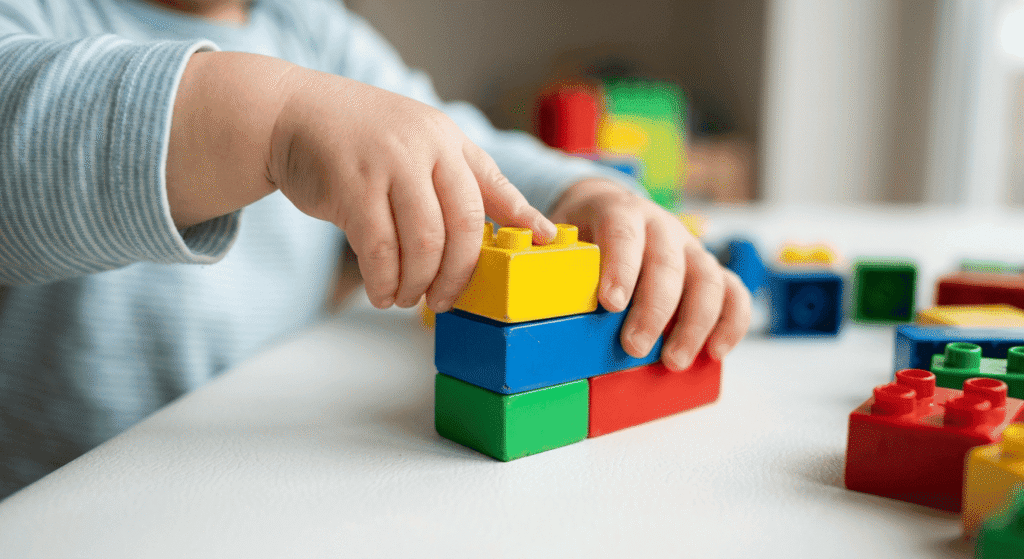
2. Large Interlocking Plastic Bricks (e.g., LEGO DUPLO)
Interlocking blocks allow toddlers to build sturdy, tall structures that don’t easily fall over. This stability gives younger toddlers a sense of accomplishment.
- Why they foster imagination: They bridge the gap between simple stacking and complex structural design, often incorporating figures that trigger storytelling.
- Best for: Developing hand strength, frustration tolerance, and thematic pretend play.
3. Magnetic Tiles and Blocks
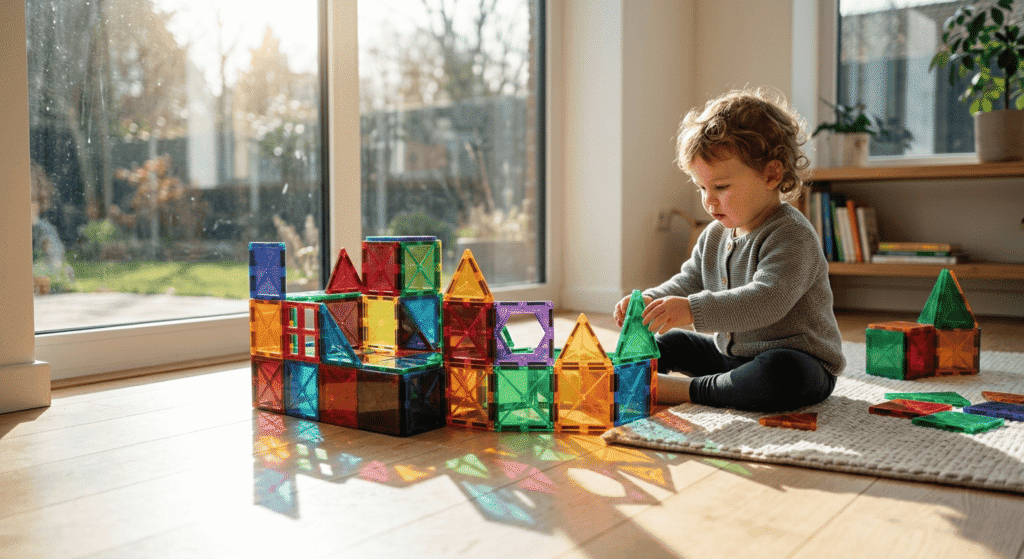
Magnetic building tiles have taken the parenting world by storm. Their built-in magnets allow shapes to connect easily from any angle, introducing young children to 3D geometry and light reflection.
- Why they foster imagination: Children can construct hollow spaces, houses, and translucent colorful domes that interact beautifully with sunlight.
- Best for: Understanding symmetry, magnetics, color mixing, and architectural creation.
4. Soft Foam and Silicone Blocks
For younger toddlers or toddlers who love sensory exploration (and throwing toys!), soft foam or food-grade silicone blocks are a safe and quiet alternative.
- Why they foster imagination: They provide a tactile building experience without the fear of heavy falls or loud crashes, encouraging risk-free experimentation.
- Best for: Sensory play, bath time construction, and safe play for mixed-age siblings.
5. Hollow and Oversized Cardboard Blocks
Large lightweight blocks allow toddlers to build structures on a scale relative to their own bodies—such as fortresses, walls, or caves they can actually interact with.
- Why they foster imagination: Large-scale building encourages gross motor movement and immersive dramatic play scenarios.
- Best for: Physical movement, collaborative group play, and spatial reasoning.
Practical Tips for Using the Best Building Blocks for Toddler Imagination at Home
Simply buying a box of blocks isn’t always enough to spark long-term play. The environment and adult engagement play a huge role in sustaining interest.
- Create a Dedicated Building Zone: Set up a low-pile rug or flat play surface where structures can remain standing without wobbling.
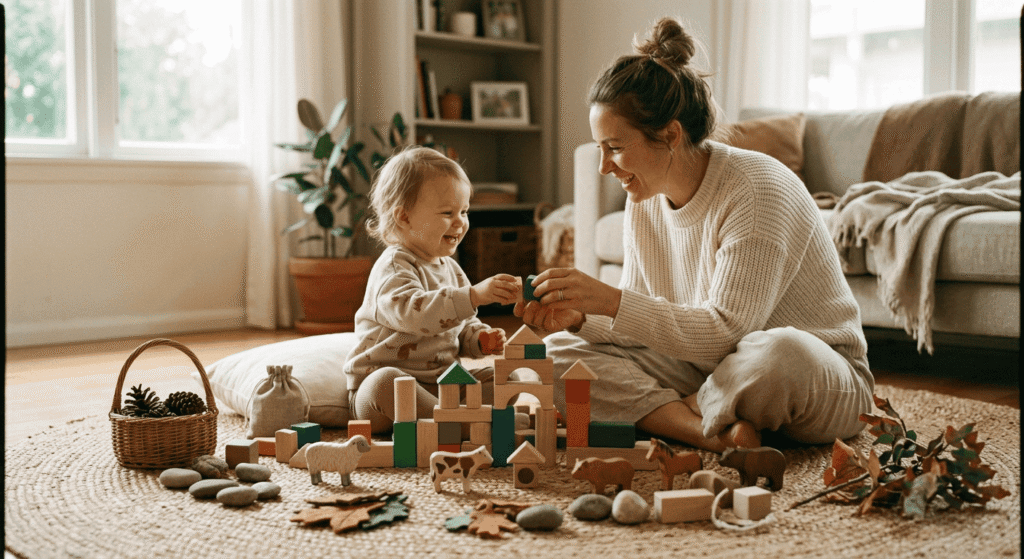
- Add Open-Ended Props: Integrate loose parts like wooden animals, silk scarves, toy cars, or natural pinecones. Research highlighted by the National Association for the Education of Young Children (NAEYC) shows that adding unstructured props to block areas significantly enriches symbolic play and oral vocabulary.
- Follow Their Lead (Avoid Over-Directing): Resist the urge to fix their tower or tell them what to build. Ask open questions like, “Tell me about what you are making!” instead of “Is that a house?”
- Embrace the Collapse: Knocking down towers is a normal and necessary stage of learning gravity and control. Celebrate the crash as much as the creation!
Safety Checklist for the Best Building Blocks for Toddler Imagination
When selecting the best building blocks for toddler imagination, keep these practical safety and quality guidelines in mind:
- Non-Toxic Finishes: Look for water-based paints, natural vegetable oils, or BPA-free plastics.
- Choke-Hazard Safe: Ensure all pieces are larger than 1.25 inches in diameter for children under 3 years old.
- Smooth Edges: Wooden blocks should be sanded smooth without sharp corners or splinters.
- Ease of Storage: Choose sets that come with canvas bags, wooden crates, or sturdy bins so cleanup becomes part of the routine.

Final Thoughts
Investing in open-ended play materials is one of the most impactful choices you can make for your child’s early development. The best building blocks for toddler imagination aren’t just toys—they are versatile tools that cultivate curiosity, critical thinking, and confidence. By giving your toddler the space and freedom to build without boundaries, you are laying the bricks for a lifetime of creative problem-solving.
“To help your toddler develop early logic and problem-solving skills, explore the [Top Shape Sorters and Stacking Toys for Toddler Development].”
“If you are deciding between different toy materials, read our breakdown on [Wooden Toys vs. Plastic Toys: Why Parents Choice Eco-Friendly Play].”