
Watching your toddler transition from simple babbling to articulate words is one of the most magical milestones of early parenthood. Around 18 months, toddlers experience a major cognitive and linguistic leap. While every child develops at their own pace, providing the right environment and interactive tools can significantly boost their communication skills. Using engaging language development toys for 18-month-olds is one of the most effective ways to nurture speech naturally through play.
Play is a toddler’s natural language. When carefully chosen toys are paired with warm caregiver interaction, simple play sessions turn into rich learning experiences. In this article, we explore how speech develops at this stage and highlight the best toys to encourage early speech and language skills.
In This Article
18-Month Language Milestones and the Best Language Development Toys for 18-Month-Olds
At 18 months, a toddler’s brain is rapidly forming neural connections related to sound, comprehension, and vocabulary. During this phase, speech development generally manifests in two ways:
- Receptive Language: Understanding what others say. An 18-month-old can usually follow simple one-step commands like “Pick up the ball” or point to familiar objects when named.
- Expressive Language: The words and sounds they produce. Typically, toddlers at this age have a lexicon of 10 to 20 functional words, though they use gestures, facial expressions, and intonation to communicate much more.
Interactive toys bridge the gap between understanding words and vocalizing them. They give toddlers a concrete reason to label objects, express choices, and engage in back-and-forth communication with parents.
Key Features of Effective Language Development Toys for 18-Month-Olds
Not all toys are created equal when it comes to boosting speech. To maximize language practice, look for toys with the following characteristics:
- Open-Ended Design: Toys like wooden blocks or play dough allow open interpretation, encouraging descriptive language (e.g., tall, fall, more, big).
- Cause-and-Effect Mechanisms: Toys that require an action to produce a result help toddlers learn action words like push, pop, go, and stop.
- Cause for Interaction: The best toys promote social connection rather than passive consumption. Avoid battery-operated toys that do all the talking for the child.
- Real-World Connections: Toys representing everyday objects—like toy phones, animals, and play food—help children connect vocabulary to their daily lives.

Top Language Development Toys for 18-Month-Olds
Here are the top categories of toys clinically and educationally proven to foster early speech and vocabulary in 18-month-olds.
1. Pretend Play Sets (Kitchen, Food, & Telephones)
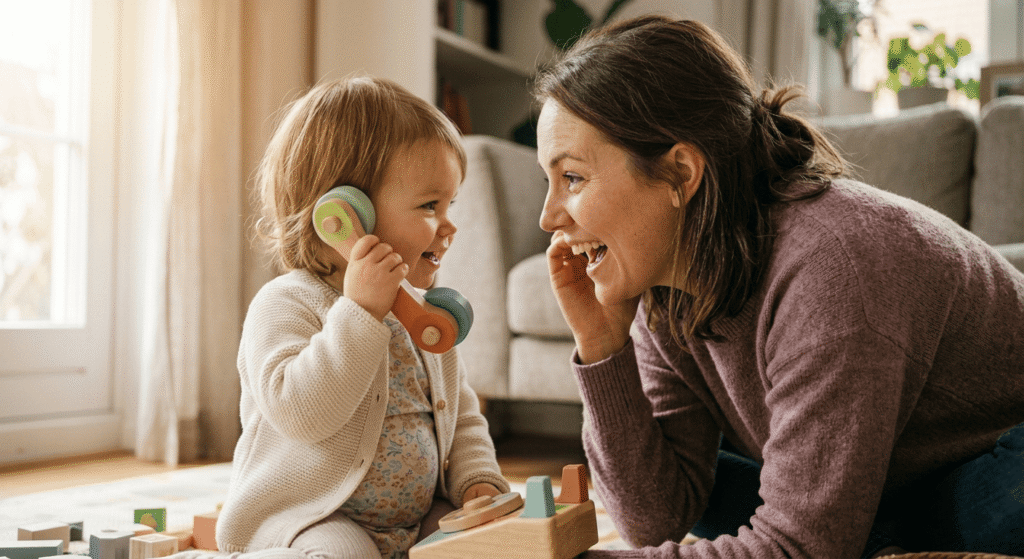
Imitative play explodes around 18 months. When toddlers pretend to cook, feed a doll, or talk on a toy phone, they mimic real-life adult conversations.
- Why they work: Pretend play encourages functional words (eat, more, hot, water) and back-and-forth conversational turns.
- Speech Tip: Hold a toy phone to your ear, say “Hello!”, and hand it to your child to prompt a response.
2. Interactive Sound & Picture Books
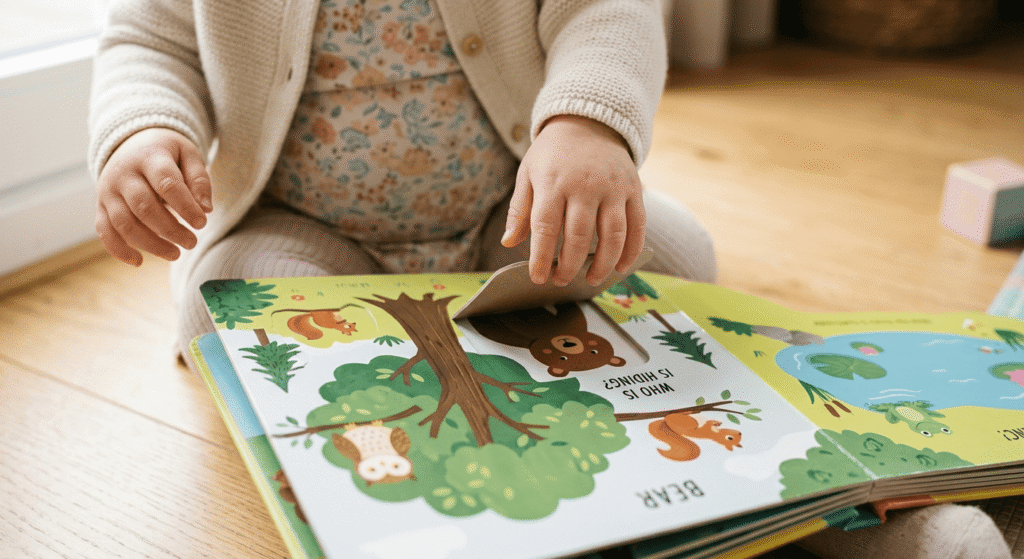
While traditional storytelling is essential, interactive lift-the-flap books or touch-and-feel sensory books keep active toddlers focused.
- Why they work: They build vocabulary through immediate visual association. Research supported by the CDC’s Developmental Milestones highlights that pointing and naming objects in books is a cornerstone of toddler language growth.
- Speech Tip: Pause before revealing what’s under a flap and ask, “Who’s hiding?” to encourage imitation.
3. Animal Farm Sets and Figures
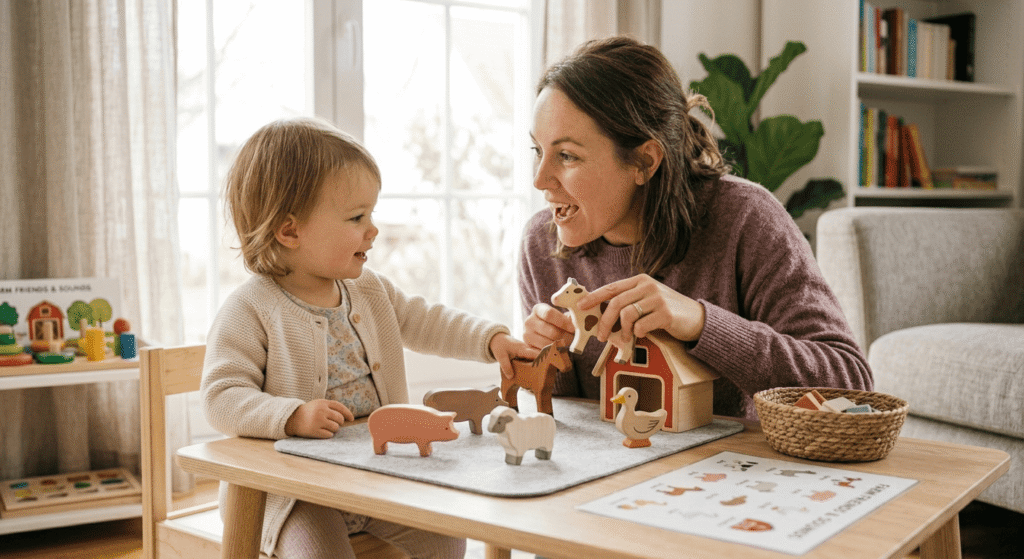
Replicas of everyday animals offer an easy entry point for early vocalizations. Animal sounds (moo, baa, neigh) are often easier for a toddler’s vocal cords to produce than complex word structures.
- Why they work: Mastering animal sounds gives toddlers a sense of accomplishment, building confidence to try bigger words.
- Speech Tip: Pair the action with the sound: “The cow says Moo! Can you make the cow walk?”
4. Nesting Cups and Stacking Blocks
Simple spatial toys are foundational for building descriptive vocabulary.
- Why they work: They naturally teach prepositions and spatial concepts such as in, out, on top, up, and down.
- Speech Tip: Build a tower together and emphasize exclamations like “Up, up, up… BOOM!” as it falls.

5. Sound Puzzles & Wooden Peg Puzzles
Wooden puzzles featuring animals, vehicles, or household items require fine motor skills alongside cognitive problem-solving.
- Why they work: Completing a puzzle provides an engaging contextual framework for naming objects and practicing patience.
- Speech Tip: Hold onto a puzzle piece near your mouth before handing it over so your toddler looks at your lips while you pronounce the name clearly.
How to Use Language Development Toys for 18-Month-Olds for Maximum Growth
The toy itself is only half the equation; the way you interact during playtime makes all the difference. Early childhood experts at Zero to Three emphasize that responsive parenting during play is the single greatest catalyst for language acquisition.
Here are four simple strategies to apply during play sessions:
- Narrate the Action (Self-Talk & Parallel Talk): Describe what you or your child is doing like a sportscaster. “You are building a big tower. Wow, blue block!”
- Use the “Repeat and Expand” Technique: If your toddler points and says “Car,” expand it into a complete thought: “Yes, that is a fast red car!”
- Offer Choices: Instead of handing over a toy directly, hold up two options and ask, “Do you want the ball or the block?” This encourages vocal selection or intentional pointing.
- Embrace Whimsical Pauses: Give your child 5 to 10 seconds to process what you said and respond. Toddlers process language slower than adults.
When to Seek Speech Guidance Beyond Language Development Toys for 18-Month-Olds
Every child develops on their unique timeline, but keeping track of general milestones ensures timely support if needed. By 18 months, consult your pediatrician or a speech-language pathologist (SLP) if your toddler:
- Does not use at least 6 to 10 words consistently.
- Does not point to show items of interest or respond to their name.
- Has difficulty understanding simple verbal requests.
- Avoids eye contact during interactive play.
Early intervention is highly effective, and addressing potential delays early gives children the best foundation for future communication.
Final Thoughts
Promoting early speech doesn’t require complex gadgets or screen-based electronics. The most effective language development toys for 18-month-olds are simple, interactive, and open-ended. By pairing these engaging tools with active caregiver participation, you create a rich environment where your toddler’s communication skills can thrive naturally.
“For enhancing auditory development and rhythm through play, explore the [Best Musical Toys for 9-Month-Olds to Nurture Cognitive Skills].”
“To support early cognitive milestones in infants, learn [Why Every 8-Month-Old Needs an Object Permanence Box].”