

In This Article
Why the Best High-Contrast Toys for Newborns Are Essential
As a new pAs a new parent, watching your newborn baby gaze into the world is a magical experience. You might notice them staring intently at a ceiling fan, the edge of a dark picture frame, or the contrast between your clothes. This isn’t accidental—during the first few months of life, your baby’s eyes are undergoing a massive developmental shift, making visual tracking and stimulation essential.
One of the simplest, most effective, and scientifically proven ways to support this journey is by introducing the best high-contrast toys for newborns, specifically black and white flashcards. In this comprehensive guide, we will dive deep into the science behind newborn vision, why high-contrast images act as a “superfood” for your baby’s developing brain, and how you can easily use these tools at home to give your little one the best start in life.arent, watching your newborn baby gaze into the world is a magical experience. You might notice them staring intently at a ceiling fan, the edge of a dark picture frame, or the contrast between your clothes. This isn’t accidental. In fact, during the first few months of life, your baby’s eyes are undergoing a massive developmental shift.
One of the simplest, most effective, and scientifically proven ways to support this journey is through high-contrast visual tools, specifically black and white flashcards.
In this comprehensive guide, we will dive deep into the science behind newborn vision, why high-contrast images act as a “superfood” for your baby’s developing brain, and how you can easily use these tools at home to give your little one the best start in life.
Understanding Newborn Vision & the Best High-Contrast Toys for Newborns
When babies are born, their eyes are physically developed, but their brains aren’t quite ready to process all the visual data of our colorful world.
- The Range: A newborn can only focus clearly on objects about 8 to 12 inches away from their face. Coincidentally, this is the exact distance between a mother’s face and her baby during breastfeeding.
- The Colors: The retina of a newborn is not fully matured. They cannot distinguish shades of pastel pink, light blue, or soft yellow—colors ironically common in modern nurseries. Instead, they see the world as a blurry mix of shades, where stark contrasts stand out the most.
- The Preference: Because their visual acuity is roughly 20/600, a newborn’s eyes will naturally seek out the boundary where a dark color meets a light color. This high contrast provides a strong visual signal to their brain.
Neurological Benefits of Flashcards in the Best High-Contrast Toys for Newborns
How exactly do a few black and white shapes help your baby get smarter? The secret lies in a biological process called synaptogenesis (the creation of connections between brain cells).
1. Stimulating the Visual Cortex
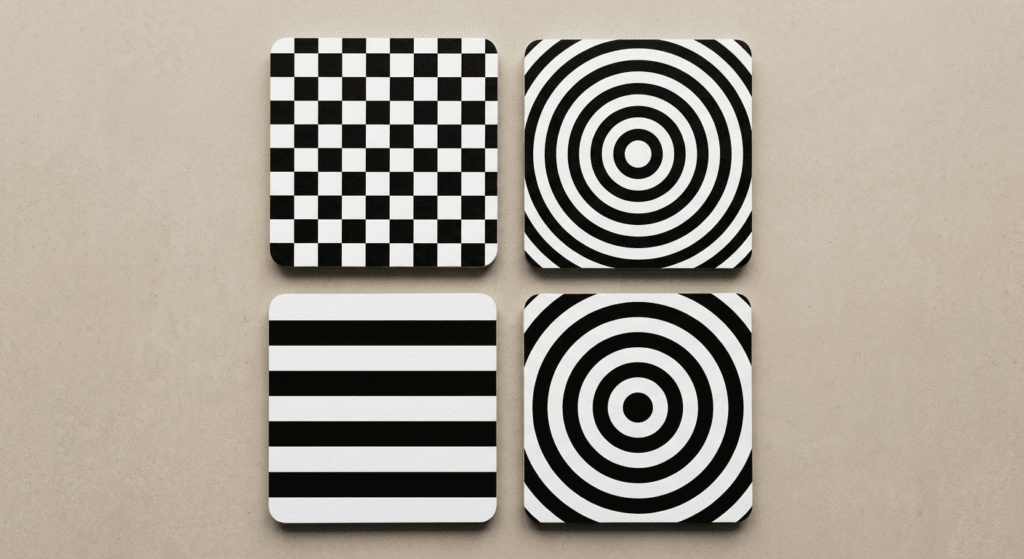
When a newborn looks at a crisp, black-and-white geometric shape or an animal silhouette, the strong contrast sends a powerful electrical signal to the visual cortex of the brain. This stimulation acts like a workout for the brain, helping the visual pathway mature much faster than it would with low-contrast environments.
2. Increasing Attention Span
You might think newborns have zero attention span, but try placing a high-contrast card in front of them during tummy time. Parents are often amazed to see a 1-month-old baby stare fixedly at a black-and-white pattern for 60 to 90 seconds. This prolonged focus helps lay the foundation for future cognitive learning, concentration, and curiosity.
3. Enhancing Spatial and Object Awareness
By tracking the sharp edges of high-contrast designs, babies begin to learn where one object ends and another begins. This is the very first step toward understanding 3D space, depth perception, and object permanence.
What the Experts Say: Pediatricians and child psychologists agree that providing rich visual stimuli in the first 6 months helps strengthen the optic nerve and accelerates overall cognitive development.
Daily Routines Using the Best High-Contrast Toys for Newborns
Using high-contrast cards doesn’t require a rigid schedule. You can seamlessly weave them into moments you already share with your baby.

Tummy Time Companion
Tummy time is crucial for building neck and shoulder strength, but many babies dislike it initially because looking down at a blank mat is boring.
- The Fix: Prop up 2 or 3 high-contrast cards right in front of your baby’s view. It gives them a captivating reason to lift their head up, making tummy time a much happier experience.
Side-Lying and Diaper Changes
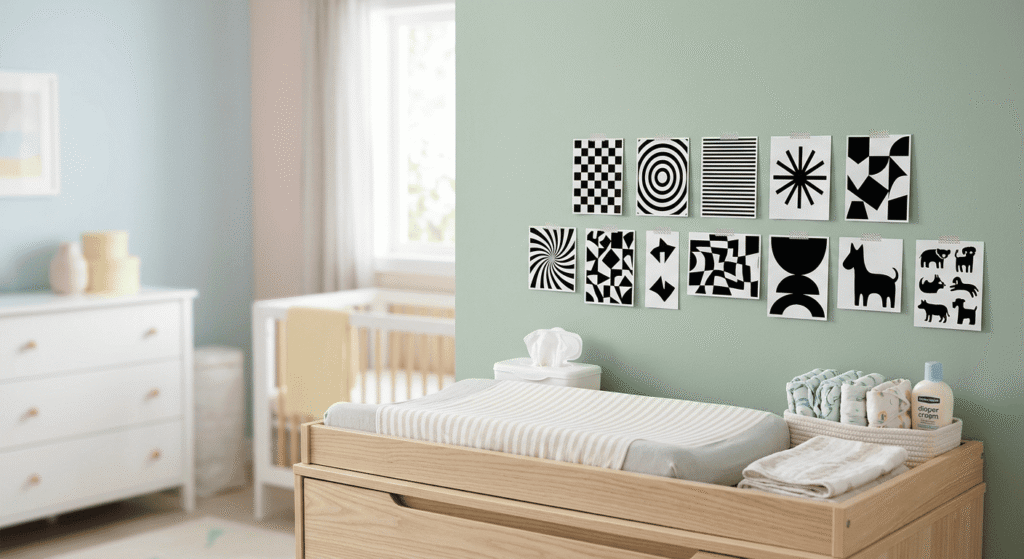
Tape a few cards to the wall next to the diaper changing table. During a diaper change, your baby will have something engaging to look at, which can significantly reduce fussiness.
Visual Tracking Practice
Hold a card about 10 inches away from your baby’s face until they lock their eyes onto it. Slowly move the card from left to right, and then up and down. This exercises the eye muscles and improves their ability to track moving objects smoothly.
Buyer’s Guide: Features of the Best High-Contrast Toys for Newborns
Not all black-and-white cards are created equal. When selecting the best tools for your baby, keep these factors in mind:
- Progression of Complexity: In the first 0 to 2 months, simple geometric shapes (lines, circles, checkerboards) are best. By months 3 to 6, your baby can handle more complex silhouettes (animals, fruits, and abstract patterns).
- Durability: Look for thick, matte-finish cards. High-gloss cards reflect room lights, creating glare that makes it harder for a baby to focus.
- Safety First: Ensure the cards use non-toxic, soy-based inks and have rounded corners to avoid scratches when your baby starts reaching out to grab them.
Moving Beyond the Best High-Contrast Toys for Newborns (Months 3–6)
By the time your baby reaches 3 to 4 months of age, a wonderful change happens. Their color vision begins to unlock!
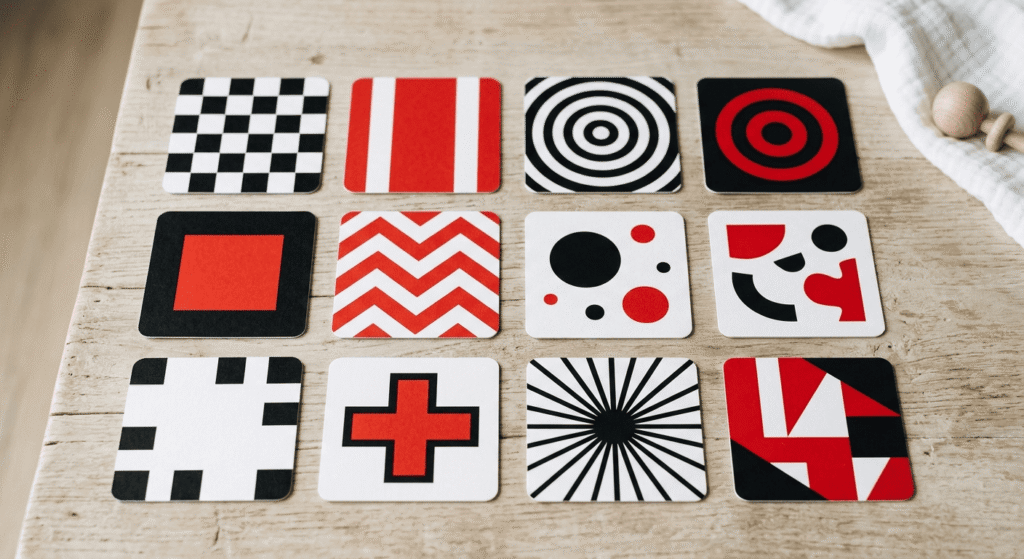
The first color they can perceive clearly is Red. Shortly after, they begin to see vibrant shades of green, blue, and yellow.
When your baby transitions to this stage, you don’t need to throw away your black-and-white cards. Instead, introduce cards that feature high-contrast combinations of Black, White, and Red, gradually moving into full-color, high-saturation patterns by month 6.
Conclusion: A Simple Tool with Lifelong Impacts
Investing in your child’s brain development doesn’t require expensive electronic gadgets or complex software. Nature has designed your baby to learn through simplicity, interaction, and contrast.
By spending just 5 to 10 minutes a day with high-contrast flashcards, you are not only giving your baby’s visual cortex a healthy boost, but you are also creating beautiful, focused moments of connection between you and your little one.
Does your baby have a favorite shape or pattern they love to stare at? Let us know in the comments below! Don’t forget to share this article with other new moms who want to boost their baby’s early development.
“While fine motor skills can be developed at the dinner table, you might be looking for tools that teach more broadly. Check out our selection of the [Best Educational Toys for 1-Year-Olds] to foster deeper learning.”
“Choosing the right toy for the high chair involves prioritizing safety and ease of cleaning. Explore our article on [Wooden Toys vs. Plastic Toys] to discover which material is best suited for your mealtime routine.”